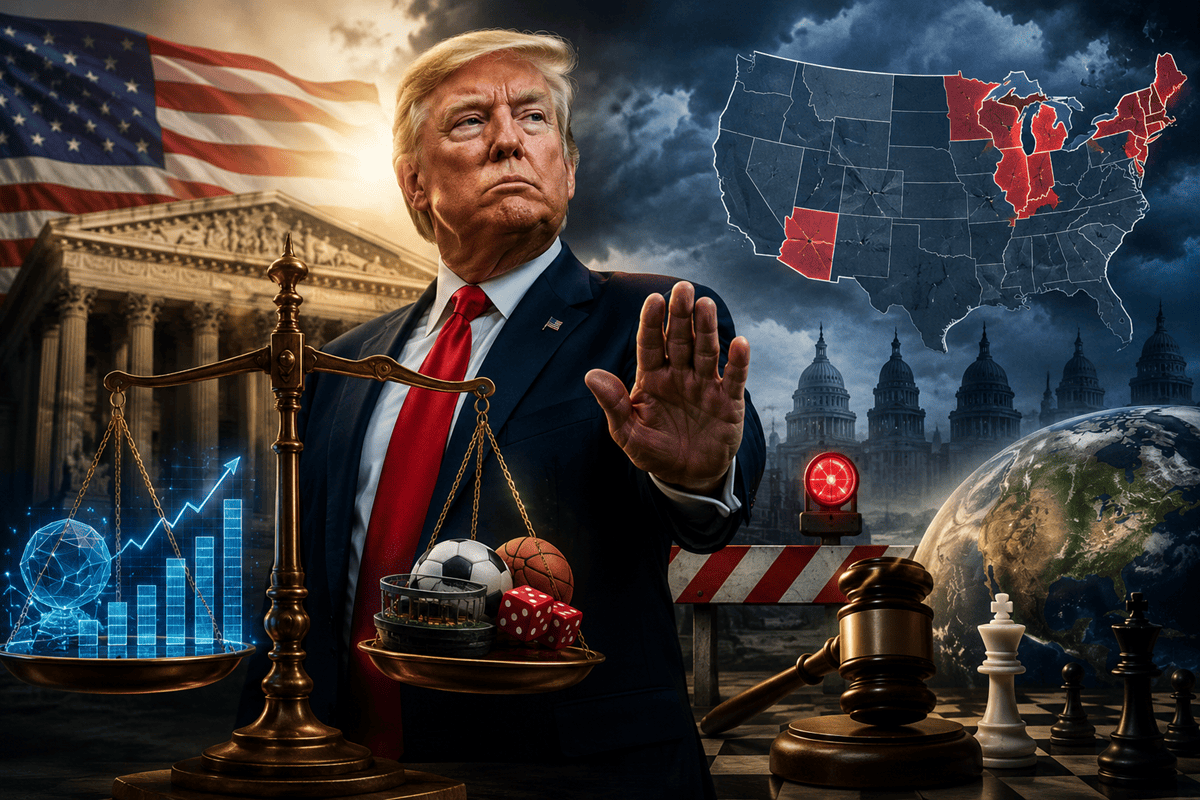
United States President Donald Trump is raising regulatory tension by demanding that the Commodity Futures Trading Commission (CFTC) maintain exclusive control over prediction markets, a rapidly expanding sector that is already facing legal, political and international clashes due to its hybrid nature between finance and betting.
In a message posted on his social network Truth Social, Trump insisted in which the United States must retain global leadership in both cryptocurrencies as in these new financial markets, warning that other countries are trying to compete in the sector. At the same time, he advocated for a strong federal regulatory framework, which he said represents the “gold standard” for the American financial system.
The debate intensifies because the CFTC maintains that all contracts offered by markets regulated under the designated contract markets (DCM) should be considered financial instruments under its exclusive supervision. However, several states such as New York, IllinoisArizona, Connecticut and Wisconsin They argue that these products function in practice like sports betting or games of chance, so they should be regulated or prohibited at the state level. This dispute has already generated lawsuits, cease and desist orders and restrictive laws in different territories.
On the political level, Trump directly criticizes governors and former governors such as Chris Christie, Letitia James, Tim Walz and JB Pritzker, who have promoted positions in favor of state control, which increases the tension of the debate and turns it into a regulatory as well as political conflict. In parallel, journalistic investigations have pointed out possible links between the ecosystem of prediction markets, cryptocurrency companies and people close to the Trump family environment, including Donald Trump Jr.’s role as an advisor on some platforms in the sector, such as Kalshi, which has added additional pressure to the debate.
The conflict has already escalated to federal appeals courts and is considered likely to reach the Supreme Court, while US legislators also increase supervision over the industry, as highlighted by CriptoNoticias.
International regulatory debate
Internationally, several countries have begun to restrict or ban these types of platforms, including India, Spain and Indonesia. In Latin America, countries such as Argentina, Brazil and Colombia have also blocked the platform for their fellow citizens. A position that contrasts with the American approach, which seeks to integrate them into the financial system.
In general terms, the central problem is based on the legal definition of the product. If they are considered financial instruments, they fall under the orbit of the CFTC and can be integrated into the cryptocurrency and derivatives ecosystem; But if they are classified as games of chance, they become dependent on state regulators or even prohibited, as is already the case in some jurisdictions. This explains why the issue has escalated to federal courts and will likely reach the Supreme Court.
Altogether, the scenario shows a market in global regulatory transition: the United States seeks to consolidate a federal framework to avoid losing leadership compared to other countries, while Europe toughens its posture to avoid legal and financial risks. The outcome of this tension will define not only the future of prediction markets, but also its integration (or exclusion) within the broader ecosystem of cryptocurrencies and financial derivatives.