The XRP liquidity ratio on Binance fell to 0.043.
In this context, large orders can cause large impacts on the market.
XRP liquidity on Binance fell to its lowest level since January 2020, a move that reflects deteriorating market activity around the Ripple Labs-issued cryptocurrency.
This is shown by an analysis published on May 25, 2026 by Arab Chain, a firm specialized in digital asset market analysis, for the CryptoQuant platform.
According to this report, XRP 30-day liquidity ratio fell to 0.043 as cryptocurrency trades near $1.33as seen below:
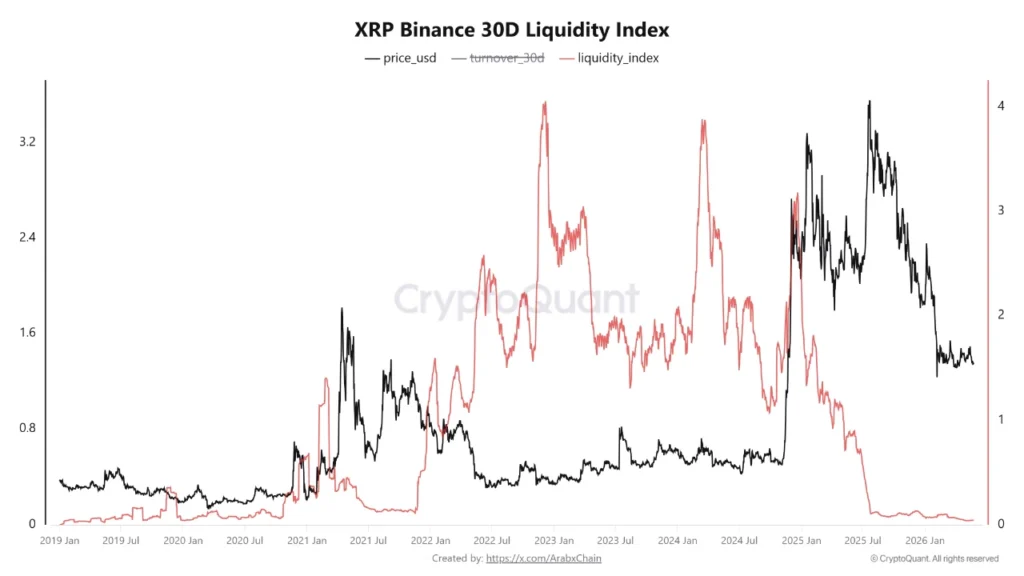
The black line represents the price of XRP, while the red line shows the 30-day liquidity index within Binance, the world’s largest cryptocurrency exchange by traded volume.
It should be noted that liquidity measures how much capacity the market has to absorb buy and sell orders without causing sudden movements in priceas explained by CriptoNoticias.
A buy order, meanwhile, is an instruction to acquire an asset at a certain price, while a sell order seeks to get rid of that asset.
When liquidity is high, the market has greater depth and can support large transactions with less impact. However, when it falls to low levels, even relatively large orders can move the price much more aggressively.
According to the chart, the index reached its highest levels between 2022 and 2024, widely exceeding 3 and 4 points in periods of strong speculative activity and high volatility.
However, over the past few months liquidity has plummeted to current levels. The report argues that this reflects “a significant decline in market depth and liquidity available for trading compared to previous periods.”
Furthermore, the analysis warns: “The persistence of liquidity at these low levels could make the market more sensitive to sudden price movements.”
Arab Chain explains that this situation usually appears when speculative interest decreases and the inflow of new capital into the market is reduced.
The report clarifies that low liquidity does not necessarily represent a bullish or bearish signal on its own. But, it does reflect “a state of caution and expectation within the market.”
And this is reinforced by a context marked by geopolitical uncertainty linked to the war between the United States and Iran and its effects on the price of oil, a factor that keeps risk appetite at bay and exerts downward pressure on bitcoin (BTC) and cryptocurrencies.