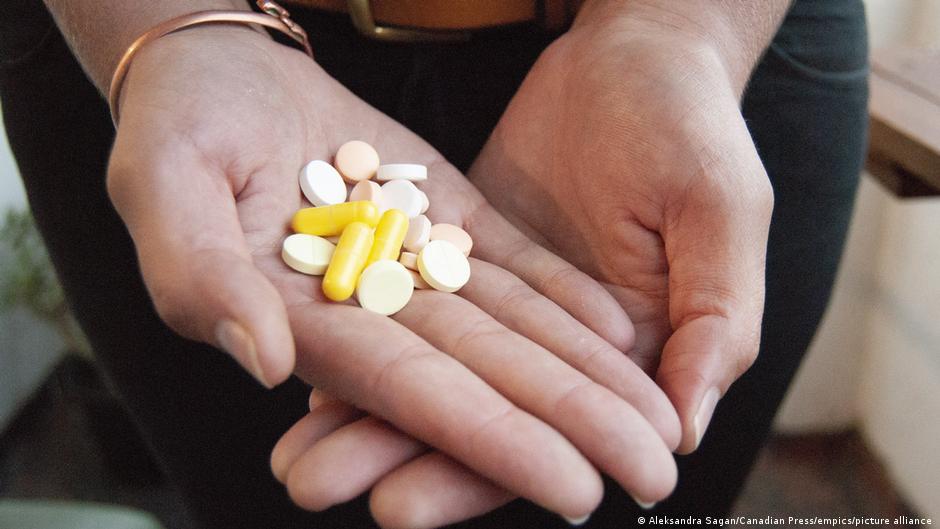
At the age of 25, Vanessa Carter was injured in a devastating car accident in Johannesburg. It broke every bone on the right side of his face, and took him on a years-long journey through multiple reconstructive surgeries.
Six years later, Carter received an artificial implant to reconstruct her cheekbones. Perhaps his worst orders were over. But one day, he noticed some pus on his face. It was an infection. And for about a year, it wouldn’t go away.
“I was taking antibiotics, I was seeing my doctors, but no one could give me answers,” she told DW. “And this whole time this bacterial infection was basically eating away the tissue in my face.”
It turns out the culprit was MRSA – methicillin-resistant Staphylococcus aureus – one of a growing number of superbugs against which antibiotics have stopped working.
An impending global crisis with 10 million deaths per year
Antimicrobial resistance – when bacteria, viruses, fungi and parasites evolve to defeat drugs designed to kill them – has been identified by the United Nations as a major global health challenge.
There could be drug-resistant superbugs by 2050 Claim 10 million lives annually. Drug-resistant infections can be costly if left unchecked. $412 billion (€352 billion) annually by 2050.And $3.4 trillion will be cut from GDP per year over the next decade.
One reason for their spread is the incorrect or excessive use of antibiotics in health care. The second is antibiotic pollution in the environment.
“Maybe you irrigate a crop with water that contains these bacteria. And then we consume that crop or maybe we drink some water that contains these genes,” said Alistair Boxall, a professor of environmental science at the University of York in Britain. “That resistance will come back into our bodies.”
Narcotics have been found around the world
Pharmaceuticals have been found in rivers and soil All over the world. A recent study Boxall was involved in testing river water at over 1,000 sites in 104 countries.
“We discovered 61 different pharmaceuticals, and apart from a very small number of sites, we found pharmaceuticals everywhere,” Boxall said.
The only sites free of drug residues were Iceland and a remote village in the Venezuelan rainforest, where the natives do not use modern drugs.
Elsewhere, researchers found high levels of antibiotics and drugs for depression, epilepsy, pain and allergies, as well as the diabetes drug metformin. Pharmaceutical levels at a quarter of sites were considered harmful to wildlife.
How are drugs disappearing from the environment?
When we take medicine, our body absorbs only a part of it. The remainder is excreted and goes into the sewage system. Antibiotics are also often overprescribed and overused. Humans consume more than 30,000 tons of the drug per year. About one third of that land is in rivers.
Many wastewater treatment plants are not designed to completely remove these substances, so traces leach into rivers, lakes and soil.
Globally, more than half of all wastewater is treated before release.
In many low-income countries, treatment systems are limited or absent altogether. Meaning, pollution is often much worse in parts of sub-Saharan Africa, South Asia, and Latin America.
Pharmaceutical manufacturing plants, like agriculture, are another source of pollution. Medicines are given to farm animals in large quantities. Some estimates suggest that at least twice the amount given to humans is spent treating livestock. And when their manure is spread as fertilizer, nearby waterways can be contaminated.
The impact on wildlife can be severe.
Research from North America shows that synthetic hormones found in the birth control pill caused the “feminization” of male fish in the same waters, leading to reproductive failure and population decline. Another UK study found that the antidepressant Prozac caused people to lose appetite and libido.
What solutions are there to combat antimicrobial resistance?
Improving wastewater treatment is an important part of the solution.
In many Western countries, this would require additional levels of treatment – and would require, for example, the use of chemicals or activated carbon filters to capture those pharmaceutical compounds.
But advanced treatment uses a lot of energy, potentially increasing greenhouse gas emissions. It may also form other toxic compounds in the process.
And “it costs a lot of money,” Boxall said.
Still, the EU is moving forward. According to this urban waste water treatment instructions, Member states will be required to upgrade treatment plants in the coming years, with 80% of the cost borne by the pharmaceutical and cosmetics industry – a provision that has faced intense resistance from the pharmaceutical lobby.
The EU has also introduced rules to reduce pharmaceuticals in surface and groundwater and will require member states to track antimicrobial resistance in wastewater.
in America, Environmental Protection Agency moves to include pharmaceuticalsOn the list of drinking water contaminants for the first time.
But Boxall says change is not happening fast enough and advanced filtering is not realistic for poor countries that often face the worst pharmaceutical contamination.
Does biodegradable medicine exist?
Klaus Kummerer, professor of sustainable chemistry at Leuphana University of Lüneburg in northern Germany, believes the answer lies in designing drugs that will be completely destroyed after completing their function in the human body.
“That would be the gold standard: mineralizing carbon dioxide and water,” he said.
His team has developed anti-cancer drugs that completely biodegrade in waste water treatment plants. he also did Patented two biodegradable optionsThe antibiotic ciprofloxacin, which is considered particularly difficult to break.
Once their antibiotic has done its job, and reaches the bladder, a change in pH or acidity begins the degradation process.
But the antibiotic never reached the market.
“We, as a small university working group, can’t develop a campus and bring it to market. Now industry has to step in,” Kummerer said.
He believes that designing cleaner medicines and not relying on expensive wastewater treatment upgrades is the real long-term solution to pharmaceutical pollution. But using fewer pharmaceuticals in the first place, which means using medicines more carefully, and doctors prescribing only what is absolutely necessary, is also important.
“Antibiotics don’t kill viruses, and viruses are responsible for colds,” Kummerer said.
“My grandmother used to say: If you’re sick with a cold or something like that, it takes about a week if you take pharmaceuticals and about seven days if you don’t.”
This article was based on an episode of Living Planet produced by Natalie Muller. listen to Full episode here.
Edited by: Jennifer Collins