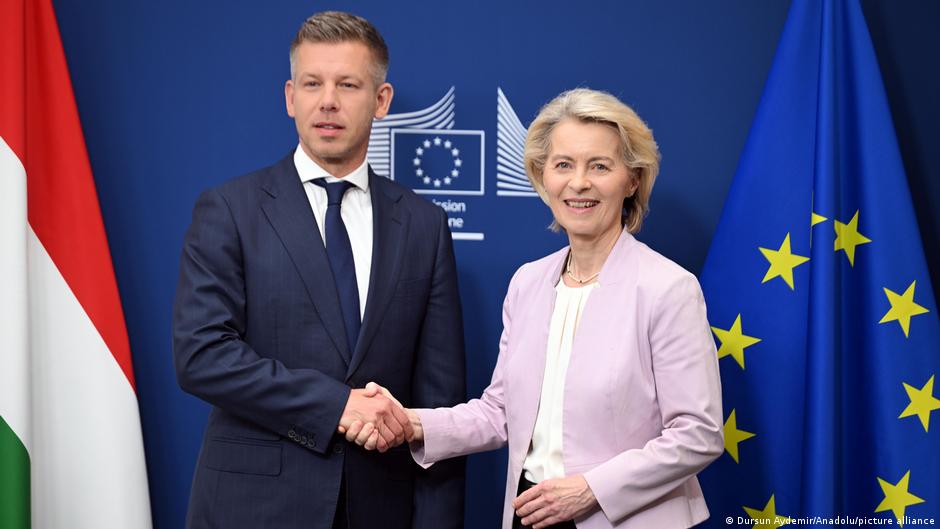
Hungary’s reform progress under its new government will allow the European Commission to unlock €16.4 billion (about $19.1 billion) of previously frozen EU recovery and solidarity funds, Commission President Ursula von der Leyen said in Brussels on Friday.
She was speaking to reporters after talks with Hungary’s new Prime Minister Peter Magyar, who defeated his predecessor Viktor Orban in an election last month.
Under Orbán’s leadership, Budapest and Brussels frequently clashed – both over domestic Hungarian issues and on foreign policy matters such as support for Ukraine amid Russia’s invasion. As a result, various funds designed to help one of the EU’s poorer member states were held up for years.
What did Magyar and von der Leyen say about the fund?
Von der Leyen revealed the sources of aid at a press conference in Brussels.
“I can confirm that this is €10 billion that has been unfrozen or will be unfrozen from the Next Generation EU [the bloc’s recovery fund]“Then €4.2 billion in cohesion funds, with an additional €2.2 billion once the reform is complete,” she said.
“It’s a huge amount, but…the Hungarian people deserve it. Again, thank you very much for the excellent work done,” the German politician said, standing with the Magyars.
The new prime minister on Friday described the agreement as a “historic breakthrough” and said he had agreed to all steps allowing the release and that Hungary would be able to pass the necessary legislation.
“As we promised, we will bring this money home to rebuild Hungary, grow the economy, restore and develop public services, and strengthen the competitiveness of Hungarian companies and small and medium-sized enterprises,” Magyar told reporters.
What is the state of Hungary’s economy?
The Hungarian economy has been more or less stable for the past three years, registering only minimal growth.
This is despite a rising budget deficit that could reach 6.2% of GDP this year following heavy pre-election spending by former Prime Minister Orbán – well ahead of the EU’s target. The central bank’s base interest rates are 6.25%, much higher than the ECB’s 2%.
The national currency, the forint, has revived since Magyar’s election, partly on anticipation of renewed EU recovery funding.
Don’t let algorithms hide news. If you rely on our team for reliable reporting, please take a moment Select us as your favorite source on Google by clicking here and pressing the “Star” or “Favorite” buttonThat’s why you’ll always see our verified news first.
Edited by: Wesley Dockery