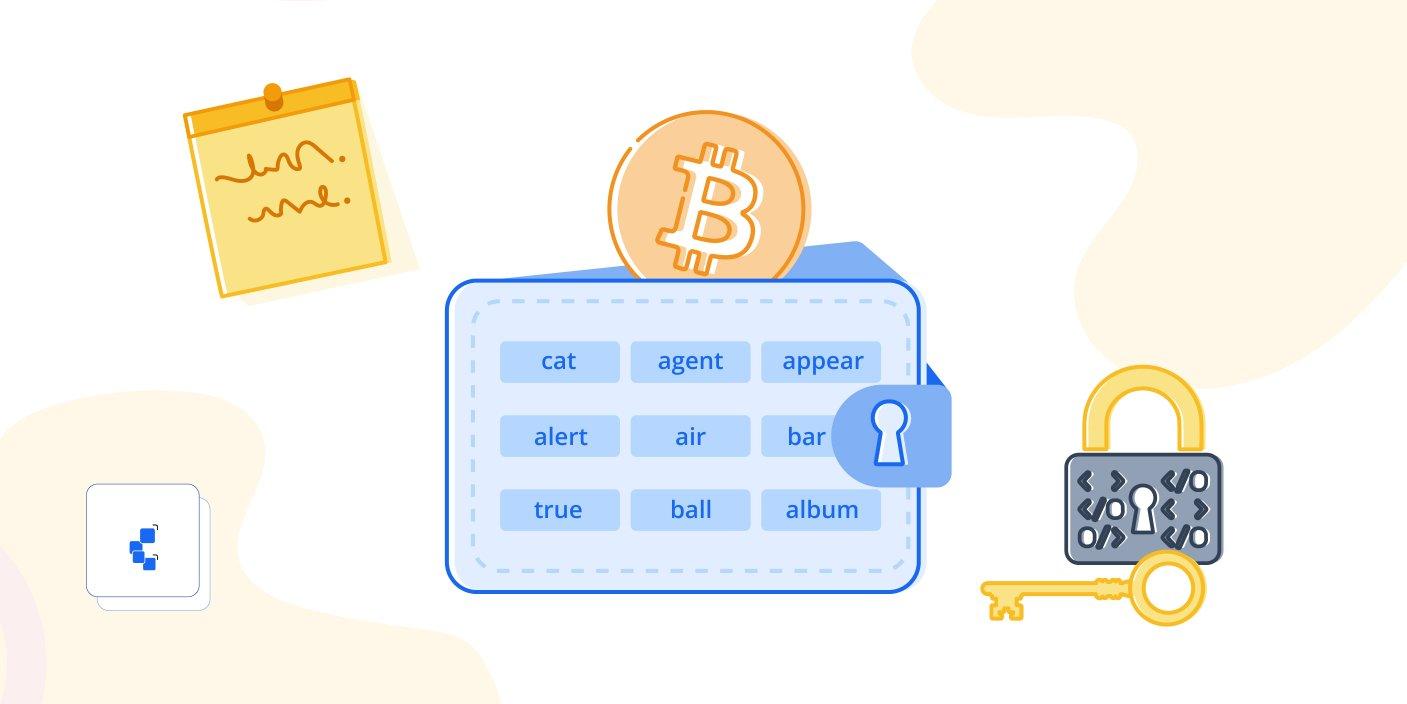
In the Bitcoin ecosystem, security does not depend on traditional passwords or centralized recovery systems. Instead, total control of the funds falls on a set of cryptographic elements that, well managed, offer absolute sovereignty, but poorly managed can imply irreversible losses. Understanding this balance is key to understanding how self-custody works in practice.
1 What is a seed phrase?
A seed phrase (either seed phrase) is a sequence of words which represents a large, randomly generated binary number to facilitate human interaction, and works like the backup of a cryptocurrency wallet. The phrase can be written on paper or spoken over the phone, making it easy to transmit and store. If you lose your phone, computer or even your wallet, that phrase allows you to recover it and regain access to the funds.
Think of it as the master key of a wallet: Whoever has access to those words can restore it and control all associated assets. It is usually made up of 12 or 24 words generated randomly when you create a wallet.
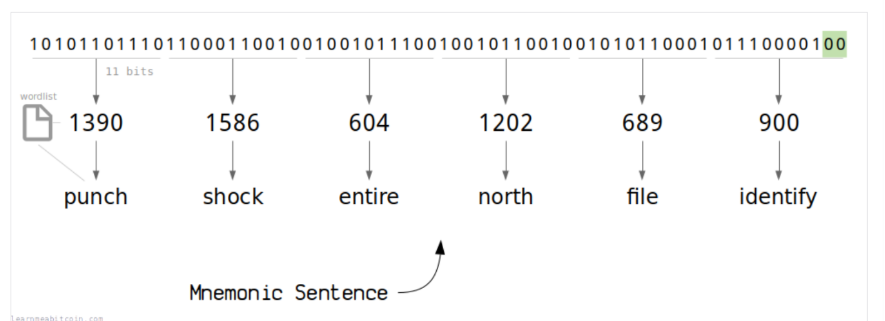
Why can 12 or 24 words restore an entire wallet?
Although they seem like simple words, They actually represent binary numbers. A very large random number called entropy is generated by the wallet under the BIP39 standard and represented with a sequence of words, the seed phrase. From this phrase the wallet creates a cryptographic seed to generate all the keys and addresses. That is, a single phrase can recreate the entire wallet structure.
The greater the entropy, the greater the security, but the length of the sentence increases. The allowed size for entropy is 128 to 256 bits. The most common versions are:
- 12 words (128 bits): They offer a high level of security and are common in mobile and desktop wallets.
- 24 words (256 bits): add more entropy (randomness), which is why they are often used in hardware wallets and configurations focused on maximum security.
What is the origin of the famous BIP39?
The BIP39 standard was proposed in 2013 by developers Marek Palatinus, Pavol Rusnak, Aaron Voisine and Sean Bowe, several of them linked to the Trezor project. Its goal was to solve a practical problem: private keys were too difficult for most people to backup and restore. The solution was to convert complex cryptographic data into lists of 12 or 24 words that were easy to type and remember. Over time, BIP39 became one of the most widely used standards.
2 How do you create a seed phrase?
A seed phrase is not created by choosing words at random. Behind it there is a cryptographic process that converts a random number into a sequence of words that is easy to copy and save.
This process begins with entropy, a very large random number like a string of bits 10011010101001… that no one has generated before or will ever generate. To that number is added a checksum to help detect errors. This is created by applying a SHA-256 hash function to the entropy, which gives us a unique fingerprint for it. Then, 1 bit is taken from the start of the hash for every 32 bits of entropy and added to the end of the entropy. That number is then transformed into a readable format represented in words.
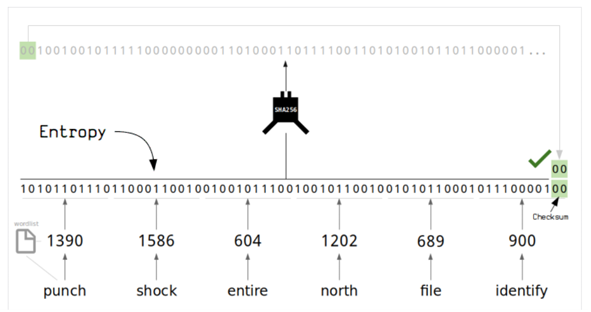
The simplified process would be like this:
Entropy → seed phrase → cryptographic seed → private keys → addresses
To create the seed, the PBKDF2 hash function is applied to the seed phrase. This function is applied to the phrase multiple times and the 64-byte (512-bit) result is the cryptographic seed.
Therefore, a single phrase can reconstruct the entire structure of a wallet: it does not directly store the coins, but rather the information necessary to regenerate access to them.
Seed phrases, private keys and addresses… They are not the same!
The seed phrase differs from a private key. The seed phrase is the main backup from which the private keys are generated and the entire wallet is recovered. The private key gives access to a specific account or address, while the address is the data you share to receive cryptocurrency, similar to an account number.
The “word 25”
Some wallets allow you to add a passphrase additional to the seed phrase. It is popularly known as the “word 25”, although in reality it can be any combination of letters, numbers or symbols.
This passphrase It works as an extra layer of security: even if someone obtains the 12 or 24 words, they will not be able to access the wallet without that additional password. However, it also increases the risk of loss, because if the passphrase is forgotten, the wallet cannot be recovered.
3 How to protect a seed phrase and avoid common mistakes?
The security of a wallet depends not only on the technology, but also on how the user protects their seed phrase. A simple mistake can expose all funds.
These are some basic recommendations:
- Do not photograph it: Saving the phrase in photos or screenshots can expose it to hackers, malware, or automated cloud leaks.
- Do not store it in online services: Platforms such as emails, synchronized notes or cloud storage can be vulnerable to data theft.
- Keep physical copies: Writing the phrase on paper and keeping it in a safe place reduces the risk of digital attacks.
- Use metal plates: Some people engrave the phrase on steel plates that are resistant to fire, water, and corrosion, especially for long-term backups.
- Separate backups geographically: Keeping copies in different places helps prevent losses from fire, theft or disasters.
- Be wary of fake links and supports: No legitimate service will ask for the seed phrase via mail, chat, or social media. Many phishing attacks impersonate wallets, exchanges, or support teams to steal funds.
In self-custody, protecting the seed phrase is essential: whoever has access to it can control all the cryptocurrencies associated with the wallet.
What happens if you lose your seed phrase?
Losing a seed phrase can mean losing access to a wallet forever. In self-custody there is no company capable of recovering accounts or resetting passwords: the user is solely responsible for protecting the backup that gives access to their cryptocurrencies. For this reason, many people keep their phrases on paper, metal plates or physical copies in safe places, while others prefer wallets guarded by third parties to delegate that responsibility.
4 Which wallets use seed phrases?
The seed phrases They are used by virtually all modern self-custody walletsboth in mobile and desktop applications and in hardware wallets. This system became the de facto standard for backing up and restoring funds within the cryptocurrency ecosystem.
In the case of bitcoin, one of the oldest and most used wallets is Electrumknown for offering advanced features and a bitcoin-centric approach. Another popular option is BlueWallet, geared toward mobile users and compatible with technologies like the Lightning Network.
Within multi-currency wallets, MetaMask became one of the most used to interact with decentralized applications and Ethereum-compatible networks, while Trust Wallet and Exodus gained popularity for their simple interface and support for multiple digital assets.
Hardware wallets also popularized the use of physical seed phrases. Companies like Ledger and Trezor developed devices designed to store private keys outside the internet and reduce the risk of remote attacks. On these devices, the seed phrase typically appears only once during initial setup, forcing the user to save it carefully.
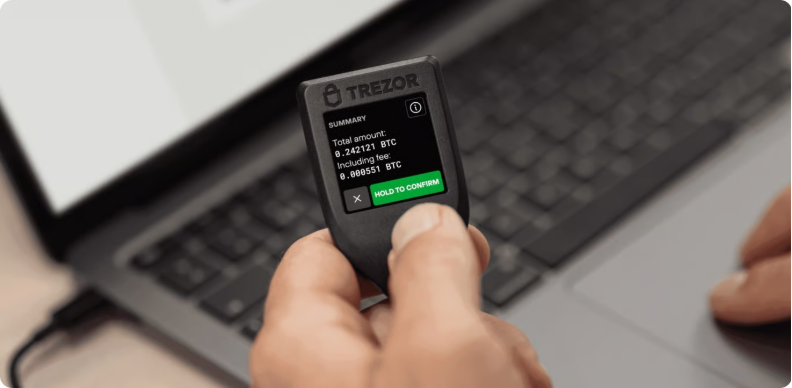
Although all of these wallets use seed phrases, They are not designed for the same type of user. Some prioritize ease of use and accessibility for beginners, while others offer advanced tools such as multi-signature, passphrases additional, integration with own nodes or configurations focused on privacy.
Therefore, choosing a wallet does not depend only on design or popularity, but also on the level of control, security and responsibility that each user is willing to assume. If you want to know more about wallets, we invite you to read our cryptopedia.
5 Beyond BIP39: passphrases and new alternatives
Although the BIP39 standard remains the most used for seed phrases, new tools and security models have emerged that seek to improve wallet protection and recovery.
SLIP39 and fragmented copies
Another alternative is SLIP39, a system developed by Trezor based on Shamir’s Secret Sharing cryptographic method. Instead of using a single seed phrase, SLIP39 splits the backup into multiple chunks. For example, a wallet may generate five shards and require only three to regain access.
This reduces the risk of complete loss or theft of a single copy, since no single fragment contains all the information.
MPC portfolios and social recovery
Wallets based on MPC (Multi-Party Computing), a technology that divides control of keys between multiple parts or devicespreventing a single complete seed phrase from existing.
Some platforms combine this system with social recovery methods, where trusted people or devices help restore access if the user loses their credentials.
The goal is to reduce dependence on a single phrase written on paper, considered by many to be one of the weakest points of traditional self-custody.
Are seed phrases being replaced?
For now, Seed phrases remain the dominant standard in most cryptocurrency wallets. However, new solutions seek to make self-custody safer and easier for non-technical users.
Even so, many of these alternatives still rely, directly or indirectly, on cryptographic mechanisms similar to those of traditional seed phrases. Therefore, rather than a total replacement, the sector seems to be moving towards hybrid models that combine security, redundancy and ease of recovery.