The technology company, Sequans Communications confirmed on May 28, 2026 a definitive turn in its financial strategy: the company used part of its bitcoin (BTC) holdings to completely cancel its convertible debt and will progressively abandon its treasury model based on digital assets, while redirecting its focus to the semiconductor business for IoT (Internet of Things).
The company reported that the operation allowed to redeem all of the convertible debt issued in July 2025, leaving its capital structure practically free of liabilities and gaining financial flexibility. As a result, Sequans currently maintains around 658 bitcoinall of them without restrictions, although they will be sold gradually in the future as part of their orderly exit from this strategy.
The announcement marks the formal closing of a stage in which the company attempted to replicate the corporate bitcoin accumulation model popularized by Strategya reference that several technology companies used as a guide to incorporate BTC into their balance sheets. However, Sequans’ case ended up diverging from that approach due to financial pressure on its operating business.
At its highest point, Sequans accumulated 3,234 BTCbut the figure was reduced to 1,114 BTC after a series of forced sales amid financial pressure and operational deterioration. Before the current announcement, the company had already liquidated more than 2,000 bitcoinpart of them intended to sustain liquidity and cover obligations, as reported by CriptoNoticias.
During this process, The company faced an adverse context: recorded losses close to $50 million in the first quarter of 2026, including accounting impairments and realized sales of bitcoin, in addition to a 12% drop in quarterly revenue, according to previous reports. In parallel, part of its BTC came to be pledged as debt collateral, which amplified the sensitivity of its balance sheet to market volatility.
With the exit of the bitcoin treasury scheme, Sequans reorients its strategy towards its core business: the development of semiconductors for IoT, including 4G LTE-M, Cat-1bis and 5G eRedCap solutions, in addition to its line of RF (radio frequency) transceivers for applications such as defense, drones and software-defined radio systems.
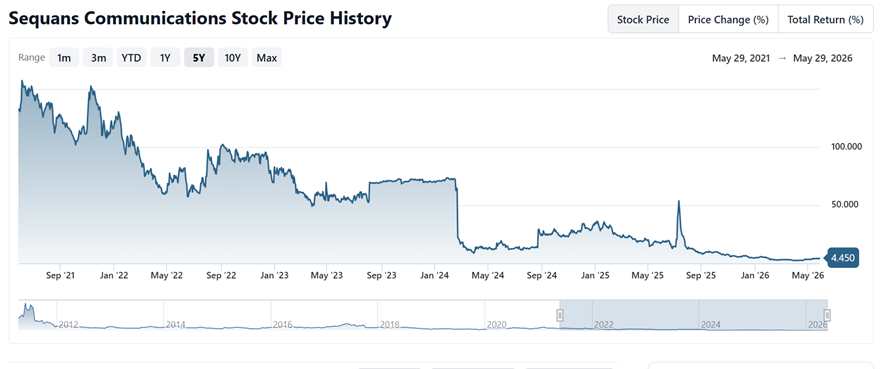
It is worth noting that in the stock market The company has seen some recent improvement: Since the lows recorded in April, the company’s shares have shown a recovery from around 70% to 75%, going from around $2.4 to over $4.2 in May, although they are still well below the levels reached when the company initially announced its commitment to bitcoin.
The Sequans case is consolidated as an example of the limits of corporate bitcoin accumulation strategies when they are not supported by a solid operating flow. Beyond the volatility of the asset, The decisive factor has been the need to prioritize financial survival.
In this new scenario, the company bets that the simplification of its balance sheet and the focus on semiconductors will allow it to stabilize its growth, while the market continues to evaluate whether these types of strategies will be tried again in technology companies with more fragile financial structures.