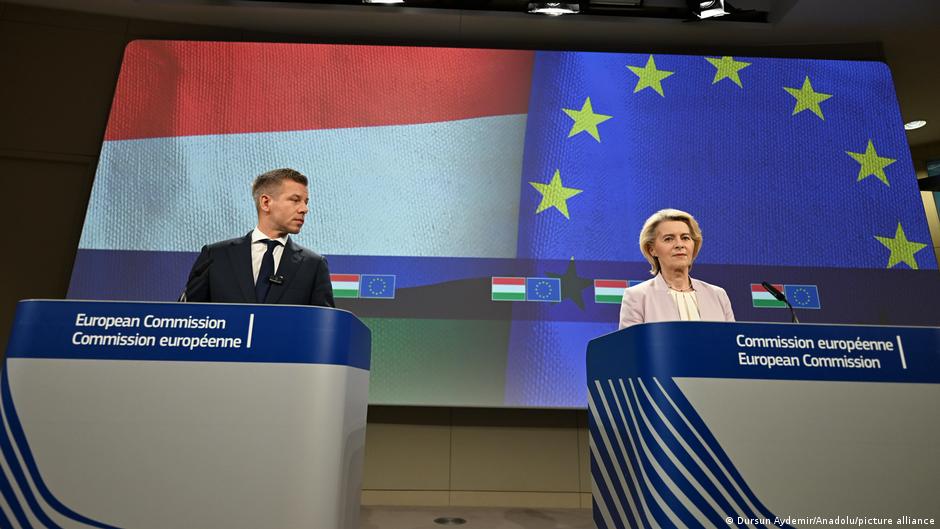
Hungary’s new government and the European Commission have reached a deal that puts the country on the path to unlocking €16.4 billion ($19 billion) in EU funds blocked due to concerns about corruption and rule of law during Viktor Orban’s rule.
Now, the government led by Prime Minister Peter Magyar has until August 31 to fulfill the promises it made to European Commission President Ursula von der Leyen during their meeting on Friday.
These include commitments to structural reforms and anti-corruption measures, as well as steps to promote academic freedom in Hungary.
When will Hungary get EU funds?
Friday’s deal does not guarantee that Hungary will get the money. “We have not agreed on disbursements,” a senior EU official told reporters at a background briefing on Friday. “We have agreed on conditions that need to be met.”
The most important of these are the EU’s 27 binding conditions, or “super milestones”. EU officials said that if Hungary fails on any of these, it will not receive any funding.
Julia Pokje, a legal expert at the Center for European Policy Studies, a Brussels-based think tank, told DW that despite the Magyar Tisza party’s victory in early May at a two-thirds parliamentary majority, meeting the criteria will be a challenge — and could leave the government vulnerable to political attacks.
“He talked a lot about wanting to legislate in a way that would allow for proper debate, or even consultation with the public,” Pokz said. “Won’t really have time for that.”
intensive high level talks
The agreement was preceded by lengthy negotiations between the Hungarian government and the European Commission – even leading to the possibility of rescheduling the announcement, which was initially expected to take place on Thursday.
“The reason we took more time was to make sure we have a list of reforms and investments that can be completed by August 31,” another EU official told reporters.
As a result of the negotiations, changes to Hungary’s pension and tax systems were removed from the list of requirements, as they were not considered feasible under the current economic conditions and in the short time frame.
EU officials said issues such as Hungary’s position on Ukraine starting talks on EU accession – which Orbán’s government had blocked – were not part of these talks.
Of the total €16.4 billion, €12.9 billion comes in the form of non-refundable grants and about €3.5 billion in loans. After August 31, €10 billion from the EU’s pandemic recovery fund will disappear forever.
What is Hungary to do?
The Magyar government has signaled its willingness to meet the criteria, even in some cases going beyond the required requirements – for example, by announcing that it will join the European Public Prosecutor’s Office (EPPO), a body aimed at protecting EU funds from corruption.
Points agreed between Hungary and the EU include reforming the existing structures governing the country’s universities, which will free up around €2.2 billion for the education sector. Hungary’s National Investment Bank is also set to be reformed and thus could benefit from a €2 billion cash infusion.
In addition to the promised reforms, Hungary and the EU agreed on a list of projects that will benefit from EU funds. Senior EU officials told journalists it would include injecting about €1.5 billion into energy grids, about €1.8 billion into railway investments and €500 million into an AI “gigafactory”.
Uncovering Orbán’s legacy
The Tisza party won the April parliamentary election on a platform that included unlocking billions of EU funds blocked during Orbán’s 16 years in power.
Orbán – who has not taken his parliamentary mandate – swiftly went on the political offensive after Friday’s announcements. In a social media post he asked, “What are Hungary’s interests [Peter Magyar] Brussels sold out? There’s no such thing as a free lunch.”
But Orbán’s government left behind a struggling economy with little growth in the last three years of his reign. €16.4 billion euros – equivalent to about 14% of the country’s GDP – would mean a significant budgetary relief.
The fiscal situation in Hungary is “extremely bad”, according to EU officials, who are expecting a budget increase of around 7% this year.
Zsolt Darvas, an economist at the Brussels-based think tank Bruegel, told DW that the unlocking of EU funds is good news. “This signals to investors that legal certainty is strengthening, which could increase investment appetite regardless of the influx of EU funds,” Darvas said.
What will happen next?
That the European Commission has agreed to potentially unlock so much money so quickly is seen by many as a major sign of Brussels’ goodwill.
“The Commission is meeting Hungary halfway, and doing everything possible to bring it back into the European mainstream,” Pokz said. “If the Magyar government keeps its promises, that trust remains, but they are taking risks.”
Hungary is set to formally hand over a revised list of planned reforms and projects in early June. EU officials said the plan would be approved by the European Commission and the European Council in July.
Meanwhile, the Hungarian government is expected to take the necessary legislative steps to meet the criteria for disbursing the funds by August 31.
Edited by: Milan Gagnon