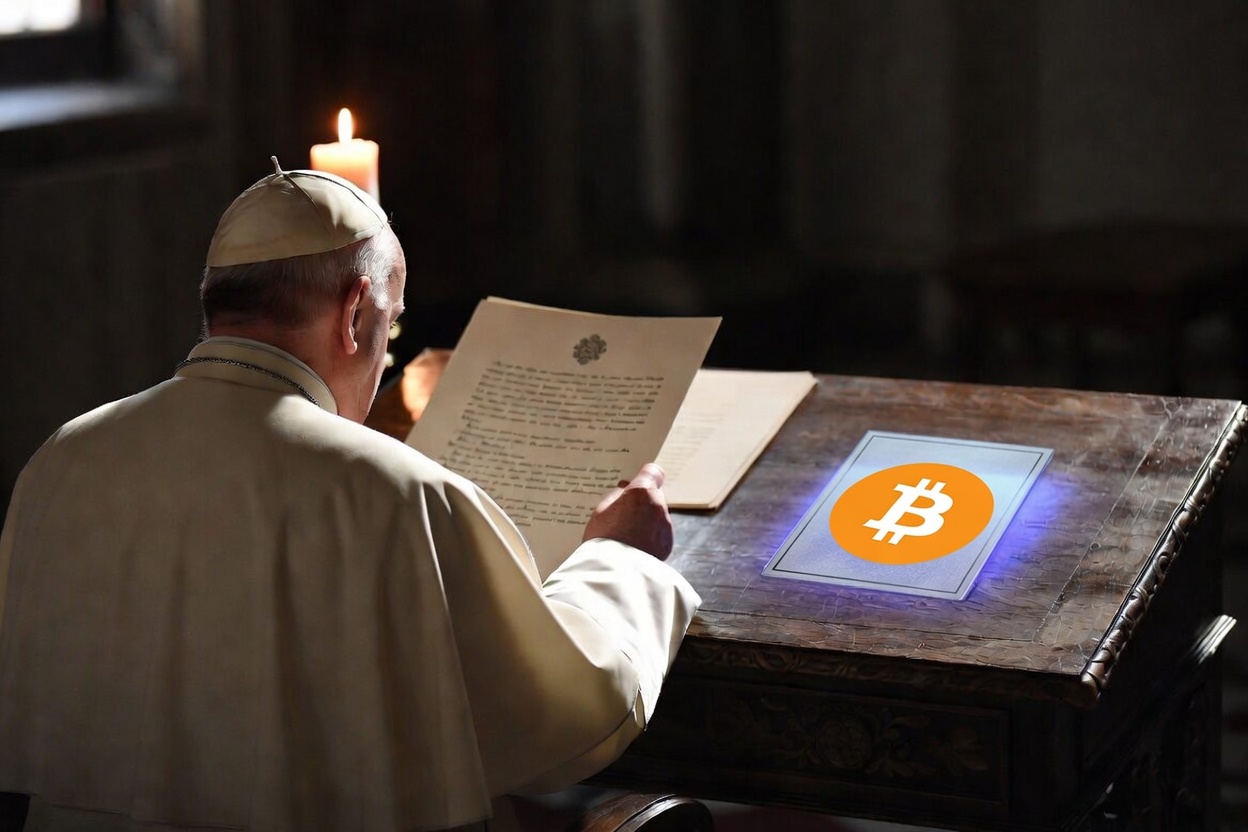
Bitcoin resolves by architecture what the encyclical asks to resolve by decree.
If work vindicates human dignity, money must too.
A bricklayer builds a wall. Each brick is an hour of your life that will not return: the sun on your back, the strength of your arms, the time you did not spend with your children. At the end of the day you receive a ticket. That ticket is, in theory, the wall translated into something you can save. It is your frozen work, your time made an object, ready to wait until you need it.
But someone, in an office thousands of miles away, decides to print more bills just like yours. The bricklayer didn’t find out. He didn’t sign anything. He didn’t sell anything. And yet, the bill he kept is worth less than yesterday. His wall still stands, his time has already been spent, his effort was real. But the object he kept it in shrank while he slept. Nobody stole his ticket. They stole what the bill represented.
This silent operation—repeated millions of times, year after year, on billions of people—is one of the problems that Pope Leo XIV set out to diagnose in his first social encyclical. And he diagnosed it accurately. What he didn’t see is that The hand that prints the bills is the same one that your document calls for strengthening.
Money is saved work
On May 15, 2026, Leo XIV published Magnificent Humanitasan encyclical dedicated to safeguarding human dignity in the time of artificial intelligence. Much of its fourth chapter deals with something older than AI: work and money.
The Pope’s argument is based on a principle that the Church has held since Rerum Novarumthe encyclical that the other León, the XIII, published in 1891, inaugurating the Social Doctrine. Work, writes Leo XIV quoting John Paul II, is “the essential key” to the entire social question. It is not a cost of production nor a mere means to obtain income: it is the way in which the person, created in the image of a creator God, He displays his freedom and dignity in the world.
From this principle follows a conclusion that the Pope does not formulate explicitly, but that underlies all his reasoning. If work is the display of human dignity, and money is the way in which that work is stored and moved over time, then Money is not a neutral object. It is human dignity preserved. Each monetary unit that someone saves is time lived, energy expended, a portion of life that the person turned into something they can look forward to. A monetary system that respects the dignity of work, therefore, has a minimum obligation: to preserve intact what was entrusted to it.
The question that orders everything that follows is, does the money issued today by States respect human dignity?
Leo XIV responds half-heartedly in paragraph 160 of the encyclical, the most financial of the entire document. There he mentions that finance has innovated “even after the introduction of cryptocurrencies,” and cites a 2018 Vatican document that diagnosed that financial intermediation, when detached from appropriate moral foundations, “has not only produced obvious abuses and injustices, but has also proven capable of creating systemic crises around the world.”
The financial intermediary, says the Pope, is a source of injustice. He is right, and the reason is deeper than what he develops.
Cryptographer Nick Szabo formulated it two decades earlier, in a 2001 essay titled Trusted Third Parties Are Security Holes– Trusted third parties are security holes. The idea is that any intermediary who must be trusted is, by definition, a point of failure: he accumulates power that can be exercised against those who trusted him, whether through bad faith, external pressure, simple incentive or ignorance. Szabo said it about digital payment systems. But no intermediary embodies that failure better than the issuer of the money himself.
The central bank is the definitive trusted third party. It is the office where it is decided to print the bills that dilute those of the bricklayer. It does not commit visible fraud: it operates within the law, with technical justifications, often with declared good intentions. But the result is what we already described: the value of the saved work is diluted without its owner deciding or realizing it. Inflation is not an accident of the fiat system that good management could avoid. It’s what the system does when it works.
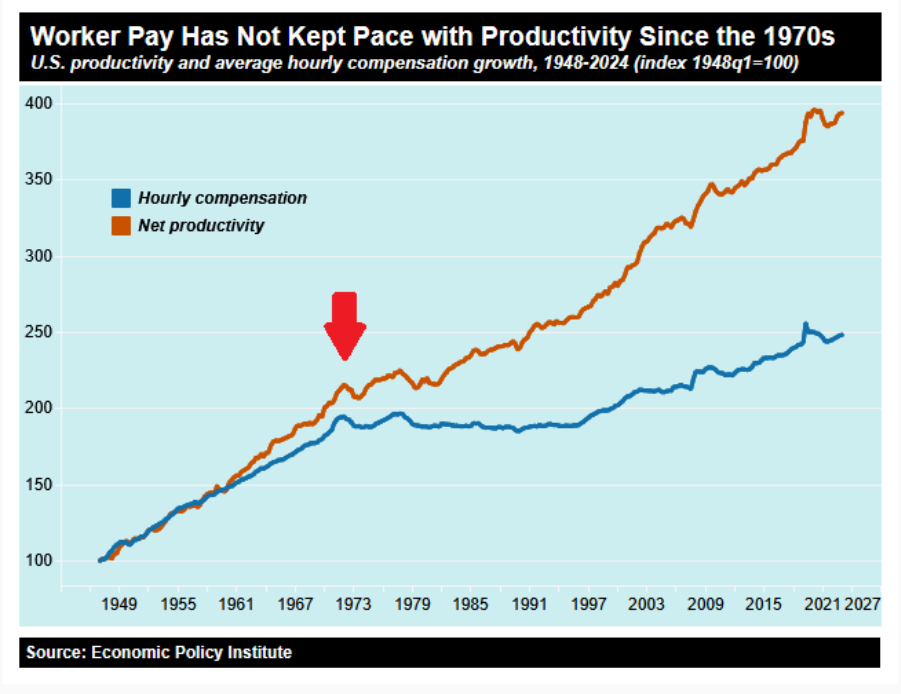
And here is the fact that the Pope denounces without naming its cause. In paragraph 161 he writes that “few have too much and too many have little.” The site WTF Happened In 1971? compiles dozens of graphs that point to the same breaking point: the Nixon Shock, the year the United States broke the last link between the dollar and goldleaving the broadcast without an anchor.
From that point on, worker productivity continued to grow, but real wages stagnated. The distance between both curves is the measure of what the monetary intermediary extracts from the worker each year, without receipt and without name. The gap that the Pope condemns was not opened by the market. It was opened by the soft money that the rulers decided to issue.
Bitcoin solved the problem raised by the Pope
If the problem is an intermediary with the power to dilute, the solution cannot be another, more well-intentioned intermediary. It has to be money without any intermediary. That’s exactly what Satoshi Nakamoto put into the world in 2009.
Bitcoin has a supply set at 21 million units, written into its code and verifiable by anyone running a node. There is no office that decides to issue more. There is no central bank, there is no decree, there is no budgetary emergency capable of printing a single additional bitcoin. The bricklayer who saves his work in bitcoin saves something that no one can dilute while he sleeps, because there is no person or institution with the authority to do so.
The minimum obligation that a decent money owes to work—to preserve intact what was entrusted to it—Bitcoin fulfills not out of the good will of its administrators, but because it lacks administrators who could fail to fulfill it.
This requires a distinction that the encyclical does not make, but which is decisive. Bitcoin is not “the cryptocurrencies.” The vast majority of the thousands of tokens that emerged later reproduce the old problem with new makeup: a foundation that controls the supply, a team that can change the rules, an issuer with discretionary power. They are trusted intermediaries disguised as trustless technology. They are, in Szabo’s terms, the same security hole with a different label.
What sets Bitcoin apart is that Satoshi decapitated it: its neutrality comes from the anonymity and absence of its creator, as well as from its distributed consensus, not from the promise of any authority. She is the only one who truly has no one to obey.
For those who live where fiat has already failed, hard money is the difference between being able to save and sinking into poverty. A Venezuelan who saw the savings of an entire working life evaporate did not suffer a market failure that the State should correct: he suffered the exact consequence of the State having the monopoly of issuing the money in which he saved. The Argentinians, the Turks, the Lebanese, the Sudanese, and almost everyone, depending on the period of time.
Hyperinflation does not degrade human beings by chance. It does so by tying it to the daily pursuit of bread, without a margin of time that allows it to raise its sights to something higher than mere survival. Money that no one can dilute is, before a financial opportunity, a condition for a life that can be something more than urgency.
The doctor is the one who caused the illness
At this point, the flaw in the papal reasoning becomes clear.
Throughout the encyclical, Leo XIV asks the State to intervene. That “justly harmonizes” the interests at stake. That guides the economy towards the common good. Let him correct with his hand the concentration of wealth that he denounces. It is the classic position of Social Doctrine: the State as a necessary arbiter against the excesses of the market.
But the State is not a neutral arbiter. He owns the monopoly that produces the problem. The money that is diluted is state money; The institution that dilutes it is the central bank, an arm of the State; The first to spend the newly issued money, before prices rise, is the State itself and the actors closest to it. The person who receives that money at the end of the chain, when prices have already risen, is the salaried worker. Inflation transfers value from the last to the first, and the State always comes first.
As we have argued in this editorial, it is not about left or right: governments of all stripes have used the same tool to finance themselves at the expense of the value held by citizens. Asking the State to correct with more intervention the inequality that its monetary monopoly generates is, in the very terms of the encyclical, confusing the doctor with the disease. The encyclical devotes entire paragraphs to the dignity of work and the gap between those who have much and those who have little. Not once does he ask who controls the issuance of moneynor what relationship does that control have with everything else.
The Pope who writes today is named after the Pope who in 1891 named the labor question when the Industrial Revolution had already been reordering the world for decades. Leo XIV names the digital question when Bitcoin has been quietly rearranging money for seventeen years. The pattern repeats itself: accurate diagnosis, late arrival. But this time the solution did not wait for the blessing. Bitcoin did not ask for permission to exist, it does not need any State to authorize it or any encyclical to recognize it. It works because its rules are in the code, because no one controls them, and because anyone can verify them without trusting anyone.
Leo XIV is right in almost everything he diagnoses. The financial intermediary disconnected from humanity produces injustice. The gap between labor and capital is widening. Work deserves money to protect it.