
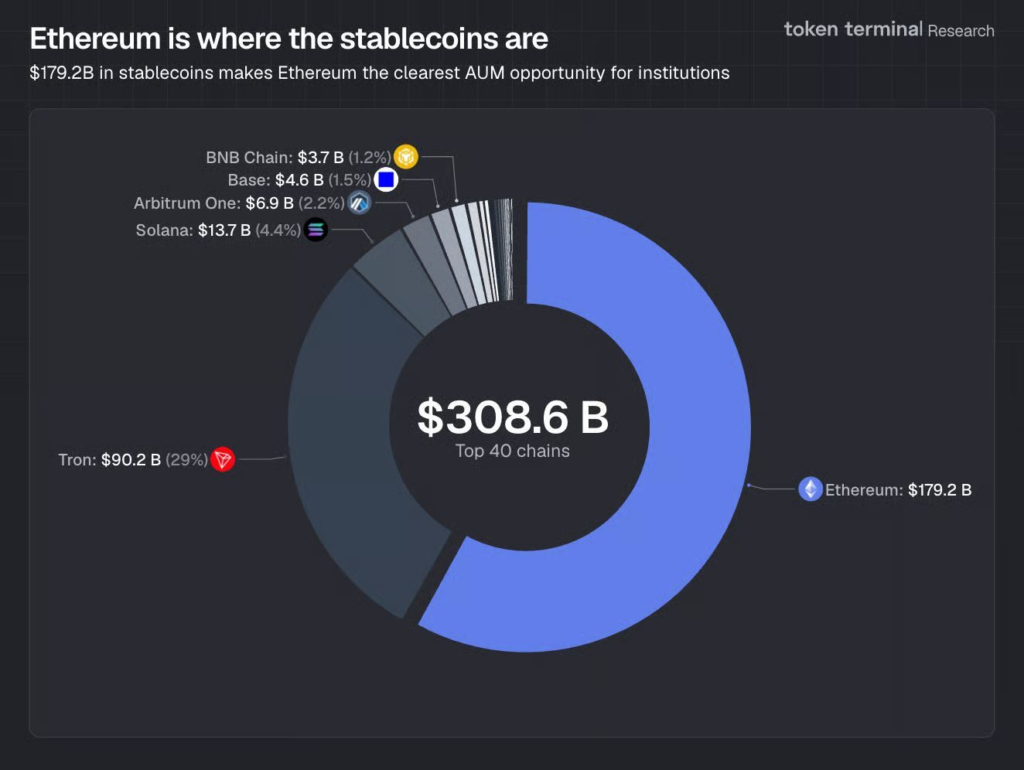
$308 billion in stablecoins alone are stored in the top 40 cryptocurrency networks, according to data from Token Terminal. 87% of that total amount live in two non-permissioned networks inspired by Bitcoin technology: Ethereum (58%) and Tron (29%).
Banks, although they are already moving in the direction they believe to be correct, still have a long way to go to get their hands on the business of earning from commissions in cryptocurrency networks; Traditional validators and stakers remain the dominant elite in the crypto asset network revenue sector.
The networks that follow Tron and Ethereum in dollar-denominated stablecoins are Solana, with 4.4%, and two layer 2 (L2) of Ethereum such as Arbitrum, with 2.2% and Base, with 1.5%. Banked ledgers such as Tempo, Canton Network or Kinexys They do not, therefore, act as dominant forces in the minting and settlement of stablecoins.
The case of the last mentioned network is curious: Kinexys, from JP Morgan, has been active since at least 2020. According to JP Morgan reports that cannot be corroborated or audited because its network is closed, Kinexys moves up to 5 billion dollars daily. That figure is money flow, not the number of stablecoins available on the network. Comparatively, it is estimated that in Ethereum some move 60 billion dollars a day only in USDC.
Stablecoins belong to free and public networks
The data demonstrates, then, that stablecoins still flow on the rails of Bitcoin-inspired networks that, although imperfect, manage to be more decentralized and permissionless than their banking competitors, designed today for institutions (and in the future, who knows if for retailers and normal individuals, killing the bitcoiner ethos forever).
This is significant because the profits (revenue) to participate, validate and work in the networks are burned (as in Ethereum to cause deflation in the ether and not defraud the holders) or are distributed among individuals and small groups, as in the Tron network, which functions as a participatory democracy.
In other words, the profits captured in the networks by transfers and services with stablecoins are not being distributed among the laps of tiny banking consortia, or among small insiders with special permissions to validate and run nodes on a network, but among people, among members of the anonymous mass from any corner of the world. This state of affairs is not immutable: it could change in the future if the no-permission philosophy disappears and gives way to bank accounting records on “blockchain technology.”
Worst case scenario: what happens if stablecoins migrate to banked networks?
If Tempo took up the majority of stablecoin usage flow in the world, profits on the network would go to select validators such as Visa, Stripe, Zodia Custody (Standard Chartered) and banking partners such as Coastal Bank. Or Canton “Super Validators,” who must first be accepted on behalf of an institution by a tokenomics committee and then incentivized to use node service providers (NaaS) such as 5North, Blockdaemon or Everstake, to whom security, uptime and regulatory compliance are delegated.
Both Tempo and Canton are public networks, although permitted and restrictive. But the worst possible scenario would come from the naturalization of a network like Kinexys, which promotes a 100% banking, closed model, where the bank captures all the revenue directly in an environment in which the network, its transactions and activities are unobservable and cannot be audited.
Of course, stablecoins are financial instruments that, although useful, are questionable. The fact that they work on an open network like Ethereum or Tron does not hide their worst side: that can be frozen, that international ordinances can facilitate acts of censorshipsometimes correct and other times arbitrary, about their holders. Which function as on-chain versions of currencies that, by design, naturally tend to depreciate because they are not bitcoin (BTC). Still, operating on open networks is the only thing that separates traditional finance from cryptocurrency finance.
If Tron or Ethereum were not the home of USDT and USDC, we would officially say that banks usurped the technology inspired by Bitcoin and that on-chain networks are nothing more than an extension of traditional finance.
Disclaimer: The views and opinions expressed in this article belong to its author and do not necessarily reflect those of CriptoNoticias. The author’s opinion is for informational purposes and under no circumstances constitutes an investment recommendation or financial advice.