Mullah Muhammad Yaqoob, the acting defense minister under the Taliban regime, disembarked on a flight in Kabul last week to warn Pakistan.
He said Islamabad “will not dare soon” to attack Afghan territory because of the military-technical cooperation agreement recently signed in Moscow. He also said that implementation of the agreement with Russia will begin soon.
At the same time, Yacob tried to downplay any international concerns about military cooperation between the regime and Moscow. The agreement he stressed was not a defense or security agreement. Its focus was on the repair and maintenance of Russian-made weapons systems already in Afghanistan’s arsenal, including helicopters and other aircraft.
He also suggested that a similar arrangement could be made with the United States, noting that American weapons had also been abandoned in the wake of the NATO invasion of Afghanistan.
This dual message – deterrence towards Pakistan, reassurance towards the wider region – reflects how both the Taliban regime and the government of Russian President Vladimir Putin have framed their budding relationship: Rather than being an ideological alliance, it is a practical exchange in which both sides see immediate benefits.
What is an arms deal and what is not
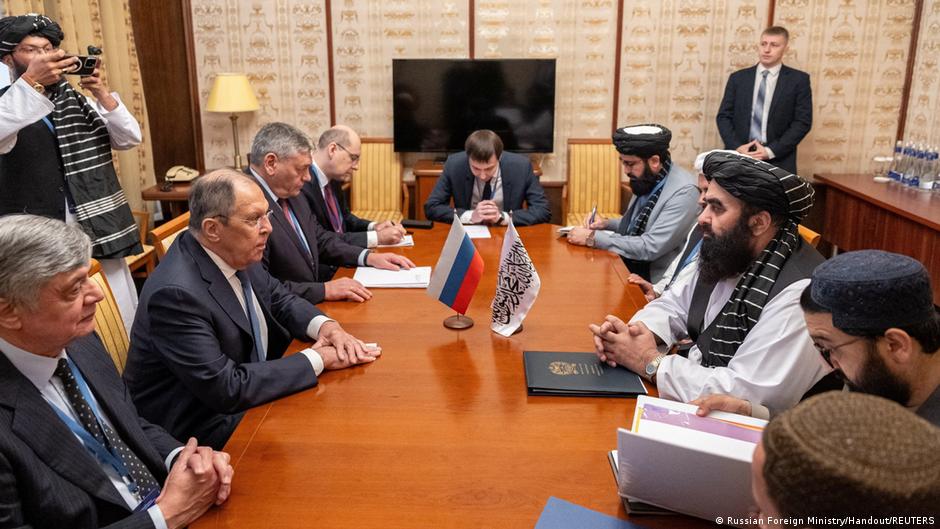
The Russian government and the Taliban signed a military-technical cooperation agreement on May 27 on the sidelines of a security conference near Moscow. Complete information has not been made public.
Russia’s special envoy to Afghanistan Zamir Kabulov said the agreement focuses on repairing Russian-made equipment and could pave the way for future defense contracts. He said, the main priority at the moment is to restore the systems already in Afghanistan’s possession.
Soviet troops invaded Afghanistan in late 1979 and remained in the country for a decade, trying to restore a friendly regime. Many of their weapon systems were left behind and survive to this day.
After 2001, the US and NATO also relied on Russian helicopters, particularly the Mi-17, to build up Afghanistan’s air force, because Afghan pilots and technicians were familiar with them and because they were considered suitable for the country’s rugged terrain.
Why does the timing of the Russia-Taliban deal matter?
Yaqoob’s comments come amid heightened tensions with Pakistan, including cross-border shelling and airstrikes inside Afghan territory. Islamabad has repeatedly accused the Taliban of harboring Tehreek-e-Taliban Pakistan terrorists, a charge the Taliban has denied.
While the Kabul-based regime wants to boost its military capabilities and send a signal to Pakistan, Russia is interested in becoming a security actor as Western influence diminishes.
According to Russian state news agency TASS, Security Council Secretary Sergei Shoigu expressed opposition to any deployment of US or NATO bases and military infrastructure in Afghanistan or neighboring countries – language that is consistent with Moscow’s broader goal of keeping the region within a non-Western security framework.
Russia’s relations with Taliban ‘pragmatic, interest-based’
Abbas Basir, who was a minister in Afghanistan’s previous government before the Taliban took over Kabul, describes the Taliban-Russia relationship as “pragmatic and interest-based” rather than a genuine political alliance.
In his view, one of Russia’s primary concerns is the Islamic State Khorasan (ISKP) and the risk that the group could use Afghan territory to destabilize Central Asia and, ultimately, threaten Russia’s internal security. Because the Taliban have fought the ISKP, Basir argues that Moscow views them as a “relative security buffer”.
Meanwhile, the Taliban gains regional political legitimacy and economic opportunities, including trade, especially energy and grain imports, at a time of severe economic stress. Basir also said the Taliban were looking for diverse relationships to avoid dependence on one or two external patrons.
Information blackout and competing narratives
Security and politics analyst Besmillah Taban cautioned that it was too early to draw firm conclusions about the contents of the agreement as both sides have a long record of restricting information.
He argued that the Taliban were also using the Moscow trip for a domestic message, calling it an attempt to gain maximum propaganda value and boost morale after confidence within Taliban ranks had weakened following Pakistani attacks.
Taban also pointed to a second dynamic: After Yakub publicly raised the importance of the agreement, Russian officials quickly moved to narrow expectations, emphasizing that the current arrangement is limited to repairing and restoring equipment left in Afghanistan from the Soviet era.
Russia looks south as Western pressure increases
Analysts have said that Russia’s primary interest in Afghanistan is still security, including limiting the flow of narcotics into Central Asia. Furthermore, Moscow’s economic reach in Afghanistan remains limited, making a long-term strategic commitment uncertain.
For the Taliban, the calculation is more immediate. With increasing pressure on Pakistan and decline in its military capabilities, the Taliban needs partners willing to provide usable weapons systems and maintenance. Experts also noted that new, US-made equipment may survive without spare parts and outside support, while Russian-origin systems may find it difficult to keep running once maintenance channels reopen.
Ghaus Janbaz, a former Afghan diplomat in Russia, said the latest arms deal should not be seen as purely technical.
“This involves military and technical cooperation, but to a large extent it also has a political dimension,” he told DW.
Janbaaz points to Russia’s role as the only country in the world that has officially recognized the current regime in Kabul. As Russia faces multiple challenges related to the war in Ukraine and tensions with Western Europe, the corridor bordering Central Asia and Afghanistan has become even more sensitive for Moscow’s security plans, Zambaz said.
He said, “Afghanistan also shares its border with these countries and there is a possibility that there could be a threat to those countries and Russia through Afghanistan, so Russia wants to secure this route.”
Islamists ready to embrace Moscow despite troubled past
Some analysts also see the Russia-Taliban rapprochement as part of a broader regional shift.
International relations researcher Idris Rahmani said Afghanistan has been repeatedly drawn into external power conflicts due to structural economic weakness. Without a strong domestic economy, he said, governments tend to lean toward what can keep the country afloat — only to later realize that alignment comes with costs.
He pointed to overlapping tensions, including the US-China rivalry and Russia’s conflict with the West over the Ukraine war, as well as the India-Pakistan standoff and broader Middle East dynamics, warning that Afghanistan risks being thrown “like a tornado” through changing regional storms.
Russia’s reach to the Taliban is also impressive in the historical context of Afghanistan. The 1979 Soviet invasion and subsequent war remains the country’s greatest shock, forcing millions to flee and reshaping Afghan society for decades.
That Moscow now presents itself as a security partner underlines how quickly geopolitical interests can realign themselves across historical fissures, and how limited the role of history can be in contemporary power politics.
The irony is hard to ignore: The Taliban movement emerged from the wreckage of the post-Soviet Union and built part of its legitimacy on religious rhetoric against foreign “occupiers,” and yet Mullah Yacob, the son of Taliban founder Mullah Omar, is now boasting about arms deals with the same power that once invaded Afghanistan.
Edited by: Darko Janjevic