
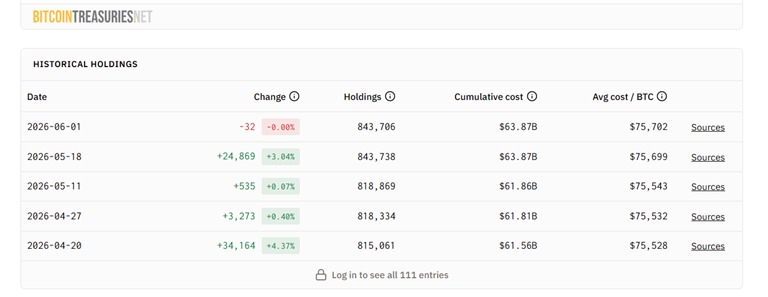
Strategy maintains close to 840,000 BTC in balance despite the recent sale.
Its STRC stock pays ~11.5% annually and trades below its par value of $100.
Strategy’s bitcoin (BTC) accumulation strategy faces a structural pressure point, according to an analysis published on June 4, 2026 by Grayscale, which warns that the company could be limited in its ability to continue purchasing BTC under current market conditions.
The analysis comes after Strategy sold 32 BTC between May 26 and 31, 2026 to cover dividends on its STRC preferred share, in the first sale recorded since 2022. The operation, although reduced in absolute terms, reactivated the debate about sustainability of the company’s financial model and its dependence on access to capital to continue accumulating bitcoin.
According to the report filed with the SEC, the sale generated approximately $2.5 million. Although it represents about 0.004% of the company’s total holdings, estimated at about 840,000 BTC, the movement was enough to alter the market reading on the consistency of the accumulation model.
It is worth noting that focus of Grayscale analysis is on STRCthe preferred stock designed to offer a return close to 11.5% per year and trade at around $100 per share. STRC is currently trading below that level, meaning investors are demanding a higher effective yield and raising Strategy’s cost of funding.
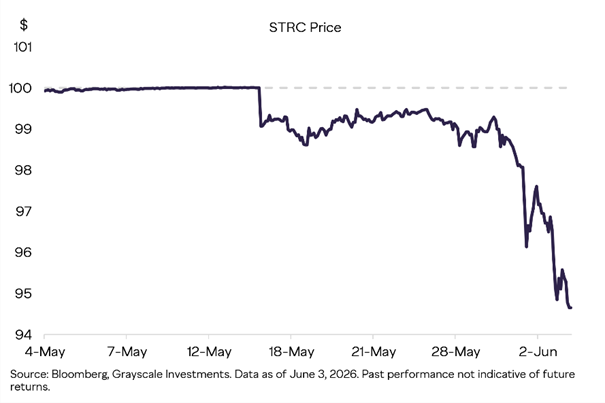
This increase in capital costs reduces the company’s ability to efficiently issue instruments and convert them into bitcoin purchases without deteriorating its balance sheet structure, something that Grayscale interprets as a loss of flexibility in its accumulation model.
Likewise, the firm points out that Strategy’s strategy It depends directly on market conditions for its MSTR common shares and its preferred debt. When these conditions weaken, the mechanism that allows capital to be transformed into BTC purchases loses efficiency.
In this scenario, the model of constant reserve expansion begins to show greater sensitivity to the price of its own financial instruments, which introduces a practical restriction on the rate of accumulation.
The market interprets the movement from two perspectives. On the one hand, the sale of 32 BTC is considered marginal compared to the approximately 840,000 BTC that the company maintains on balance sheet. On the other hand, sets a symbolic precedent by demonstrating that bitcoin can be used as a source of liquidity to meet financial obligations, as reported by CriptoNoticias.
This reopens the debate on whether Strategy continues to function as a structural buyer of bitcoin or whether its future behavior will be more conditioned by the evolution of its financing conditions.
Faced with Grayscale’s reading, Michael Saylor, founder of the company, and Strategy maintain that the sale of 32 BTC does not reflect a weakness of the modelbut rather active balance sheet management to strengthen STRC’s capital structure and credibility.
In addition, Taylor I had already anticipated that They could sell small amounts of bitcoin to pay dividends and “get used to the market“to this type of movements. After the operation, he reiterated that the objective is to strengthen the instrument and keep the company as a net buyer of bitcoin in the long term.
Beyond the immediate impact, Grayscale’s analysis presents a scenario in which institutional demand for bitcoin could become less stable and more dependent on the liquidity cycle of the capital markets. In this context, Strategy’s ability to sustain its role as the main corporate buyer of the asset will depend on the evolution of STRC, MSTR and investor appetite for its capital structure.
If these conditions do not improve, the market could move towards a phase with greater diversification of institutional demand and less dependence on leveraged buyers, which would have direct implications on the volatility and price dynamics of bitcoin in the coming months.