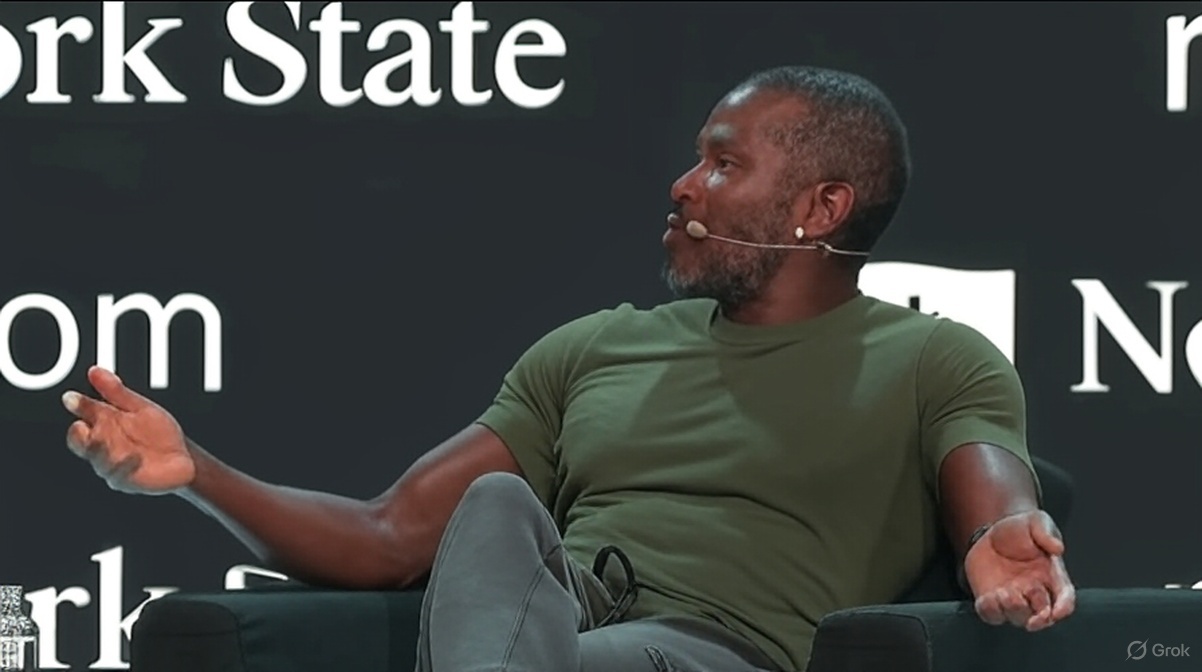
Both cryptocurrencies saw price increases amid the general market decline.
For Hayes, markets in general would reach their maximum soon, and then correct.
Arthur Hayes, co-founder and former CEO of the BitMEX exchange, reported yesterday, June 4, 2026, that he completely liquidated his financial positions in the hyperliquid (HYPE) and near (NEAR) cryptocurrencies.
“I withdrew all my money from hyperliquid and near,” the businessman said and then explain the reasons for such a decision.
Before continuing, it is worth clarifying that HYPE works as the native cryptocurrency of the Hyperliquid network, which also has its own decentralized trading platform. For its part, NEAR is the digital asset of Near Protocol, a network designed for the development and execution of decentralized applications (dApps).

The reasons for the divestment respond directly to an analysis of macroeconomic factors and international geopolitical tensions. As Hayes himself explained, the main catalyst is the strong global rise in energy prices derived from the current international war conflict with Iran.
This international energy crisis forces nations to allocate resources to urgently reconstitute their strategic fuel inventories. Added to this complex panorama is the proximity of three mega-IPOs directly or indirectly related to Artificial Intelligence (OpenAI, Anthropic and SpaceX), which consist of massive listings of companies in the technology sector on the stock exchanges.
The financial specialist projects that these stock market launches will absorb the available liquidity between this month and the beginning of the third quarter of the year. Likewise, Hayes predicts that the president of the United States, Donald Trump could adopt an “anti-AI regulatory” stance for political purposes to strengthen Republican candidates.
This electoral strategy would seek to gain positions in the face of the next mid-term legislative elections in the United States, scheduled for November 3, 2026. In this context, the analyst calculates that the “market highs will be recorded between the current date and the month of September.”
Due to this, the businessman considered it appropriate “to take profits and begin to gradually accumulate positions without the pressure of keeping positions open,” he concluded. Following his statements, data analysis from the firm Onchain Lens confirmed that Hayes sold 247,334 HYPE and an undetermined volume of NEAR.
Hayes’ announcement drew immediate criticism, for example from Arthur Cheong, CEO of the investment fund DeFiance Capital. The executive criticized Hayes’ strategy stating that he is the “epitome of a guy who over-operated his position.” With this statement, Cheong directly pointed out that the BitMEX co-founder made a technical error due to excessive short-term operations.
The liquidation also contradicts the optimism that the same Hayes showed on May 30, when he projected exponential growth for the asset. On that date, the analyst published on his official channels: “HYPE at $150, to hell with TradFi, to hell with the Clarity Law.” This is a bill in the United States that seeks to establish a clear regulatory framework for digital assets. Although the cryptocurrency industry positively values this project because it provides legal certainty, Hayes rejects it.
Hayes’s positive stance toward HYPE was supported by a $100,000 bet agreed with Kyle Samani, co-founder of Multicoin Capital. The agreement, the funds of which will go to the charity of the winner’s choice, maintains that “from February 10, 2026 to July 31, 2026, HYPE will outperform any shitcoin with a market cap greater than $1 billion.”
The market reacted to Hayes’ words
Although both cryptocurrencies (HYPE and NEAR) had price increases amid the general market decline, prices reacted with setbacks after what Hayes explained.
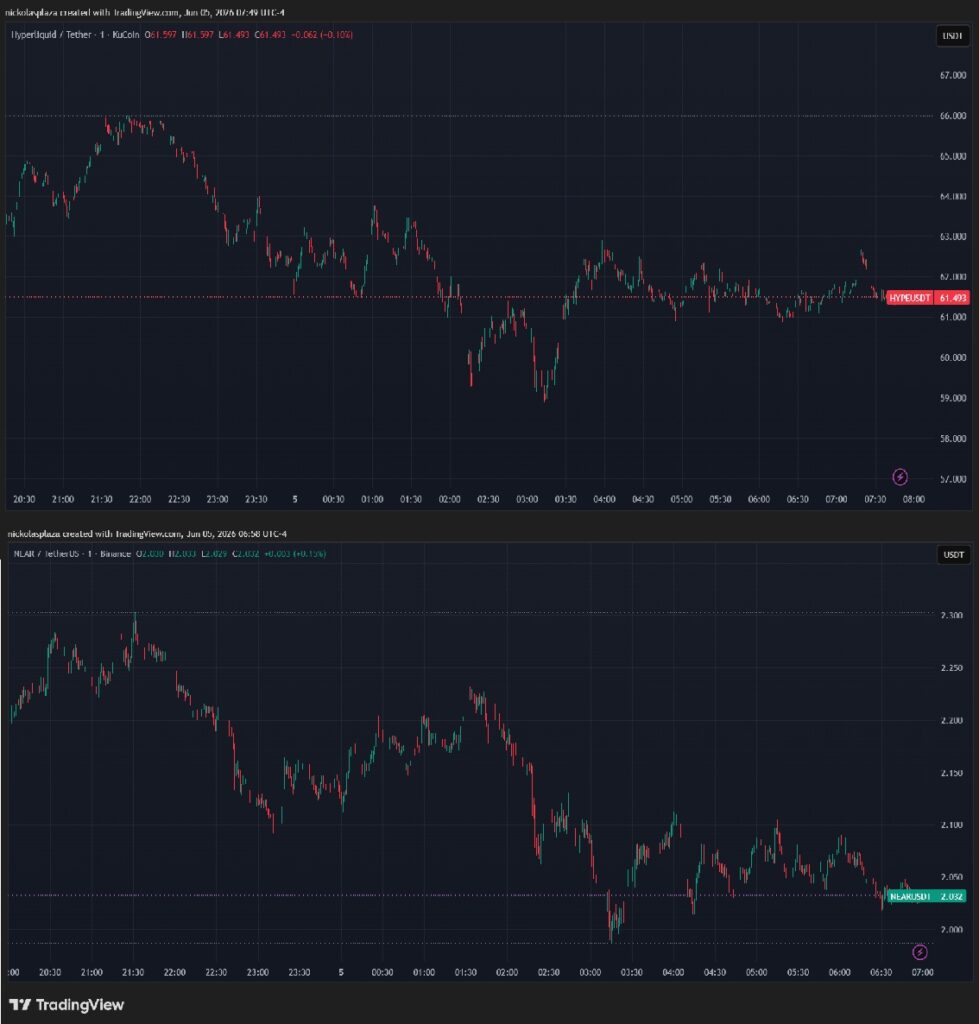
HYPE suffered a 4.7% drop in the last 24 hours to trade at $61after reaching an all-time high of $75 on June 1.
In parallel, NEAR recorded a daily drop of 13%, falling from a price of $2.33 to $2.03. Divestments carried out by figures with great capacity for capital movement can modify the short-term expectations of small merchants.