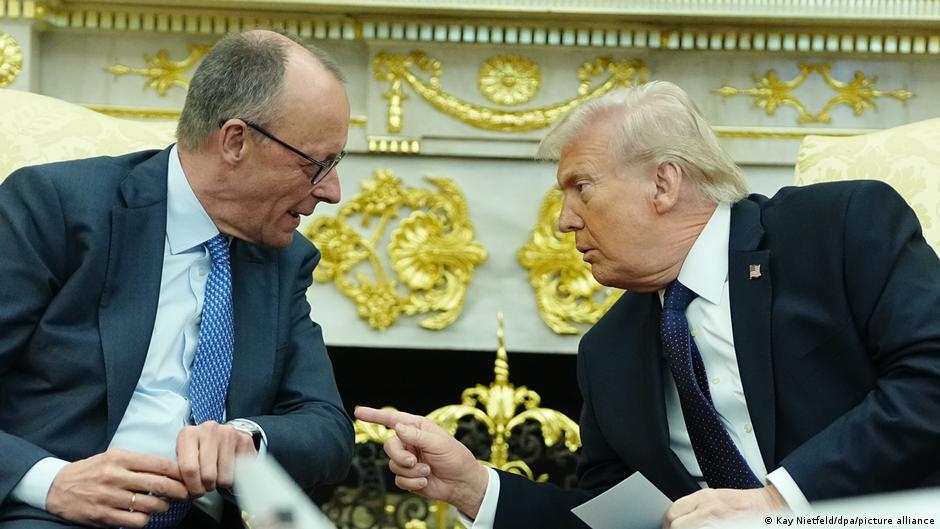
German Chancellor Friedrich Merz initially appeared stunned by the US and Israel’s attack on Iran on 28 February.
The first attacks killed key figures in the Iranian leadership, including spiritual leader Ayatollah Ali Khamenei, as well as many civilians. No prominent legal scholar has since claimed that these attacks fall within international law, nor has any member of the German federal government.
Yet the phrase “violation of international law” has not yet passed Merz’s lips. Instead, he referred to the Iranian government as a “terrorist regime” and said, “Classifying the incidents under international law would have relatively little impact,” adding that the US and Israel had “good reasons” for the attacks.
“I believe that (initially) Merz was convinced that the Israelis and Americans were doing things in Iran that the Europeans themselves are not capable of doing, but that the political goals are right,” Johannes Warwick, a political scientist at the University of Halle, told DW.
At the same time, he said, Merz did not want to criticize the Americans “for achieving common goals through methods that they themselves would not have used.”
Even at the time, Merz’s words sparked widespread debate. Critics, including those from the European Center for Constitutional and Human Rights, accused him of “giving in to power politics”, while German President Frank-Walter Steinmeier warned against “ignoring” international law.
Henning Hof of the German Council on Foreign Relations said Merz appeared to apply international law selectively – forcefully invoking it in response to Russia’s war against Ukraine, while downplaying its relevance in the Iran conflict. “Indeed, the chancellor seems to be adopting a situational approach to international law,” Hof told DW.
Transatlantic friendship by taking Trump’s side?
Criticism intensified after Merz met with US President Donald Trump in Washington just days after the attacks began. By soliciting favors, Merz was trying to secure Trump’s support, which he succeeded in doing, at least temporarily.
This sparked heated debate in Germany. Norbert Röttgen, a foreign policy expert from the centre-right Christian Democratic Union (CDU), said in the Bundestag that it was a difficult balancing act: “What is the lesser evil?” War is undoubtedly an evil, he said, but “the rule of the mullahs is the greatest evil for the region, for the people of Iran and beyond.”
In contrast, Lee Reisner of the Socialist Left Party criticized the Chancellor for allowing himself “to be presented as Trump’s partner”.
Political scientist Warwick concluded that “Merz had – and this cannot be put more clearly – a flawed compass on these issues.”
Meanwhile, Germany began to feel the economic consequences of the Iranian War. The closure of the Strait of Hormuz caused oil and gas prices to rise sharply, further crippling Germany’s already weak economy.
The timing couldn’t have been worse for Merz on home soil. While approval ratings for the German government’s performance – and especially for Merz – have fallen, ratings for the right-wing Alternative for Germany (AfD) have risen. Recent polls show the AfD ahead of Merz’s CDU/CSU.
Merz considers Iran an insult to America
Then, in late April, Merz suddenly came face to face. Speaking to students, he said that the United States had “no concrete strategy” in the Iran war and accused Iran’s leadership of “humiliating” Washington.
What prompted the apparent change? Warwick said, “My impression is that Donald Trump’s increasingly extreme rhetoric has alarmed many people and even alienated those who were previously sympathetic to his position. There has even been talk of erasing Iran from the map.”
Trump, who enjoyed cordial relations with the chancellor during their meeting in Washington, reacted sharply to the criticism. “He doesn’t know what he’s talking about!” Trump wrote on his social media platform Truth Social. “No wonder Germany is doing so poorly, economically and otherwise!”
Result of American President’s anger
This prompted Trump to announce that he was withdrawing 5,000 US troops stationed in Germany, possibly more. He also canceled his plan to deploy Tomahawk cruise missiles in Germany as a defensive shield against Russia and then once again imposed tariffs on car exports from the EU.
The merger may have angered the president, but the German public largely agrees with the chancellor’s new, critical stance. According to an ARD Deutschlandtrend poll conducted shortly after the war began, 58% of respondents agreed that the military actions taken by the US and Israel were unjustified.
Furthermore, trust in the US among Germans, which was already low, has declined even further during Trump’s presidency. Only 15% still consider the US a reliable partner.
A gesture of goodwill from Germany
Damage control now appears to be the order of the day, although at the moment this is only on the German side.
While Merz has stuck to his assessment of the Iran war, he has said that Germany would participate in a naval mission in the Strait of Hormuz after the end of hostilities. A German minesweeper is now on standby. It remains to be seen whether the mission will actually be accomplished or not. However, it seemed important to make such a cordial gesture toward Trump.
However, this does not appear to have improved transatlantic relations.
At a meeting of NATO foreign ministers in Sweden in late May, US Secretary of State Marco Rubio said that Trump sees “disappointment at some of our NATO allies and their response to our operations in the Middle East” and “has to pay attention to that.” The NATO summit in Ankara in July “will probably be one of the most important in the history of NATO,” Rubio said.
Learned a lesson?
For political scientist Warwick, Iran’s first 100 days were a clear lesson for Germany. “Germany and Europe must clearly define their interests and not stand like deer in headlights, especially when Washington is putting pressure on them, moving in one direction today and in another tomorrow,” he said.
Before becoming chancellor last year, Friedrich Merz was advocating greater German independence from the US under Trump. After months of holding his tongue, he’s now back where he started.
This article was translated from German.