
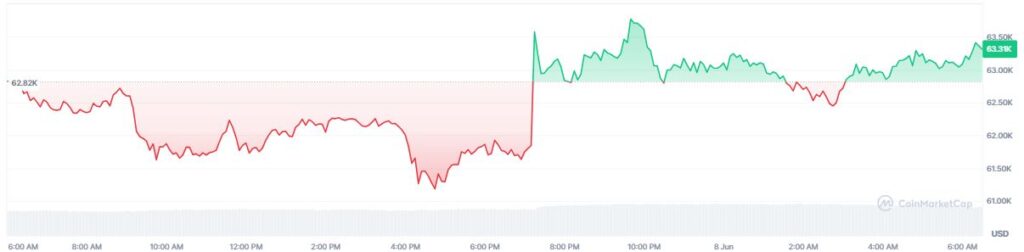
Bitcoin (BTC) rallies towards $63,000.
“A good time to add more points,” said Saylor.
Michael Saylor, co-founder and CEO of Strategy, published the company’s traditional bitcoin (BTC) acquisition chart on X on June 8, 2006.
Every time Saylor publishes the “orange dots” graph, Strategy typically files a Form 8-K with the U.S. Securities and Exchange Commission (SEC) the following Monday. confirming BTC purchases made during the previous week.
This time, furthermore, the message He was more explicit than on previous occasions: “A good time to add more points.” That is, Saylor presented current price levels as a possible attractive area to accumulate, with BTC trading in the low $60,000 range.
Hours later, Saylor he added another shorter message: “32?”, a reference to the company’s recent sale of 32 BTC at the end of May.
In this context, the executive also reposted a message by Phong Le, CEO of Strategy. “Our corporate strategy is to increase net bitcoin and bitcoin per share over time. Rumors to the contrary are just rumors,” the CEO wrote.
After the publications, bitcoin regained ground and surpassed $63,000.
Strategy shook the market with the sale of bitcoin
The signal takes on special relevance because it arrives just a week after Strategy will reveal the sale of 32 BTC between May 26 and 31. As CriptoNoticias reported, that operation was the first BTC sale carried out by the company since 2022 and raised questions within the market, as it seemed to contradict the narrative of permanent accumulation that Saylor had defended for years.
Although the sale represented just 0.004% of the company’s reserves, its impact was mainly symbolic: It broke more than three years without sales and raised doubts about Strategy’s ability to sustain its strategy in a context of greater financial pressure.
These doubts appear at a time when the company’s position is also under pressure due to the fall in the price of BTC. Strategy remains the publicly traded company with the largest amount of BTC in its treasury, with 843,706 BTC acquired at an average cost of $75,699 per unit. At current prices, that position accumulates unrealized losses close to $13 billion.
The operation was carried out to attend debentures linked to STRC, a class of preferred shares issued by Strategy. Unlike common shares, these instruments give priority in the collection of dividends and usually offer periodic payments to investors. The company uses this type of mechanism to raise capital and finance part of its bitcoin accumulation strategy.
Saylor had already anticipated this scenario during the presentation of the balance sheet for the first quarter of 2026. At that time, he explained that Strategy could sell part of its BTC to finance dividends linked to STRC, although he stressed that the objective remained to increase its net bitcoin holdings over time.
“In these periods, even if we sold 1 BTC, we would be buying between 10 and 20 more,” he said then. The phrase sought to make it clear that a specific sale would not imply abandoning the accumulation strategy, but rather using BTC as a financial tool within a balance sheet that the company intends to continue expanding.
Saylor’s posts boosted the price of BTC, but also revived criticism from his detractors. One of them was the economist Peter Schiff, who he questioned Strategy’s ability to finance new purchases without affecting its financial commitments.
“Where will the money come from to finance the purchase? Will you use up what’s left of your cash reserve? If so, how will you pay the dividends on the preferred stock?” he asked.
The comment points to one of the main debates around Strategy: the sustainability of a model that combines continuous purchases of BTC with different financing instruments that generate future obligations for the company.
If the BTC purchase is completed, the operation would serve to reinforce the idea that the May sale was a one-time event and not a change of course in the narrative that made Strategy the largest corporate holder of BTC in the world.