
Control over the monetary supply is usually the first line of defense of a State under pressure. And that is precisely what Russia is doing. Starting July 1, 2026, the law “On Digital Currencies and Digital Rights”, which is already advancing in the Duma, will change the rules of the game for those who used this ecosystem as a financial escape valve.
The Kremlin’s goal is to structure the country’s economic landscape through strict limits on permitted operations and segmentation of users.
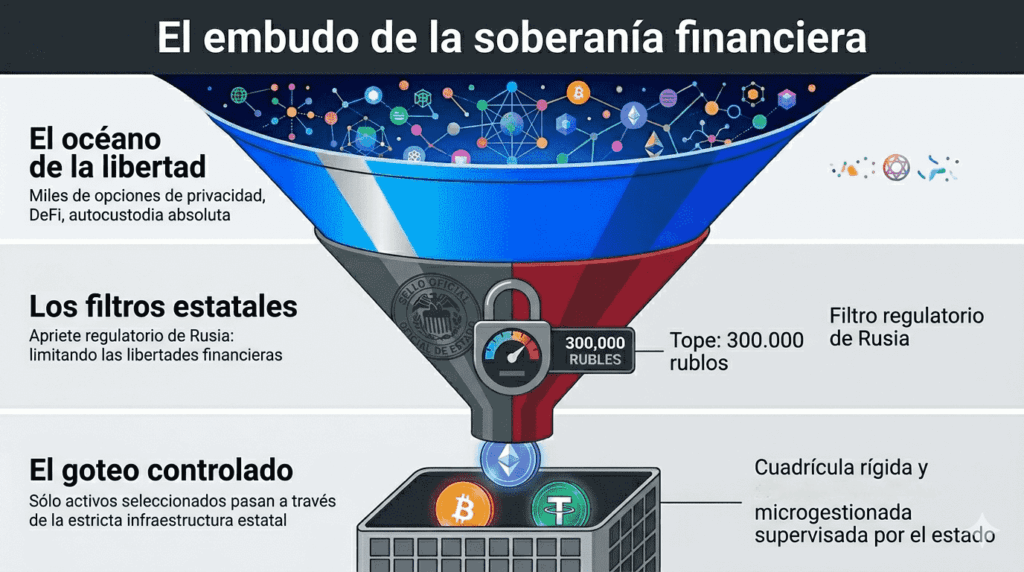
Those who do not have a professional accreditation will be classified as unqualified investors. So for this group, the Bank of Russia designed a financial trap that acts as a double filter. This is a maximum investment limit of 300,000 rubles per year (about $3,300) and a menu of options reduced to just three assets: bitcoin (BTC), ethereum (ETH) and the stablecoin (Tether) USDT.
To access this regulated catalog, the average citizen must operate exclusively through registered intermediaries and pass a state knowledge exam.
This technical barrier responds to an explicit policy; such as noted by Vladimir Chistyukhinfirst vice president of the institution, the intention is that digital assets do not become a priority investment for the general population due to their intrinsic risks.
The uncomfortable tolerance to USDT
The official justification for setting this limit is based on the average balances of traditional brokerage accounts, a parameter with which authorities seek to mitigate losses in a volatile market. However, the inclusion of stablecoins in this scheme exposes a complex institutional contradiction.
The central bank itself has warned that a private token like USDT, issued by the Tether company, carries the risk of being blocked or confiscated remotely.
Despite recognizing this vulnerability, authorities chose to authorize its use, validating the local economy’s need for liquid channels for foreign trade and setting a minimum standard while alternatives issued within Russian borders are developed.
This forced tolerance towards USDT describes a paradox that resonates strongly in Latin America. By allowing the use of the cryptocurrency, the Russian regulatory framework incorporates the main representative of American liquidity into its domestic economic activity, allowing citizens to indirectly depend on the financial system of its largest geopolitical adversary to preserve their purchasing power.
This is the same dynamic that thousands of people face every day. savers in Argentina or Venezuelawho, in their attempt to protect themselves from the devaluation of their local currencies, transfer the risk of their assets to digital structures linked to the decisions of the Federal Reserve in Washington, as CriptoNoticias has been reporting.
Therefore, what is happening in Russia makes it clear that the outcome of this reform will serve as a precedent for other economies with strict exchange controls that seek to channel the demand for so-called hard currencies.
If the law comes into force as planned, the real impact of the measure will be measured in the privacy of users, who They must weigh whether legal access compensates for the loss of personal custody of their private keys when they are registered in a database under state supervision.