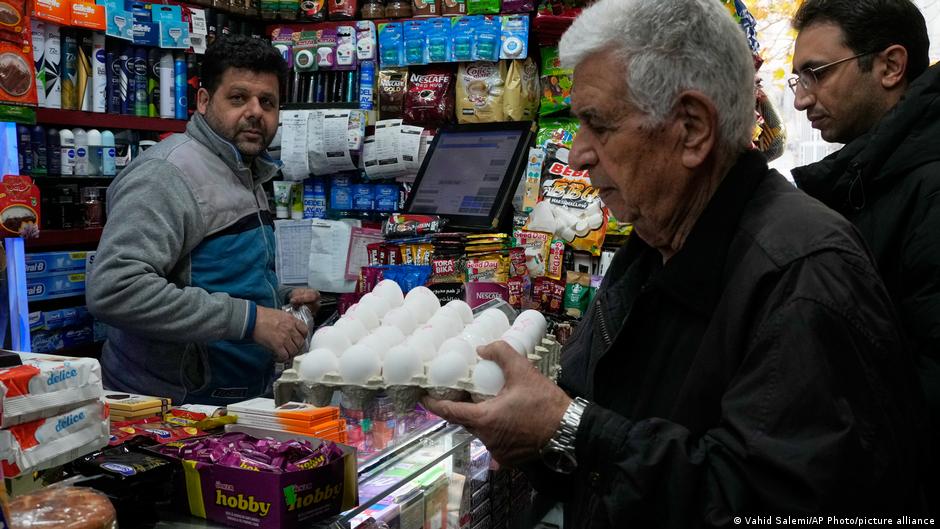
Living conditions for ordinary Iranians are becoming increasingly difficult as years of economic stress due to war and sanctions increase.
Authorities have introduced higher wages and food vouchers to try to rescue low-income families, but many Iranians say these measures are failing to keep pace with rising prices.
In March, the monthly minimum wage in Iran was raised by 60% or 166 million rials ($120, €104). However, for many households, the clearest sign of the crisis is not the core inflation figure, but the speed with which general prices change.
A resident of Tehran told DW that the price of rice has increased by 9% within two weeks. Other items like ice cream also saw a similar increase. Prices are increasing week after week, while salaries are adjusted only once a year.
Officials say the food voucher scheme is meant to ease the burden on families. But many Iranians argue that the support is not commensurate with the prices.
The same Tehran resident said that since the food voucher policy was introduced, chicken prices have more than doubled, while milk has increased by almost 50%. The voucher itself remained unchanged, the resident said.
In some households, if they have any savings left, they buy food, detergents and hygiene products in bulk and store them at home before prices rise again.
Full shelves, empty pocketbooks
The war with the US and Israel has exacerbated Iran’s existing economic problems. As a resolution to the conflict appears distant, supplies of oil, gas and fertilizer are disrupted.
This matters to Iranian households because when fuel, transportation and imports become more expensive, costs move outward.
The result is an economy in which abundance and scarcity can co-exist. The shelves may still be full, but for an increasing number of people, prices are becoming out of reach. For many consumers, the immediate problem is not that stores are empty. The situation is that the purchasing power has collapsed.
Even when the state raises the minimum wage, it matters little in a market where prices change weekly, the value of subsidies diminishes rapidly and ordinary families are forced to measure their lives in half kilos, small baskets and tough choices.
A supermarket owner in Iran said he has seen every day how prices rise faster than people can handle.
Customers who once bought several kilograms of rice now buy much less rice than before. He said that now people are not able to even buy essential items in normal quantities.
Due to years of rampant inflation, prices of common goods in Iran are often sold in “tomans” rather than the official “rials”. One toman is worth 10 riyals, and when you consider that a kilogram of rice goes for 3 million riyals, boiling it down to the toman makes everyday transactions easier to handle.
However, since the rial remains the official currency of Iran, there is a long-standing difference between the official unit used in government and banking documents and the unit generally used by the public in daily life.
The shopkeeper said, the most frustrating moments come when children come to the shop and ask for something that costs Rs 10,000. It has become almost impossible to find anything at that price. He told DW that in all his years in business, he has never seen people so desperate to buy the most basic things.
high cost of feeding
London-based economic analyst Arzoo Karimi told DW that based on data from Iran’s statistics center, the monthly cost of achieving the minimum number of calories a person needs now exceeds 7 million tomans ($39.00).
In his view, this means that food alone can consume more than 70% of a family of three’s income, leaving little or nothing for rent, health care or education.
Karimi told DW that it is misleading for Iranian officials to talk about an abundance of essential goods on store shelves if people are not able to buy them.
They argue that since rent, medicine and health expenses are often prioritized over food, families are forced to cut back on their diets step by step. First protein, then dairy, and now even carbohydrates and simple bread are becoming a serious daily challenge for many families.
Edited by: Wesley Rahn