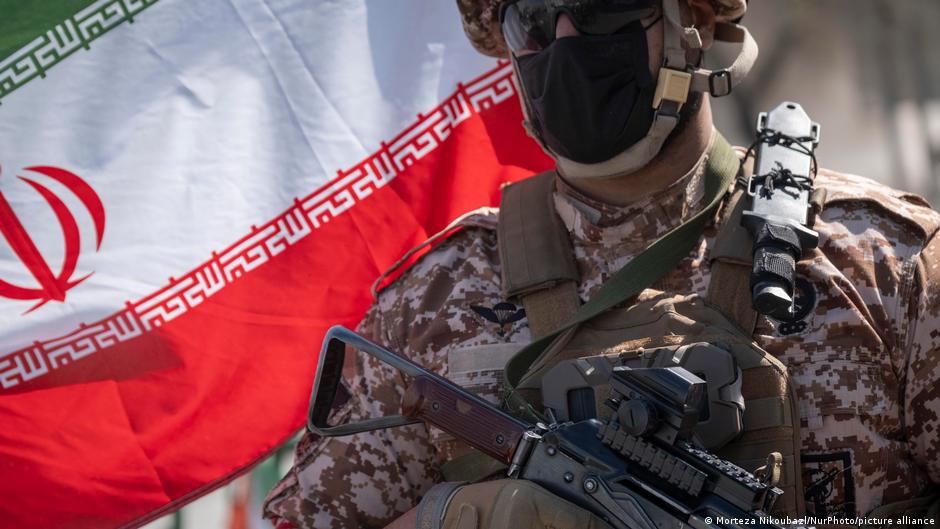
Iran analysts are debating whether the Islamic Republic is on the verge of a historic transition – from a theological system to one in which the military holds real power.
Iran’s Islamic Revolutionary Guard Corps (IRGC) – a force originally established in 1979 to defend the Islamic Revolution – has transformed from a military faction into a vast economic and political empire.
According to estimates, the IRGC, through affiliated companies, controls about half of Iran’s oil wealth, as well as interests in construction, telecommunications, and export industries worth billions of dollars.
This shift was decades in the making – but the Iran war has accelerated it dramatically.
“However, in the context of the state of emergency that has been in place since the start of the war on February 28, 2026, the country’s strategic and operational command has been officially handed over to the war headquarters and top generals,” said Faraj Sarkohi, a Germany-based political analyst and author.
“This in no way indicates the transformation of the system into a pure military dictatorship,” Sarkohi told DW. “This is because the main foundation of this rule remains the institution of velayat-e faqih, the official Islamic doctrine, and the clergy as representatives of that doctrine.”
Mojtaba’s appointment: official end of religious legitimacy?
Following the assassination of Supreme Leader Ali Khamenei in an Israeli strike on February 28, reportedly under pressure from the Revolutionary Guard, Iran’s Assembly of Experts appointed his son Mojtaba as the new Supreme Leader.
Analysts say the decision reflects a shift in power toward security institutions.
Damon Golriz, a researcher at The Hague Institute for Geopolitics, sees Mojtaba’s appointment as a turning point in Iran’s history.
He said, “The appointment of Mojtaba Khamenei as supreme leader cements the reality that political calculations and balance of power – not religious legitimacy – have become the decisive factors in the Islamic Republic.”
Mojtaba Khamenei is a 56-year-old cleric who has not held any senior religious post or played a significant role in Iran’s electoral politics.
“His appointment is based less on merit and more on his dense network of connections and internal power structures,” Golridge said. “He may sit on the leader’s chair, but at the same time he is hollowing out the office from within. He is a leader in title, but in reality a purely decorative figure.”
IRGC’s barracks power network
Mojtaba Khamenei’s ties to the security establishment date back to the war years, when he joined the Revolutionary Guard in 1987 and served during the Iran–Iraq War in the Habib Ibn Mazahir Battalion under the IRGC’s 27th Mohammad Rasoul Ollah Division.
This battalion became the birthplace of a network that formed the hard core of the IRGC’s intelligence and leadership elite over the next decades.
The barracks-based network has been functioning as an extended security arm of the Office of the Supreme Leader for the last two decades.
Golriz said that since 2009, Mojtaba has played a direct role in coordinating commanders and organizing the Basij militia, a paramilitary group within the Revolutionary Guards that was deployed to suppress popular protests.
Golridge said, “During the repression of the 2009 protests he assumed direct leadership of the Basij organization and moved security meetings to the office of the Supreme Leader, thereby establishing important institutional ties to the centers that are today highly influential actors of power.”
Golriz said that while official executive power rests with Iranian President Massoud Pezeshkian, “the real power lies in the hands of Mojtaba Khamenei and a network of new generation military and security figures.”
“Beneath this clerical facade, the center of power has shifted from the religious faculties to the barracks. The Mojtaba provides the ideological cover, while the Revolutionary Guard carries out the real work of governing.”
Economic crisis fuels fresh protests
Against the backdrop of these geopolitical and internal turmoil, economic data paint a worrying picture of poverty in Iran – even in the event of a regime change from an absolute theocracy to military rule, it is likely to trigger large-scale public protests.
International Monetary Fund estimated That the Iranian economy will shrink by about 6% in 2026 with 68.9% inflation.
This surge in inflation, coupled with the rapidly rising poverty line, has severely crushed the purchasing power of the salaried and working class.
“The regime lost its intellectual and ideological hegemony years ago,” Sarkohi said, pointing to deep divisions between the leadership and society. “The majority of the society stands in complete contradiction to the state culture and is largely alienated from it in their social and private lives.”
Golridge underlines this with strong statistics.
“About 80% of Iranians feel a deep hatred of this system. With a median age of less than 35, today’s Iran is a revolutionary society – one that did not choose this political system and has spent much of the last decade in the streets fighting against it,” Golriz said.
“The mass killings of peaceful protesters in January 2026 have certainly broken what remains of the social contract between the regime and the population.”
Political analyst Sarkohi said that “even state institutions fear a renewed outbreak of spontaneous rebellion in Iran – unrest that could bring people back to the streets with a spark.”
He added that the regime “also faces organized civil, labor and democratic movements, including teachers, workers, student groups and women.”
Between repression and political compromise
Both analysts agree on one point: In its new military-religious form, the regime can no longer rule as before.
Sarkohi estimates that even in the event of a temporary agreement with the United States, “…he would be forced to make concessions and retreat in some social areas, such as the mandatory headscarf (hijab), while continuing his political autocracy in dealing with dissidents and opposition figures.”
Golriz outlines a long-term scenario that is currently considered unlikely.
“The most desirable scenario would be a kind of civilizational reunification: a genuine national dialogue with a perspective of reconciliation and compromise, so that Iran can evolve from a ‘revolutionary utopia’ into a normal country – a country at peace with both its own population and the world.”
However, experts are well aware of the extreme difficulty of this route.
“There is currently no broad-based, credible opposition capable of cohesively representing the will of the majority of society.”
Golridge concludes that the Islamic Republic’s old method of governance – based on structural corruption, organized repression and ideological coercion – is no longer effective.
“The Ayatollahs will not disappear overnight, but their politics will slowly, yet inexorably, be consigned to the archives of history,” he said.
This article was originally written in German.