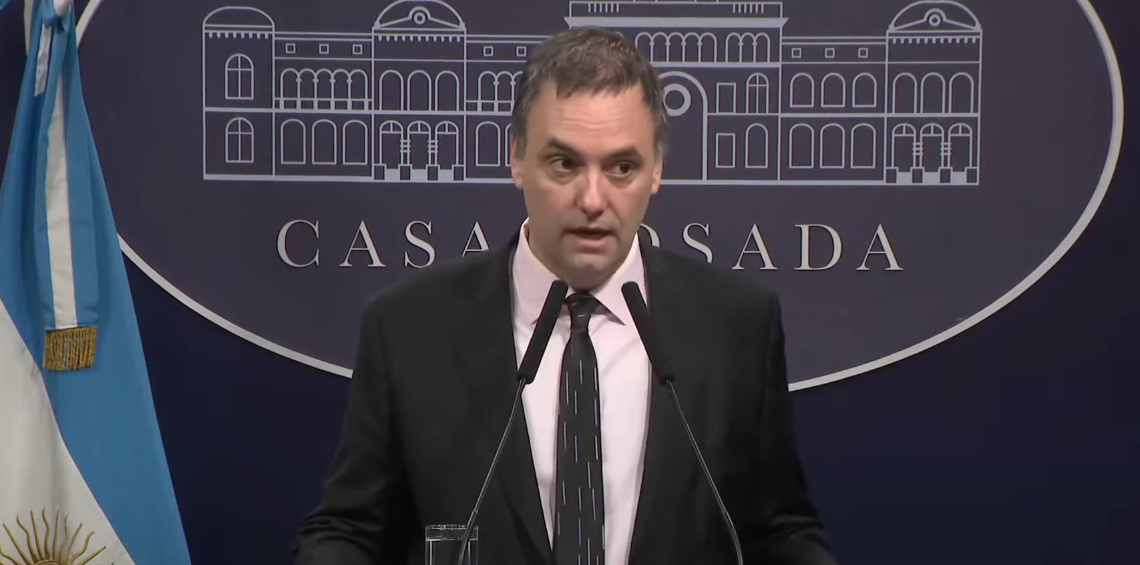
The federal prosecutor’s office detected previous omitted movements of more than USD 340,000.
The official took refuge in the Fiscal Innocence Law, but the criminal case remains open.
Manuel Adorni, Chief of Staff of Argentina, reported today, June 11, 2026, that he presented a formal rectification of his assets to detail funds in bitcoin (BTC) and cryptocurrencies. This, in an attempt to justify assets that the Public Prosecutor’s Office considered disproportionate to his salary.
In this new document, Adorni recorded holding approximately $513,000 in bitcoin. The surprise presentation occurs after the prosecution discovered previous undeclared movements with digital assets by a value greater than 340,000 dollars, which left a difference of 163,360 dollars that the official now recognizes as own capital.
To explain the origin of this money, the head of ministers attributed the funds to personal savings accumulated outside the legal financial system, a practice described in the file as “black savings.”
As CriptoNoticias has reported, the cryptocurrency laundering regime through regulated exchanges has been a tool used by many Argentines to regularize digital holdings.
The pressure on the official had intensified last month, when prosecutor Gerardo Pollicita received technical reports from more than 20 exchanges of cryptocurrencies, including Binance, Ripio, Lemon and Satoshi Tango.
The investments were made between 2013 and 2018 (with an initial capital close to $200,000 that was valued), along with personal savings accumulated in their private stage outside the formal financial system, a practice that he himself described as “black savingslike many Argentines.
These reports detailed flows made mainly in 2024 and early 2025, a period in which Adorni had not yet incorporated these holdings into his sworn statements, despite the obligations of public officials.
The progress of the case for alleged illicit enrichment in Argentina
Given the progress of the judicial evidence, Adorni chose to activate an emergency legal mechanism. For this reason, today, Thursday, June 11, the official took advantage of Law 27,799, known as the “Fiscal Innocence Law”, replicating the strategy that his wife, Bettina Angeletti, had executed ten days before.
This legal framework offers an immediate benefit. This means that it raises the minimum floor for simple tax evasion crimes from 1.5 million (around $1,000) to 100 million pesos (about $68,000) and retroactively blocks tax audits for those who adhere to the regime.
However, this tax shield has severe limits in criminal jurisdiction. Although The new regulations extinguish the action for purely tax crimes, it does not stop or freeze an investigation opened for illicit enrichment.
For this reason, Judge Ariel Lijo and prosecutor Pollicita are advancing with traceability studies in the bitcoin and cryptocurrency networks, using digital analysis tools to reconstruct in a millimetric way the origin and final destination of the funds.
The decision of a senior official to resort to a tax amnesty in the midst of a corruption investigation sparks a deep debate in Buenos Aires. In the official environment it is argued that the presentation is a legitimate act of regularization under a current law and of general access, while the opposition maintains that the measure seeks impunity.
In the midst of all this, the former head of the Financial Information Unit (UIF), María Eugenia Talerico, and other critics questioned the timeline of the estate, noting that the growth has occurred mainly since he assumed public functions.
This questioning led to requests in Congress (such as the project of Congressman Esteban Paulón) to expressly exclude officials from certain regularization benefits.
Now, prosecutor Pollicita is preparing to cross the $513,000 declared in bitcoin with the technical analyzes requested from the Directorate of Judicial Assistance in Complex Crimes (DAFI), while the Anti-Corruption Office maintains the power to demand evidence of economic consistency.
Beyond the judicial outcome, the case exposes a growing dilemma in the region such as the thin line between the legitimate regularization of digital assets and the use of tax reforms as tools to validate assets under public suspicion, challenging the transparency standards that citizens demand of their rulers.