It was one of the most emotional moments of the transfer of power in Hungary: On May 9, as the new National Assembly convened for its inaugural session, a group of children in white shirts entered the plenum of the magnificent neo-Gothic parliament building in the Hungarian capital Budapest. He played the tambourine and guitar and sang “Cygni Himnuz”, the unofficial anthem of the Roma in Hungary. The opening lines are “Zold as erdo, zold as hegy is” or “Green is the forest, green is the hill.”
This brought tears to the eyes of many members of Parliament as well as thousands of people gathered outside the Parliament. Aladar Horváth, one of Hungary’s most famous Roma civil rights activists and one of the country’s first Roma parliament members after the end of the communist dictatorship in 1990, was also there. “I got emotional too,” he said. “It was as if we were finally coming home.”
Magyar kept a promise
The performance was the fulfillment of a promise that Hungary’s new Prime Minister, Peter Magyar, made in November 2025 when he met children, members of the tambourine group SUGO Tamburazenékar, in the village of Sukosd in southern Hungary. He vowed that if his Tisza party won the elections he would invite her to play in the Hungarian Parliament.
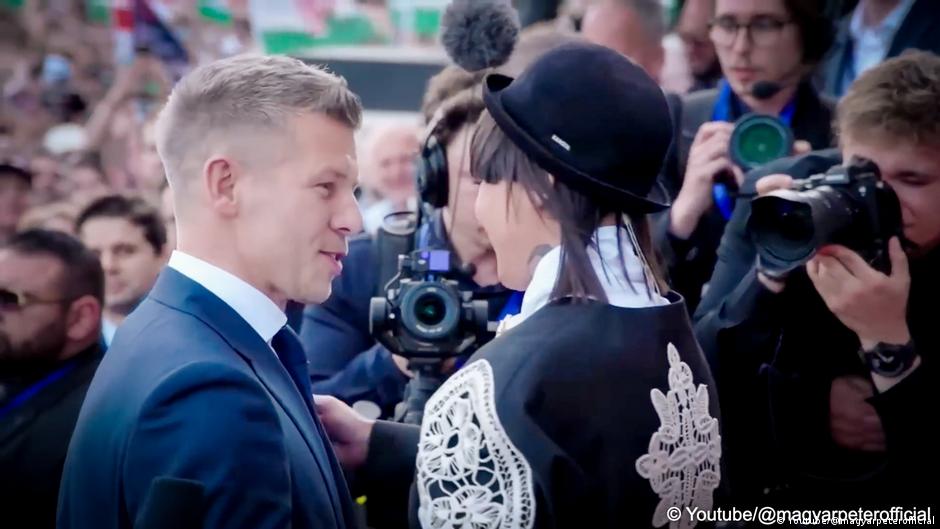
And this was not the only symbolic gesture on this historic day. As the new members of Parliament left the building, Roma singer Ebolia Olah took the stage on the stairs and sang the patriotic song “Magyarország”. For years, nationalists did not want him to sing the song, which begins with the lines: “There’s a country I walked to in my dreams: Hungary.” After her performance, Magyar hugged the singer.
Hungary’s new Prime Minister has an extraordinary ability for symbolic politics, and May 9 is a historic moment not only in Hungary but for the Roma community throughout Europe. Never before in European history had members of this minority been so demonstratively involved in a change of power. This was particularly poignant given the fact that Viktor Orban’s authoritarian regime, which ended after 16 years, was deeply anti-Roma.
The Tisza parliamentary group now includes four Roma MPs. One of them, Krisztián Kőszegi – a teacher and director of a vocational school – is the first Roma person in Hungarian history to be elected deputy speaker of the Hungarian National Assembly.
‘You should be ashamed’: Magyars speak out against antigypsyism
The Magyars have repeatedly spoken out strongly against anti-Zionism. He also condemned the parliamentary faction of the far-right Mi Hazank Mozgalom (Our Homeland Movement) for demonstratively walking out during a demonstration by Roma children. “You should be ashamed!” He told legislators that turning away from children because of their origins is unacceptable.
It reflects a radical change in the tone of Hungary’s Roma community, which officially numbers around 300,000 and unofficially 800,000. Top officials of Orbán’s regime, including the Prime Minister himself, repeatedly insulted members of the community.
In 2012, when he announced a new Roma strategy at a Roma conference, Orbán said, “Everyone must work” because “nobody can make a living from crime.” In January 2026, his Transport Minister, János Lazar, referred to Hungarian Roma as “domestic reserves” who should be used “to clean toilets on our intercity trains – because Hungarian voters are not lining up to clean the mess from clogged toilets.”
In socio-economic terms, a large part of Hungary’s Roma community remains trapped in a caste-like system of state dependence at the margins of society. Roma adults were forced to work in “public work programs”, which did not provide them with better pay and working conditions. Isolation and educational disadvantage became common for Roma children and youth. Roma voters were offered bribes to vote for Orbán’s Fidesz party and corrupt Roma politicians provided legitimacy to the regime.
Tisza pledges to end anti-Roma discrimination
Magyar and his Tisza party have promised to end discrimination. In his manifesto he wrote that Orbán’s regime hates the Roma and does not trust them. It said Tisza was different and announced plans to improve “public works programs”, end segregation in education, and provide better housing and healthcare for Roma.
Although many liberal politicians have made similar promises over the years, it is highly commendable that Magyar is serious.
Several prominent figures in Hungary’s Roma community have said they will wait and see whether the change in rhetoric is followed by action. Well-known sociologist Angela Kocze wrote on the leftist portal Merse that decades of experience have shown that Roma are needed when it comes to legitimizing election campaigns and symbolic moments, but Roma are less likely to be called upon when positions are being filled.
None of the ministers in the new government are Roma, which is disappointing. Education expert Szilvia Szenasy said the principle of “nothing about us without us” should apply.
‘I hope Magyar will take advantage of this opportunity’
Politician and activist Horvath also complained that Roma representatives were not given more say during consultations with the new government. He said there had been a constructive meeting with the new Education Minister but that he had been waiting for weeks to meet the new government commissioner responsible for coordinating the social policy strategy.
Horvath said it was still too early to pass judgment. “The question remains: cosmetic changes to the system or systemic overhaul?” he told DW. “Much depends on Peter Magyar. If he succeeds in convincing the majority that the Roma are as Hungarians as all other Hungarians, he will be counted among the great statesmen. History rarely offers such an opportunity for systemic change as in Hungary. I hope the Magyars will take advantage of this opportunity.”
This article was translated from German.