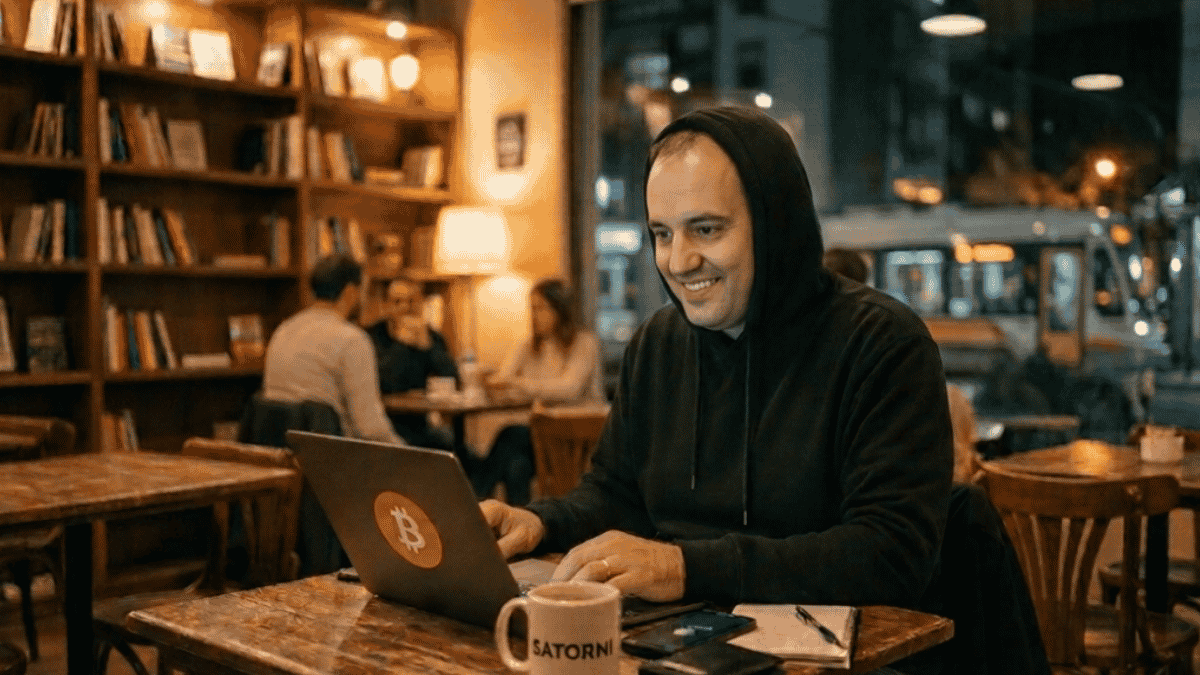
“It seems like they have a crypto magnet,” a friend told me the other day.
Politicians, as is customary, take us for naive (to avoid terms more in line with general indignation). My friend was referring, specifically, to the movements of the national government of Argentina in the last 18 months.
Yesterday was the Libra case. Today the focus is on Manuel Adorni —former presidential spokesperson and current head of the Cabinet of Ministers in Argentina—who in record time went from being under scrutiny for including his wife on a diplomatic trip, to being suspected of illicit enrichment.
But this is the detail that brings us together: in his defense, the official claimed to be a early adopter who has been buying bitcoin (BTC) since 2014.
My goal with this article is not to add fuel to the fire, but to take advantage of this controversial case so that you better understand how Bitcoin works and why that statement makes noise to anyone.
A little context
So that you better understand Adorni’s situation, this is what we have obtained in recent months about him and which represents publicly known information:
- Purchases of properties and renovations for high amounts during their public management.
- Presentation of his sworn statement one day before the World Cup (massive distraction event), after a delay of 35 days without clear justification.
- Inconsistencies in speeches, lack of statements and personal recognition of tax evasion in public interview.
- Application to join the tax innocence regime before submitting the sworn declaration. It is important to clarify that this regime is not the problem, but that it appears to be used in this case to avoid being subject to inspection for aggravated evasion of previous periods.
- He claimed to have purchased bitcoin since 2014 in large dollar amounts.
Again appears the Anti-Corruption Office, whose head is elected and removed by the President and who must be held accountable for the management and, therefore, for these situations. There is no neutrality or impartiality if I have appointed the person in charge of investigating me or my officials myself.
I said this about the Office in my article on the Libra case in 2025 and I will continue to support this idea to the extent that this accountability mechanism does not show a resounding change.
What corresponds is that the verdict is offered by Justice, because that is why we live in a Republic with division of Powers. But we require an impartial and independent Justice with expert experts in the matter, because if I put a judge or a prosecutor in the case who is friendly to the power in power, we will continue in the same maelstrom of complicities.
As usual, a problem of trust appears regarding the honesty of human institutions.
Traceability on the network: is it always simple?
Let’s start from a base that many find difficult to process: the Bitcoin network records information pseudonymously. In fact, the very name of its creator, “Satoshi Nakamoto”, is a pseudonym.
The network is not interested in the identity of the users. To interact, just generate a wallet (even without balance) and you are ready to receive funds. To audit it, however, you only need an Internet connection.
That said, we can distinguish two types of traceability:
- Of origin and pseudonymous permanence: when a user acquires bitcoin through a means that does not allow the funds to be associated with a real identity. The typical case is mining, where the protocol rewards newly issued bitcoins to an address that may have been created five minutes ago and no one knows who it belongs to.
Here’s the trick: you can have an empty wallet associated with your identity and, at the same time, another with a fortune that no one could suspect.
However, if we stop in 2013 or 2014, the context was radically different. Ethereum did not exist, stablecoins They barely appeared and Bitcoin did not have solutions off-chain like the Lightning Network, nor modern obfuscation systems like Silent Payments. There were only the CoinJoinsbut its accessibility was low.
Conclusion: At that time, you had to be a very advanced user to prevent your movements from being exposed for life on the blockchain, whether or not there was a KYC involved.
A message for journalists and economists
There are two healthy ways to communicate in the media: speak with propriety and coherence or, if you do not master the subject, invite a specialist and let him explain without interrupting him every two seconds with cross-questions that only seek sensationalism.
In Argentina neither of the two things is happening, and that conceptual vacuum is the ideal breeding ground for impunity. If the media demonstrates ignorance, anyone who is “lack of papers” will be able to continue evading both tributes and uncomfortable questions.
Try a little harder to incorporate these basic concepts to avoid ridicule:
- A password is used to protect the session of a device or application. To restore access to your cryptocurrencies, it is correct to talk about “recovery phrase” and “keys.”
- A pendrive is a generic file storage. A hardware wallet is a device dedicated exclusively to managing cold private keys. Just because they may have a similar aesthetic does not make them the same.
- Cold storage means that the private keys were natively generated offline and never touch the Internet. If they had contact, we would have a hot wallet.
- “Blockchange” does not exist: someone once crossed the wires between blockchain and exchange, and the error went viral.
“I can’t find the keys”: the infallible tactic
In Bitcoin, I can have very high amounts and claim that I lost access to a wallet. You could use resources such as: “the dog ate the paper with the sentences”, “I had an accident on a boat”, “someone stole them from me”, etc.
Even if that inactive bitcoin wallet started moving funds, there is no way to contradict the defendant if he maintains that another user actually managed to access them, unless a new KYC contact confirms my identities.
Taking this into account, “Satorni” (as they call it now) appeals to the great difficulty of demonstrating those possible purchases and sales. It does not matter whether or not there were wallets with those amounts at that time, because what must be proven is whether they belonged to him and that is not simple if he does not cooperate.
There are 2 components that make it more difficult to verify this:
- In 2014 there were few Argentine exchanges. At that time, Mt. Gox, the largest exchange in the world that processed about 70% of the planet’s bitcoin transactions, went bankrupt. The concentration was maximum precisely due to the lack of platform options.
- Market liquidity was much lower than it is today and a transaction of hundreds of thousands of dollars required to be treated as an institutional or OTC transaction (ORsee The Counter), and not all platforms formally had it.
We are not interested in whether the official has 100,000 or 200 million dollars, as long as the origin is legal. You could argue, for example, that you lost your old recovery phrases and ran out of records, and that wouldn’t complicate it, because it’s common practice and doesn’t constitute a crime.
However, the legal loophole is enormous. Even if it came out to show live accesses and movements of those historical wallets, the million-dollar question would still float in the air: Where did the money for all your operations come from?
That is where the story falls apart, covered by a dozen contradictions between his own words and his sworn statements.
The final message
Politicians have infinite ways more than you and I to dodge bullets. If they do not end up in prison, a simple resignation, disappearing from the public scene for a while or moving to another neighborhood is enough for things to be “fixed.”
As citizens, we are obliged to be critical. Common sense is a very good tool for finding answers, although today it is a totally underrated aspect.
If I tell you that I am not a thief and I repeat it a thousand times, but you have dozens of pieces of evidence against me, the most logical thing is that you will distrust me more every day. The same thing happens with the political story.
Let’s apply the bitcoiner premise for our lives and, more than ever, for politics: don’t trust, verify.
End.
Disclaimer: The views and opinions expressed in this article belong to its author and do not necessarily reflect those of CriptoNoticias. The author’s opinion is for informational purposes and under no circumstances constitutes an investment recommendation or financial advice.