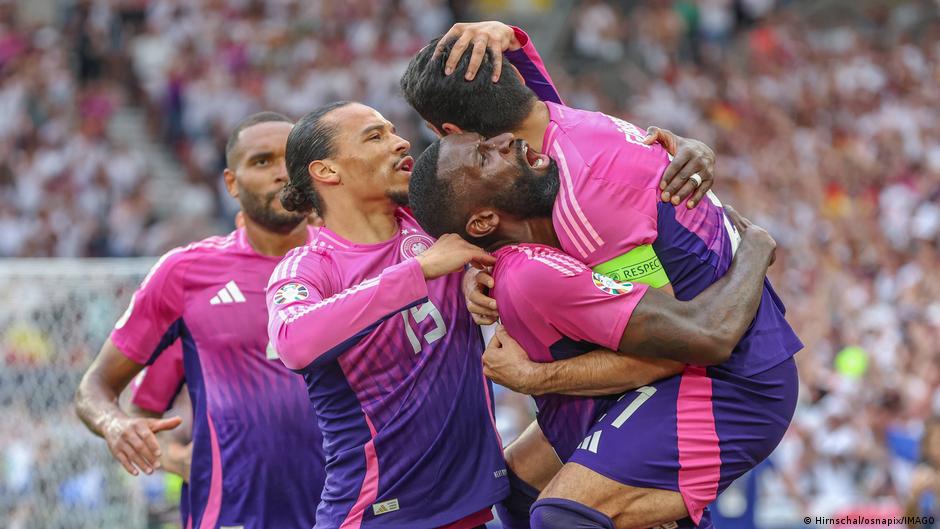
Much of the news regarding Germany’s World Cup squad revolved around the return of Manuel Neuer. But read another story beyond the headlines.
Of the 26 players representing Germany this summer, eight have roots in Africa: Jonathan Tah (Ivorian father), Antonio Rudiger (Sierra Leonean mother), Leroy Sané (Senegalese father), Felix Nmecha and Jamal Musiala (both Nigerian fathers), Assane Ouedraogo (both parents from Burkina Faso), Malik Thiaw (Senegalese father) and Jamie Lewelling. (Ghanian father).
In fact, if you look at last year’s Germany team selection, a total of 17 players of African descent have been called up. The relationship of German footballers with African countries is inevitable and of great importance in the 2026 World Cup.
“Today we have a very diverse team, which symbolizes the new generation of German players,” UN General Assembly President Annalena Baerbock told DW. “This was not always the case,” Baerbock said. “It shows how There are important anti-racism campaigns. A team is always a reflection of the society.”
Diversity is important when it comes to division
Ugandan-British writer and football podcaster Moses Okwonga, who has lived in Berlin for over a decade, believes the timing of this team’s diversity is significant.
“With the far right leading by five, six, seven points in some of the major polls in Germany, I think it’s really important at this time, when a quarter of immigrants arriving in Germany are thinking about leaving again, to show that there are people here who are thriving within this country, who are not white, who have heritage from somewhere else, who grew up here, who moved here,” Okwonga told DW. And made Germany my home.”
The German FA (DFB) has obviously not gone out of its way to highlight the diversity of this team, but recognizes its importance.
“At the end of the day, everyone is united in making decisions with conviction, not in choosing the venue where there is more chance of success in the game,” DFB director Andreas Rettig told DW.
Citing the example of Jonathan Tah, Rettig said, “We were pleased to see the early commitment from the Germany team and it impressed us.”
“We know it from the economy, mixed teams with men and women or different nationalities, young or old, are always beneficial to the final product, so we are happy to have this diversity in the team,” Rettig said.
In early 2025, Tah visited Ivory Coast for the first time since he was 14, telling in an interview with DW that the visit was “extremely important”. Rüdiger has also established a foundation in Sierra Leone.
“Going back to a place where you’ve benefited from Western European colonial extraction, and you’re going to meet your relatives who you were with only two generations ago and who you may have been with, it’s hard for a lot of people,” Okwonga said.
Given that Germany has colonial historical roots in Namibia, Tanzania, Cameroon, and Togo, to name but a few, it is clear why connecting to both one’s native country and one’s new home comes with conflicting and complex emotions. Okwonga believes the visibility of football players who have African roots is an important symbol, but he is equally proud of his home in Germany.
Impact beyond football
In preparation for Euro 2024, Germany head coach Julian Nagelsmann called for a survey by the German public broadcaster WDR It revealed that 21% of those asked wanted more white players in the national team.
Nagelsmann said, “A football team can be a perfect model of uniting different cultures, religious backgrounds and skin colors. It’s as good as it is right now. We play the Euros for everyone in the country and anyone who plays top football is invited to become a member of the national team.”
His sharp stance on non-football matters was notable, as the symbolic value and influence of the German team and football is widespread.
Okwonga said, “In 12 years of being here, the team I saw at the Euros was the best version of the Germany team. In terms of the football they played, how they worked together, how they supported each other. It’s everything you want from a football team, a collective, a community.”
Clearly, a lot has changed since Gerald Asamoah became the first African-born German to compete in the World Cup in 2006. But the issue still persists, as evidenced by incidents in 2023 when two Germany youth international players of African descent were bombarded with racist comments on social media after missing a penalty. Systemic issues may be rectified by policies, not the actions or words of a football team, but that doesn’t make their symbolism any less important.
“I think it’s really not about the diversity of this team that people hate to see it. It’s about modeling the fact that friendships are totally possible across all groups,” Okwonga said. “If they don’t win, it’s not because the multi-ethnic project failed. It’s because they were beaten by a better team.”
What would a World Cup win for Germany mean?
Germany are certainly not favorites for the World Cup this year, but there will be an obvious temptation to consider the social and political impact on the country if they win it. Can it bring the happiness we saw in 2014 or 2006 when Germany hosted a tournament and enjoyed a “summer fairy tale” despite not winning it?
“If Germany wins the World Cup, it is primarily a victory for this group of players and the supporters who have been behind them. I don’t think it’s an issue of political advantage in the progressive sense, because I think there are too many other things going wrong in Germany at the moment,” Okwonga explained.
“I think the success of a diverse team on the football field can be a catalyst in the right political context. Unfortunately, I don’t believe that’s the right context.”
With or without the right context, this Germany team’s diverse heritage needs recognition.
Edited by: Chuck Penfold