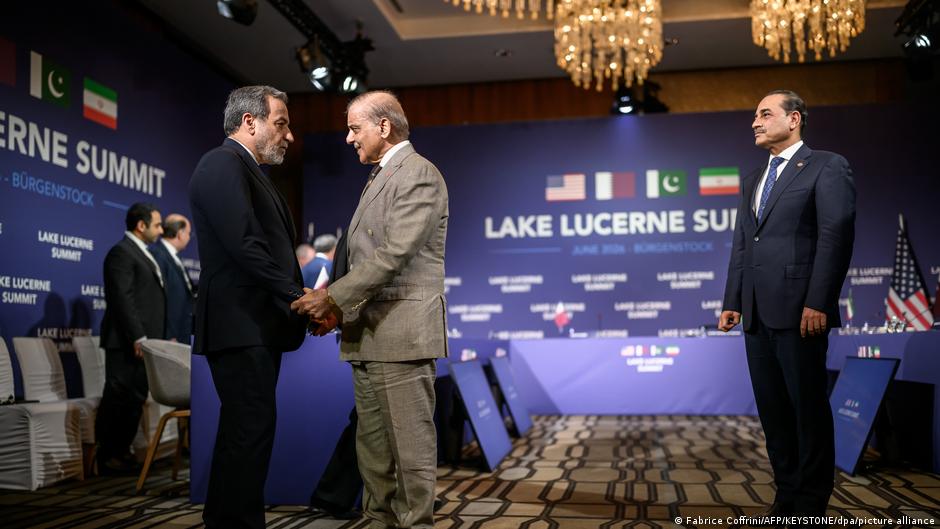
The US-Iran deal, which serves as the foundation for the ongoing talks in Switzerland, is a significant diplomatic achievement for Pakistan, perhaps the most significant in the country’s modern history.
“Pakistan was able to effectively leverage not only its ties with Tehran and growing closeness to Washington but also its network of regional partners such as Qatar, Saudi Arabia and Turkey,” Farwa Amer, director of the South Asia Initiative at the Asia Society Policy Institute in New York, told DW.
“This gave greater diplomatic importance and international support to Pakistan in its mediation role,” he said.
Islamabad also boasts close ties with China – no easy feat on a continent rapidly being shaped by Washington-Beijing rivalry.
“Pakistan’s patient diplomacy was crucial in getting the US-Iran deal across the finish line, although its long-term impact will depend on the durability of the agreement as difficult negotiations continue,” Elizabeth Threlkeld, South Asia director of the Washington-based Stimson Center, told DW.
He praised Islamabad for balancing relations with the US and Iran while keeping key Gulf partners and China on board and “helping find formulations that work for all parties”.
Trump described Pakistan’s Munir as his ‘favorite field marshal’
But good working relationships with regional and global powers were just a starting point. The Pakistani government has been pursuing a pragmatic diplomatic strategy towards Tehran, with Pakistan’s most senior military commander Asim Munir and Prime Minister Shehbaz Sharif both visiting Iran in May 2025, just weeks before the short-lived conflict with Israel that ended with the US bombing Iran’s nuclear facilities.
“Asim Munir and Shehbaz Sharif both visited Iran that summer. In my view, that’s when the Trump administration first started to recognize that the Pakistanis could be a viable and credible mediator,” Michael Kugelman, senior fellow for South Asia at the Washington-based Atlantic Council, told DW.
Notably, Army chief Munir has left a positive impression on Donald Trump, with the US President repeatedly praising him as a “great fighter,” “an extraordinary human being” and “my favorite field marshal.”
Pakistani leaders had a lot to lose as the US-Israel conflict and Iran escalated into an all-out regional war. Pakistan shares a border with Iran and is heavily dependent on Gulf trade routes, so prolonged instability could lead to refugee flows, economic disruption and security challenges on its western border.
Pakistan works with Washington, Tehran
Once the US and Israel launched new air strikes against Iran in late February, Sharif’s government began to engage in an intensive diplomatic effort involving shuttle diplomacy, direct contacts with Washington and Tehran, and coordination with regional capitals.
While Munir and Trump discussed the conflict over the telephone on March 22, Prime Minister Sharif spoke to Iranian President Massoud Pezeshkian the next day. Sharif then floated Islamabad as a possible destination for direct talks between Washington and Tehran.
In early April, Pakistan announced a preliminary ceasefire between the two warring sides, and then hosted a delegation led by US Vice President JD Vance and Iranian Parliamentary Speaker Mohammad Bagher Qalibaf for a marathon talks session on 11 April.
Despite peace talks eventually being moved to Switzerland, the Pakistani government repeatedly emphasized its mediatory role over the following months. As fighting in Lebanon threatens the peace process, Pakistani Interior Minister Mohsin Naqvi visited Tehran twice last week.
Support from China and Gulf countries
Many voices have speculated that Pakistan may only act as a mediator due to China’s strong support. Beijing has ties to Tehran and needs stability in the Gulf to keep energy imports and regional trade routes open. Chinese officials have publicly supported Islamabad’s diplomatic initiatives and encouraged efforts to de-escalate tensions.
Kugelman said, “I think the role of China and the Gulf countries is important here. One must give credit to Pakistan for its role as a key mediator, but it cannot do it alone. It will never happen.”
Kugelman underlined, “When (Pakistan Foreign Minister) Ishaq Dar went to Beijing several weeks ago, this joint proposal for peace came out. That was the moment when China formally signed on to the Pakistan-led peace process, and that meant the Iranians knew that China was getting involved in the process. China benefits Iran in a big way because of its economic clout, because of importing energy from Iran, etc.”
Analyst Farwa Amer says China has played no direct role in Pakistan’s diplomatic effort, but warns that Beijing’s influence cannot be ignored.
“The Pakistani leadership deceived China the whole time and Qatar was another major but influential player in this process,” he said.
Countries like Qatar and Saudi Arabia have strong incentives to avoid a protracted conflict, which threatens energy markets and maritime traffic through the Strait of Hormuz.
Qatar, in particular, has now positioned itself as a second mediator in the conflict, with officials attending US-Iran talks in the luxury Swiss resort of Bergenstock.
Is Pakistan a proud ambassador between America and Iran?
Diplomatic sources familiar with the talks say Pakistan’s role extends beyond mediation between the warring parties.
“Pakistani officials helped identify areas of agreement, coordinated draft proposals and worked to keep the lines open during several moments when talks were close to breaking down, and maintained contact with both sides throughout the crisis,” a senior diplomatic source in Islamabad told DW.
Atlantic Council analyst Kugelman agrees that Pakistan was not merely an envoy in the US-Iran talks, pointing to Army chief Munir and his direct involvement in the Islamabad talks.
“Three-way discussions were taking place that go far beyond the role of a country sending messages between two parties. This is direct mediation,” Kugelman said.
Kugelman commented, “US Vice President JD Vance even commented that he has spoken to Field Marshal Asim Munir more than anyone else in the last few months. Such statements reflect the depth of Pakistan’s involvement in this process.”
Vance joked about Pakistan’s Munir
In fact, Vance’s comments on Munir went much further this Sunday, when the US vice president praised the Pakistani army chief as a “great diplomat.”
“We would not be here without his political acumen and military leadership,” Vance said, also drawing a comparison between Munir and his wife Usha, the daughter of Indian immigrants to the US.
Vance said, “As Field Marshal Asim Munir welcomed us to Islamabad with the Prime Minister, I joked that there are two very important people in my life. An Indian and a Pakistani. The Indian is my wife, and the Pakistani is Field Marshal Munir.”
Edited by: Srinivas Majumdaru