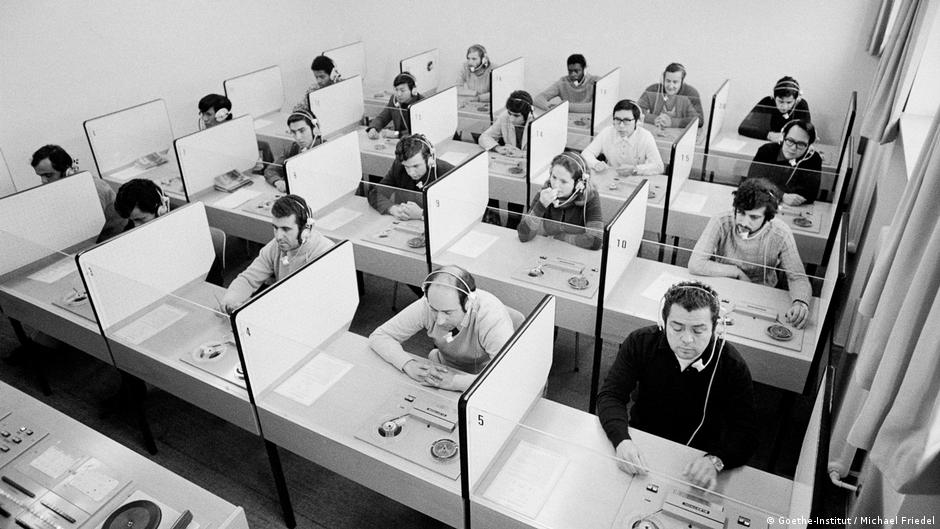
Shortly after speaking to DW, Gesche Jost, who serves as president of the Goethe-Institut through 2024, traveled to Mexico with German Foreign Minister Johann Waddefull.
The Goethe-Institut in Mexico City is one of the largest in the world and, in Jost’s view, exemplifies the work of the institute.
“Latin America is an incredibly important region for Germany and we maintain a very strong partnership there,” explains Jost. “Mexico is one of our key partners, especially when it comes to attracting skilled workers.”
The Goethe-Institut prepares young Mexicans interested in pursuing careers in fields such as nursing or engineering in Germany not only through language courses, but also by providing information about everyday life and culture in Germany.
“For me, the Mexico branch embodies everything that the Goethe-Institut stands for,” says Jost.
A difficult beginning after World War II
For 75 years, Goethe Institute Has worked to represent Germany abroad and promote the German language and culture around the world. It was founded in 1951, at a time when Germany needed to regain international trust after World War II and crimes committed under National Socialism.
Initially established as Goethe e.V. for further training of foreign German teachersThe association invited foreign German teachers to Germany for language training courses.
But before long, the focus shifted to teaching German abroad. The first Goethe-Institut opened in Athens in 1952, and only 10 years later there were already 54 branches abroad compared to 17 in Germany.
Today, the Goethe-Institut operates a global network employing just under 4,400 staff at 154 locations in 100 countries. Approximately 1 million people take the official German language test annually through the Goethe-Institut, or one of its partner organizations.
From classical culture to jazz and literature
The credibility of the Institute as an independent association was key to its success from the very beginning. Although two-thirds of its funding comes from Germany’s Foreign Office, it develops its programs independently – and has constantly adapted them to reflect the spirit of the times and the political climate.
Beyond language learning, cultural programming and public engagement were intended to help convey a broader picture of Germany.
“[But] “It wasn’t about exporting so-called German culture to the world,” says Jost. “Rather, it was about asking how we can make a new start – and how we can shape society and the future together.”
In the early years, the Institute consciously drew on Germany’s classical culture, the Nazi era failing to diminish the international appeal of figures such as Schiller, Bach and Beethoven.
By the 1960s, German jazz had become one of the Goethe-Institut’s most successful cultural exports, along with literature, with Nobel Prize-winning writers Günter Grass, Heinrich Böll and Herta Müller touring on behalf of the institute.
Amid the social turmoil and student protests of the 1968 generation, the Goethe-Institut engaged more deeply with social and political issues, including confronting Germany’s Nazi past.
dialogue and mutual learning
The Goethe-Institut was also moving away from its focus on cultural export towards principles of dialogue, cooperation and mutual learning. That approach continues to shape its work today.
During the Cold War division of Germany, East and West Germany also competed for political alliances abroad through cultural diplomacy.
In the 1970s, the East German media also spread rumors that the Goethe-Institut was a spy organization.
But after the fall of the Iron Curtain in 1989, the institute opened several new branches in Eastern Europe and the former Eastern Bloc countries, including Moscow.
After Russia launched its invasion of Ukraine, the Russian Foreign Ministry ordered a significant reduction in the number of Goethe-Institut employees in the country – although its work there continues.
The same is true in Ukraine, where the Kiev Institute remained open throughout the war. It offers a flexible, hybrid model for German-language courses: When air-raid sirens sound, individual classes go into shelter.
Key partners in crisis areas
“I think working in crisis situations has become the norm in many areas,” Jost says of the institute’s global reach. “Either because democracy is being curtailed, because our allies are working under censorship conditions – or because they are at risk of armed conflict.”
“We have come to see ourselves as key partners for civil society in crisis areas,” says the institute’s president. “At the same time, we have to act with sensitivity and diplomacy to avoid being forced to leave.”
The Goethe-Institut is committed to providing a space for open debate, critical thinking and cultural exchange. But the German government’s stance on the Middle East conflict is making this difficult at the moment.
The institute faces a boycott and suspension of cooperation in parts of the Arab world, with critics arguing that pro-Palestine advocacy is being suppressed.
“Our job is to explain the situation in Germany and the history behind it,” says Jost. “But also to show the debates taking place in Germany. And we also convey criticism from many countries to Germany.”
The work of the Goethe-Institut has been challenged in recent years by significant cuts in federal funding, forcing a restructuring process that also included the closure of some branches.
And as Germany faces new challenges in integrating the growing number of international skilled workers, Jost sees the institute playing an important role in that effort.
“We can see that many foreign skilled workers envision a future in Germany. But settling in Germany is not always easy,” she explains, which is why the institute provides guidance for newcomers on how to live and work in Germany.
The Goethe-Institut celebrates its 75th anniversary under the motto we in the world (“We in the World”), and celebrating with partners around the world.
The programme, which is already underway, includes concerts, performances, film series and discussion programs – details can be found Here. The highlight will be an official ceremony at the Haus der Berliner Festspiele on June 23, 2026, attended by the President of Germany and several international guests.
This article was originally written in German