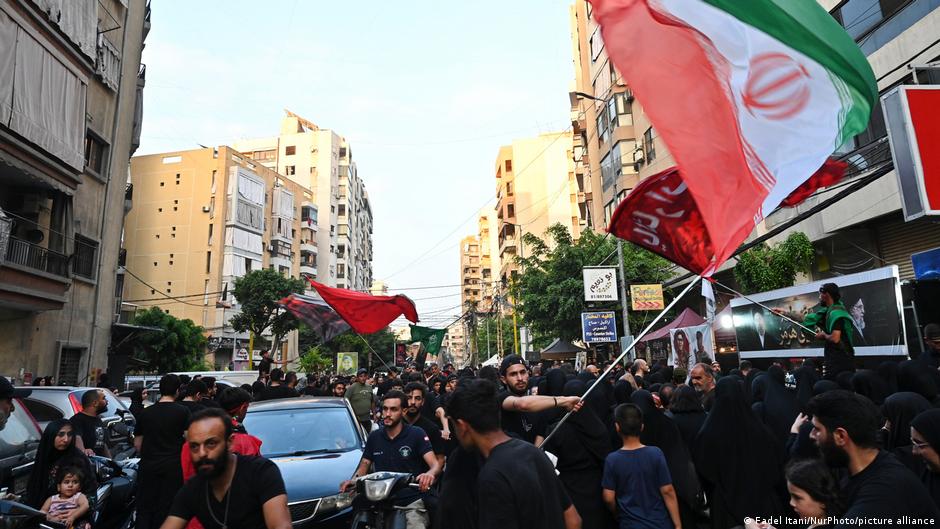
As Lebanese government representatives begin another round of talks with their Israeli counterparts in Washington this week, their country finds itself in an impossible situation.
In Lebanon, fighting between local militant group Hezbollah and neighboring Israel has displaced more than a million people, killed thousands and caused about $1.4 billion (€1.2 billion) in damage.
Israel says it plans to remain in a “security buffer zone” there so that its own citizens in northern Israel are safe from Hezbollah attacks.
Iran, which supports Hezbollah in Lebanon, wants the fighting there to stop and has made respect for Lebanese sovereignty a condition of the memorandum of understanding it signed with the US last week. The Iran-US-Israel memorandum began in late February.
Neither Israel, Hezbollah, nor Lebanon were involved in those talks.
That is why the Lebanese government views the strategy of bringing Iran into a peace agreement as a violation of its sovereignty. Lebanon is trying to negotiate directly with Israel to end the conflict. Both are discussing how to neutralize Hezbollah. Critics of the talks, another round of which is taking place in Washington from June 23 to 25, say what Israel wants is to leave Lebanon at the mercy of its neighbor and if the Lebanese army is forced to directly confront Hezbollah, it could spark a new civil war in Lebanon.
All this leaves Lebanon with a difficult choice: Iran or Israel? Neither option offers much chance of lasting peace or economic recovery for the small Mediterranean nation.
a better option
Michael Young, senior editor at the Carnegie Middle East Center in Beirut, believes there may be an alternative. In June 18 remarks, he wrote about the potential of the solution first presented by Egyptian diplomats late last year. Egypt’s proposal or framework is gaining increasing support from other countries in the region, including Saudi Arabia, Qatar and Turkey as well as Pakistan in the role of mediator.
Young writes that the countries involved want neither Iran nor Israel to dominate the region.
Young explains that the Egyptian-backed framework outlines a three-phase process of “an organized, gradual transition” for Hezbollah.
This includes ending the group’s cross-border activities, integrating Hezbollah fighters into the Lebanese army, and integrating Hezbollah social services into the Lebanese state. The end result would be “the transformation of Hezbollah into an exclusively political and civilian entity”.
At the same time, the framework also requires a change in the way Lebanese politics work, shifting them from a sectarian system based on assigned roles for certain demographics – for example, Lebanon’s prime minister is always a Sunni Muslim, the president a Maronite Christian and the speaker of parliament, a Shia Muslim – toward a more fluid, more equal power-sharing system.
Young suggests, “It would make sense for Lebanon’s president and prime minister to acknowledge this possibility and momentarily abandon their insistence that Iran should play no role in anything that affects Lebanon.” As have other observerstoldThis requires moving beyond black-and-white thinking that would require Lebanon to surrender to Iran or Israel.
Can the plan work?
In the past, similar plans – particularly those aimed at changing Lebanese politics – have come to naught. But because of the Iran war, the entire Middle East is changing and this could make such a proposal more plausible, argue its supporters.
With its blockage in the Strait of Hormuz, Iran has shown that it does not need proxies like Hezbollah for forward defense. So it may be more willing to compromise on that, Young argues.
report in local media That said, beyond the headline-making US-Iran talks, parallel efforts are also taking place in regional diplomacy. This includes efforts to restore confidence with Iran and talks about prospects. non-aggression pact With Iran. This is important because Iran’s network of proxies was a kind of regional insurance policy. Better regional relations make them less necessary.
Another change: The US is pressuring Israel to help Lebanon maintain its deal with Iran.
Hezbollah was founded in 1982 with the support of Iran to oppose the Israeli occupation of Lebanon at that time. Its popularity among Lebanon’s Shia Muslim community is partly based on it being viewed as a resistance movement.
Earlier, a major issue in Lebanon’s recent efforts to disarm Hezbollah was that regional expert Mohannad Hage Ali said that “commitments related to Israel” were not safe. Written for the Italian Institute for International Political StudiesOr ISPI.
And Israel’s presence means Hezbollah can continue to present itself as defending the country and its community. But if Israel withdraws, it will affect Hezbollah’s core objective.
Israel this week insisted it would continue its occupation of southern Lebanon. However also this week, Israel’s most important ally, the US, supported the creation of a “de-conflict cell” to monitor an end to the fighting in Lebanon. The cell includes representatives of Lebanon, the US and Iran, but not Israel. and this New York Times reported Israeli troops in Lebanon have already been given new orders to de-escalate tensions.
Hezbollah give up guns, become political
ISPI researcher Luigi Toninelli says Egypt’s plan certainly has some positives.
“This is essentially the latest attempt to address Lebanon’s most important issues through agreement between different parties,” he told DW. “Iran may ultimately decide to support the disarmament of Hezbollah while preserving it as a political party and at the same time securing greater political influence for the Shia community within Lebanon. In principle, this is a positive development.”
More challenging will be the integration of Hezbollah fighters into the Lebanese army and whether Israel accepts this. And at the same time, unless the Lebanese state is strengthened, all this will be difficult, Toninelli adds, because there is so much intense competition over the small country.
He explains, “Arab countries want to disarm Hezbollah, yet they do not want Beirut to negotiate with Israel, or even recognize it.” “Iran aims to preserve its sphere of influence… and Israel wants to strengthen its regional hegemony, which includes Lebanon.”
Faysal Itani, a senior fellow at the Washington-based Middle East Policy Council, has similar concerns.
In principle, the proposal supported by Egypt and others is fine, Itani says, but its success will ultimately depend on how willing everyone is to play along.
“In theory, [the framework] That’s right,” Itani told DW. “The problem lies in its underlying expectations – that Hezbollah will respond. I don’t believe that would happen, unless he was weak and desperate. And we’re not there yet.”
He added, “And is it practical to assume that Iran will respond by retreating from Hezbollah?” “I think it’s almost non-existent as a possibility. I don’t believe the incentives are really there. That’s an optimistic reading of the Iranian perspective on the situation. “I don’t believe that hegemonic actors, even ones bound by agreements with the US, would willingly give up such strategic assets.”
Edited by: Andreas Illmer