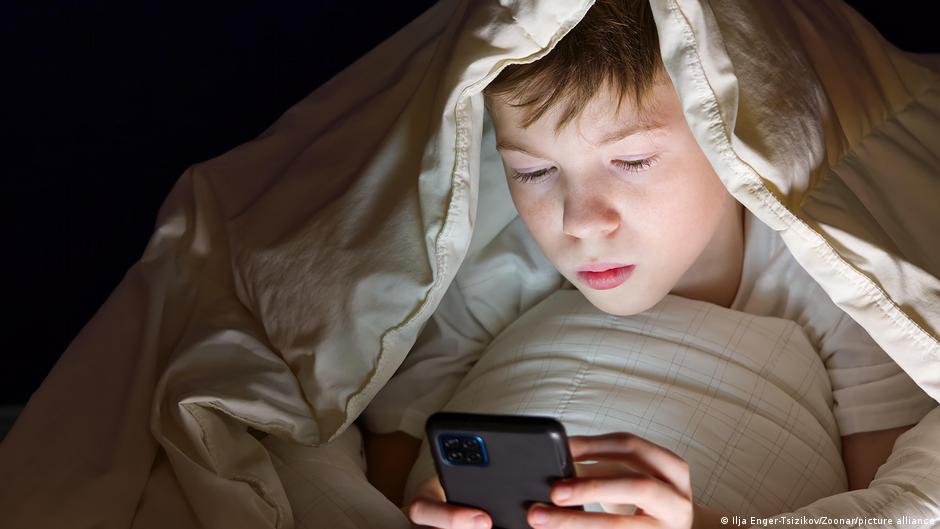
Leni realized two years ago that she was on her smartphone too much. She rarely left her room to interact with her parents, stopped going out on weekends and found that she sometimes spent 10 hours a day on TikTok and YouTube.
“I noticed that I really neglected school and didn’t study as much as I used to,” the now 18-year-old told DW. “I started monitoring the time I spend consuming media on my phone, put my device away more often and no longer cancel plans to meet up with my friends in favor of just being on my phone. Now, on average, I spend about five hours a day consuming media.”
Leni’s situation is daily life for a large portion of teenagers growing up in Germany. According to recent OECD findings, 15 year olds in germany Spend about 48 hours per week in front of a screen – an average of about seven hours per day. Compared with 36 other countries, Germany ranked fifth in terms of screen time, behind Poland and Estonia. one more Study by German health insurance provider DAK showed that 1.5 million young people in Germany use social media to a problematic extent, and about a quarter of these, 350,000, are considered addicted.
These early statistics have prompted repeated calls for a ban on social media for youth in Germany. It would follow the example of Australia, which in December was the first country to ban social media use for children under 16.
Lenny thinks it’s a good idea. “It will provide a little more protection to children and young people. I’ve noticed that there are things on TikTok, Instagram and YouTube that are not regulated at all,” he said.
Expert commission calls for stronger controls for online platforms
Earlier this week, an independent expert commission released eagerly awaited recommendations on how to better protect children and young people in the digital world.
Nadine Schön, co-chair of the commission, said, “We are seeing how digital media radicalises our democratic discourse and impacts the development of children and youth. We see that screen time is increasing. And we see that children and adolescents are more often suffering from drug addiction.” “We want platforms to be more accountable, so that they can enable participation, but also provide more security than they do now, for example with age verification.”
Key points of the Commission’s 56 recommendations:
- Platforms and providers should be held more accountable for their content
- Safe default settings for minors, with age-appropriate offerings
- Clear and simple ways to report problematic content
- Parental responsibility for digital education should be enshrined in law.
- Smartphone use will be banned in schools until class seven, when children will be around 12-13 years old
Prien, the education minister from the conservative Christian Democratic Union party (CDU), has also advocated for an age limit, which should preferably be set by the EU.
“The proposal for a legal minimum age of 13 for free use of social media is the right way forward,” he said, adding that he also called for effective age verification and phased-in safeguards for youth until they turn 18.
disconnect between parents and children
Florian Buschmann also supports banning social media for children under 13. As a teenager, he was deeply immersed in the world of computer games. He played the online first-person shooter game Warface for up to 16 hours a day – as he now feels, “a prisoner of this virtual world.”
It gained popularity after a student exchange in Romania, where he played with dogs and participated in campfires, rock climbing and activities with other youth. He realized that the time had finally come to break free from his media addiction.
Bushman later wrote a guidebook called “Ade Avatar” (“Goodbye Avatar”), so that others could follow his example and break free from digital dependency. Now 25, he leads an initiative called “Offline Heroes” in which he and his team visit schools across Germany. So far this year, he has made 534 appearances; The latest event this week attracted 1,300 concerned parents.
“Many people don’t know how to communicate with their child in this situation,” she told DW. Also, she said, it’s important for parents to set clear rules regarding media use.
“Many policy ideas come too late. We are currently chasing social media, but we are already moving toward the next issue of artificial intelligence and deepfakes. Again, we must ask ourselves: ‘How long has it taken us to be able to take action and actually do something?'”
Porn addiction, online debt is increasing
Andreas Pauli struggles with screen addiction every day. Social education worker manages a Cologne-based organization that focuses on preventing media addiction (“Media Addiction Prevention NRW eV.”) He is currently training new “Internet Pilots” teenagers who will be able to educate their friends and classmates about the responsible use and dangers of digital media.
“We have seen two new growing phenomena: on the one hand there is addiction to pornography; on the other there is uncontrolled consumption in terms of purchasing and spending,” he told DW. “Some 17-year-olds are already €10,000 [$11,400] In debt. This is also because payment platforms like PayPal have no idea about this.”
Leni also freelances for the organization, sharing her experiences. Pauly said so-called “peer multipliers” connect better with children and teens who are addicted to or are becoming addicted to media. Their current campaign is called “One Day Off” and it challenges participants to stop using smartphones for 24 hours on July 7th.
“Every year we organize a surfing camp, where after four days the kids always say: ‘Without the media it’s totally cool, much less stressful, I can actually talk to people again,'” Pauley said. “We need more places for young people to experience things together. A colleague recently said that we need to make the real world more beautiful again, so that they don’t escape into the virtual world.”
This article was originally written in German.