For decades, Indian citizenship was rarely questioned. Most people voted, obtained passports, enrolled in welfare schemes and lived their lives without demonstrating that they were in the country where they were born. That perception is constantly changing.
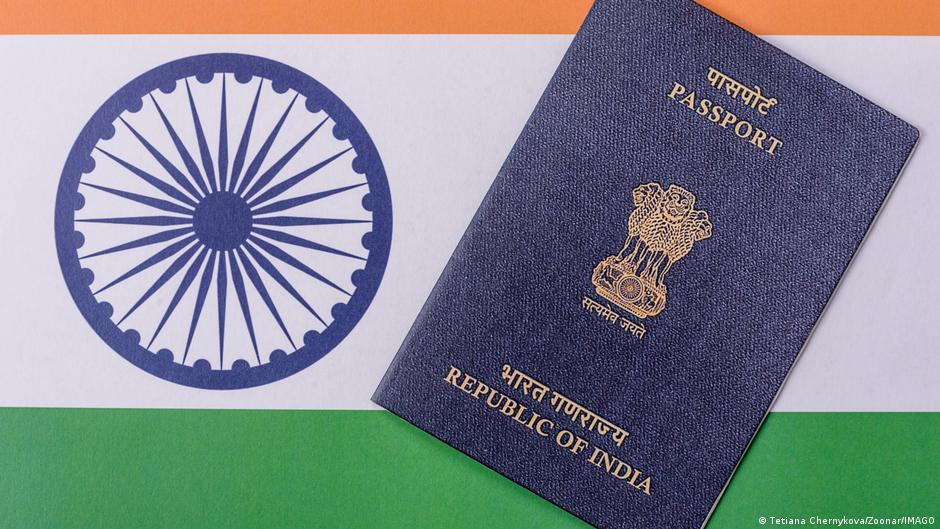
According to Indian media reports, last week, a senior official of India’s Ministry of External Affairs (MEA) said that the Indian passport is primarily a travel document and should not be considered as conclusive proof of citizenship. Legally, this distinction is not new.
Former diplomat Veena Sikri says the Home Ministry – not the External Affairs Ministry – has the sole authority to grant and determine citizenship.
“The passport is an attribute of citizenship, but it does not confer it,” Sikri told DW.
The reported statement by the External Affairs Ministry official comes at a time when citizenship itself has become one of the most politically contentious topics in India.
It also coincides with the ongoing Special Intensive Revision (SIR) of voter lists by the Election Commission in several states and territories, including Bihar, one of India’s largest states by population, and West Bengal, where Prime Minister Narendra Modi’s party recently won state elections.
The Election Commission of India (ECI) said “thorough vetting” is needed to remove ineligible voters, but critics say it goes against marginalized and minority communities.
Members of Modi’s Hindu nationalist Bharatiya Janata Party (BJP) have long claimed that large numbers of undocumented Muslim immigrants from neighboring Bangladesh have fraudulently entered India’s voter rolls.
No proof of citizenship
India’s citizenship law does not provide most people with a single document that conclusively proves their status.
Instead, different documents serve different purposes. Aadhaar biometric card establishes identity for welfare and public services. Voter ID card enables electoral participation. Passport certifies nationality for international travel. Birth certificates, school records and land documents may all be relevant in different circumstances.
Senior lawyer Rebecca Mammen John, who has closely studied the issue, says the real problem is that India has no universal document that conclusively establishes citizenship.
“Under the Passport Act, a passport is issued only to an Indian citizen, yet the government does not issue any separate citizenship certificate to people who acquire citizenship by birth or descent,” he told DW.
Recognizing that a passport may not always be conclusive evidence in exceptional circumstances, he said the timing of the clarification had unnecessarily heightened public concern.
He said, “At a time when citizens are already struggling with SIR and the National Register of Citizens is being debated repeatedly, the government has raised doubts about the document that most Indians consider the ultimate proof of belonging without offering any alternative.”
Overall, the various identity documents held by most Indians generally leave little room for doubt. However, individually, none are recognized in law as conclusive proof of citizenship.
That legal distinction has taken on new importance as official scrutiny of documents has intensified.
For many Indians, collecting documentary records is not always easy. Millions of people were born before birth registration became widespread.
Families have repeatedly migrated for work. Land records are incomplete in many parts of the country, while school certificates may have been lost decades ago.
politics of documentation
Faizan Mustafa, vice-chancellor of Chanakya National Law University in Patna, the capital of India’s Bihar state, says the bigger concern is that citizenship is increasingly being determined through documentation exercises.
“I think anyone born in India and having Aadhaar should be considered a citizen because Aadhaar is issued after taking biometric data,” Mustafa told DW.
“The absence of universally accepted proof of citizenship creates uncertainty for ordinary Indians and leaves room for arbitrary challenges to their status,” Mustafa said. “Low level executive officials should not be given the power to determine someone’s citizenship.”
Mustafa argues that the burden of proof should work the other way.
“If the state has issued someone a passport or enrolled them as a voter after official verification, these documents should be considered as conclusive proof of citizenship,” he said. “Except in cases of fraud, the burden of proving otherwise should be placed on the government.”
Passport row highlights documentation gap
The ongoing passport controversy is also a reminder of the proposed National Register of Citizens (NRC), part of the Modi government’s effort to identify and expel people who came to India illegally.
It has already been implemented in the northeastern state of Assam, resulting in the exclusion of nearly two million people, including both Hindus and Muslims, from Indian citizenship.
The NRC debate quickly converged with the controversial Citizenship Amendment Act (CAA) enacted by Parliament in 2019.
The CAA fast-tracks the Indian citizenship applications of Hindu, Sikh, Buddhist, Jain, Parsi and Christian immigrants who came to India fleeing religious persecution in Muslim-majority Pakistan, Bangladesh and Afghanistan.
The Supreme Court has drawn an important legal boundary.
While upholding the right of the Election Commission to modify the electoral roll, it has made it clear that determination of citizenship is beyond the powers of the Commission. It says that removal of name from the voter list does not result in loss of citizenship.
Yet the passport controversy has largely brought the legal debate into the public sphere.
This has exposed a fundamental gap in India’s citizenship structure. While millions of people have passports, voter ID cards and Aadhaar, there is still no single document that conclusively establishes citizenship for most Indians.
Edited by: Keith Walker