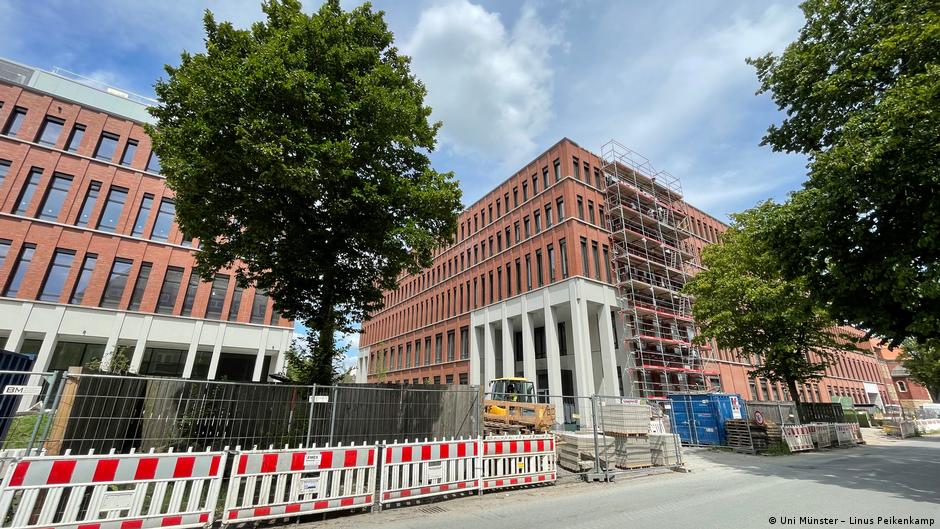
Since 2021, work has been underway on a new “complex of religions” in the western German city of Münster. Much of the site is still under construction. Scheduled for inauguration in 2027, the campus will bring together in one place the Faculties of Catholic, Protestant and Islamic Theology, as well as the Department of Religious Studies.
The Faculty is a milestone: for the first time in Germany – and indeed in Europe – a public university is home to an independent Faculty of Islamic Theology.
“I am privileged to be part of a unique chapter of history,” scholar Mohannad Khorchid told DW. Looking back at his 15 years of work at the University of Münster, he said that this achievement fills him with deep gratitude. At the same time, the 54-year-old also stressed on the responsibility that comes with it.
“We want to make the most of this unique opportunity and advocate for an open-minded, enlightened understanding of Islam.” According to Khorchid, the faculty’s work will have an impact not only on Europe but on the entire Muslim world.
a new chapter
From July 1st, a new chapter begins for Khorchaide. However, for the time being he will continue to work from temporary university offices near Münster’s Paulus Cathedral. Until now, the sociologist and religious teacher has led the Center for Islamic Theology (ZIT) at the University of Münster. He is now the founding dean – the first dean of the newly established Faculty of Islamic Theology.
The granting of full faculty status gives Islamic Theology a new status within the University and represents an important academic policy milestone. Until now, ZIT lacked faculty status of its own and was therefore dependent on other faculty for important academic functions.
Increase in Islamic religious education
As an independent faculty, Islamic Theology can now offer doctorates and habilitation in its own right, helping to prepare a new generation of scholars and establish a lasting academic legacy. The new status is also expected to make it easier to secure third-party research funding.
Khorchid recalls the early days of ZIT in 2012, when it had just 15 students and three staff members. Today, the center employs eight professors and more than 50 staff members, and Khorchid expects the number of students to exceed 500 in the coming years.
They expect high demand. Throughout Germany, Islamic religious education is being introduced into public schools, increasing the need for qualified teachers.
For example, North Rhine-Westphalia, Germany’s most populous state, where Münster is located, has a need for 3,000 teachers, but only 330 currently exist. For graduates, it provides a clear career path.
Islam and social work
Starting in 2027, Khorchid plans to launch a master’s program called “Islam and Social Work”. He says there is strong demand for this specialism, particularly in areas such as youth services, hospital chaplaincy and elderly care.
Among its guiding principles, the Faculty affirms the compatibility of faith and democracy, promotes scholarly and contemporary studies of the Quran, and emphasizes interreligious dialogue. It also clearly rejects extremism, anti-Semitism and Islamism. “We oppose every form of religiously motivated violence and ideological manipulation,” the document states.
Links to Asia and Africa
Khorchid says he has been impressed by the level of interest generated since news of the new faculty was made public. Media outlets as far away as Africa and Asia have reported on developments. He specifically points to Indonesia, the country with the world’s largest Muslim population.
“People want an open-minded Islam,” says Khorchid, who believes that in the long term, Münster can help shape the broader debate on the future development of Islam beyond Germany.
“Munster has traditionally been strong in theology,” university spokesman Norbert Robers told DW. Now, for the first time, the two Christian Theology Faculties and Islamic Theology are being brought together under one roof, sharing a library and a cafeteria. “It has great symbolic power.”
Europe’s first Islamic theology department in a public university
A Faculty of Islamic Theology has long existed in Bosnia, but it is not part of the public university structure. Münster is therefore now home to the first faculty of Islamic theology in a public university in Europe.
Robbers, TA university spokesperson says the upgrade to faculty status may appear to be a “pure administrative act”, but it has significant legal and institutional significance. A formal inauguration is scheduled for September 24 in the main hall of the university.
Annette Schwann, a politician from the center-right Christian Democratic Union party (CDU), served as Federal Minister of Education of Germany from 2005 to 2013. He played a key role in the establishment of Islamic theology in German universities and described the current move as a “milestone”. Writing on Catholicism based in Cologne cathedral radioOn the portal in mid-June, he argued that the opening of the Faculty of Islamic Theology represents “the strengthening of academic theology as a whole” and predicted that the new faculty would be recognized throughout Europe.
This article has been translated from German.