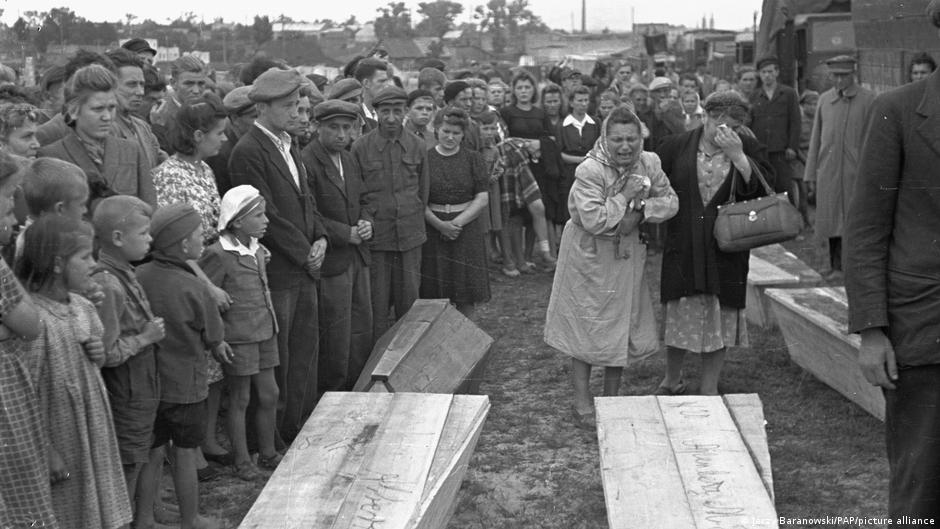
Eighty years ago, the city of Kielce in southern Poland was the scene of the worst massacre in post-war Polish history. In 1946, just 14 months after the Allied victory over Nazi Germany and the end of World War II, an estimated 40 Jewish Holocaust survivors were robbed, beaten, and brutally murdered by their neighbors.
On the morning of July 4, 1946, an angry crowd gathered in front of what became known as “Jewish House” at 7 Plenty Street, the headquarters of several Jewish aid organizations. The two-story building also served as temporary housing for more than 150 Jews who escaped the Nazi regime by hiding in Poland or going into exile in the Soviet Union. These injured persons were trying to build a new life in Poland or were planning to immigrate to Palestine.
“Death to the Jews!” A crowd armed with stones and sticks gathered in front of the building and were shouting.
A rumor was spreading around the city: that Jews had kidnapped and murdered Christian children. A civilian militia was sent to the house and told others that they were going to search for the children, which further increased the crowd.
Then, instead of protecting people indoors, militia members and soldiers shot at the Jews inside and dragged others outside where the mob could beat them, sometimes to death. Men and women were thrown out of the second floor balconies.
“The soldiers started firing, but not at the attackers, at us,” Philip Alpert, who survived the massacre, later testified. “Soldiers shot at our windows. Inside the house, the army murdered the Jews. They initially fired through the doors, then forced their way inside, fired at people, threw the victims into the crowd where they were beaten to death.”
a child’s lie
This massacre was started by a young boy who made up a story to avoid getting into trouble. Henryk Blaszczyk, who was eight or nine years old at the time, had visited another village near Kielce but did not tell his parents and was gone for two days. His parents reported him missing.
To avoid getting into trouble, Blaszczyk said he was lured into a trap by a Jew and held captive in a basement with other Polish children.
After his father reported the incident to the nearest police station, the boy went to visit police officers and identified a Jewish man, resident of the house on Planty Street, as the alleged kidnapper. The child even described the “Jewish house” as the place where he was held hostage, although it later became clear that this could not be true. There is no basement in the house.
A second wave of violence broke out in the afternoon after rumors of child murders reached workers at the Ludwiko Metalworks in Kielce. Then several hundred workers, armed with their tools, joined in the massacre.
The violence spread to other parts of the city as well. Jews were also attacked in railway stations or on trains. And it was not until the afternoon, when more soldiers were called in to stop the violence, that the killing and beatings ended and the survivors were evacuated to safety.
how many people died?
The exact number of deaths is not clear.
The Polish state research institute, the Institute of National Remembrance, says that 37 Jews died that day. According to the institute, three Polish Catholics, including the caretaker of the Planty Street house, also died. He stood up for those who were being attacked.
Meanwhile the Museum of the History of Polish Jews, or POLIN, in Warsaw says that “at least 40 Jews were killed in the massacre, as well as two Poles who tried to defend them.”
The museum also notes that the massacre caused “widespread panic” in the Jewish community in Poland and led to a wave of emigration, leading to about 100,000 people leaving the country, including for Germany.
Polish historians say that what happened in Kielce was not an isolated incident. After the country was liberated from the Nazis, anti-Jewish riots broke out, including in Kraków. Almost everywhere they did this, rumors spread that Christian children were being murdered by Jews, leading to violence.
Kraków historian Julian Quick documented approximately 1,100 murders of Jews between 1944 and the end of 1947. Quick writes in his book “We Don’t Want Jews in Our Place”, “Violence against Jews was a widespread phenomenon. Hostility toward Jews in 1944–1947.”
Polish cultural anthropologist Joanna Tokarska-Bakir states that the “blood libel” myth was revived after World War II and was a major cause of various massacres. But, she adds, the dispute over property was also a source of hatred toward Jews who returned home after the war and wanted their houses and apartments back.
no communist conspiracy
“It faced resistance from the new Polish owners, who had already been living there for three years and who considered them their property,” the historian said during a discussion in Polin at the end of June this year.
In Kielce in 1946, the authorities, who had lost control of the city within hours, tried to gain the upper hand by launching a rapid prosecution. Just within a week of the massacre taking place, nine defendants were found guilty, sentenced to death, and hanged.
The massacre was a taboo subject in Kielce for many years thereafter. Censorship by the Communist authorities prevented further research or any publications on the subject.
However, in recent years, the Institute of National Remembrance has found no evidence to support the theory that the Kielce massacre was instigated by communist or Soviet intelligence agencies and it closed its investigation into the event in 2006. Researchers at the institute concluded that the massacre was the result of an “instinctive reaction” in the crowd, driven by existing prejudices.
This article was originally written in German.