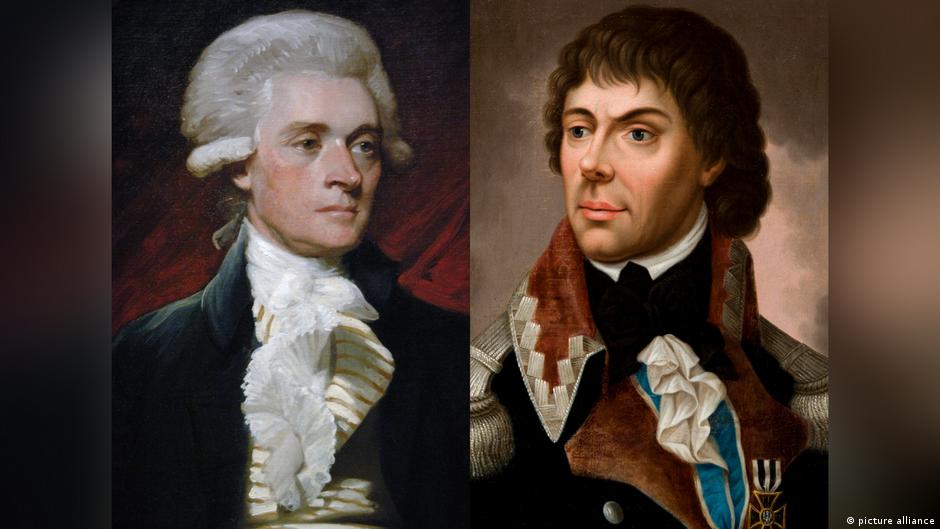
Bronze statue of a man in 18th century clothes looking into the distance. This statue is located in the US capital Washington and is a likeness of Thomas Jefferson. His likeness can also be found carved in the rocks of Mount Rushmore in South Dakota, along with three other American presidents, George Washington, Abraham Lincoln and Theodore Roosevelt.
As the author of America’s Declaration of Independence, Jefferson is known as one of the country’s Founders. Jefferson was a lawyer, planter, and politician. He served as the young republic’s first secretary, second vice president, and then third president. His tenure as President is marked by what is known as the Louisiana Purchase, the acquisition of the territory of Louisiana from the French. By purchasing this vast area the size of the young nation almost doubled.
But like almost every iconic historical icon, Jefferson had a dark side that has only really been discussed openly for the past few decades.
This darker aspect of his biography is closely linked to that of Thaddeus Kosciuszko, a Polish military engineer who became one of the most important figures in the American war against the British. Many streets, intersections, and bridges in the US are named after him today – although his name is not always spelled the same, with some people calling him Tadeusz and others dropping the “z” from his surname.
Kosciuszko is also revered in Poland, where he is mostly celebrated as the leader of the unsuccessful 1794 rebellion against Tsarist Russia, which he led when he first returned from America.
‘Son of Freedom’
Jefferson first met Kosciuszko in 1780 during the War of Independence. The future president was then only the governor of Virginia while the Polish officer had already made a name for himself as an exceptionally talented military engineer.
A close friendship did not develop between the two men until 1797. After his release from Russian prison, Kosciuszko moved to Philadelphia, which was the US capital at the time. Still suffering from the effects of his Russian imprisonment, Kosciuszko met regularly with Jefferson, who by then had become Vice President.
In a letter to another general, Jefferson wrote that he saw Kosciuszko often. The Vice President said, “He is as pure a son of freedom as I have ever known, and a son of freedom that belongs to all, not just the few or the rich.”
Then when Kosciuszko decided to leave America permanently in 1798, he asked Jefferson for an extraordinary favor. He would leave behind property acquired in America and he requested that after his death it be used to free and educate Jefferson’s slaves.
Kosciuszko was a staunch opponent of serfdom and slavery and it was no coincidence that, as an officer in the US Army, he apparently chose a black soldier as his assistant.
Was Kosciuszko’s request an attempt to embarrass his American friend? Or did he simply want to remind him of the American ideals for which he had risked his life?
promise broken
Kosciuszko died in Switzerland in 1817, and two years after his death, in May 1819, Jefferson appeared at a local court in Virginia with his friend’s will. Jefferson explained that he was unable to execute Kosciuszko’s final wishes himself and asked the court to appoint another executor.
In February 1810, Jefferson assured Kosciuszko that if anything happened to him, he would keep his promise regarding Kosciuszko’s property. In his last letter to Jefferson before his death, Kosciuszko also reminded his friend of his obligations.
Nevertheless, Kosciuszko’s last wish was never fulfilled. It was not until 1852, after decades of legal battles, that the U.S. Supreme Court awarded property in Europe to Kosciuszko’s heirs.
The story of how the author of the Declaration of Independence did not keep this promise has fascinated American historians. In fact, after the discovery that Jefferson had had a sexual relationship with his slave Sally Hemings for years, it was seen as another major crack in the image of the Founding Father.
Henry Wiencek, author of “Master of the Mountain: Thomas Jefferson and His Slaves,” a critical biography of Jefferson, says the text of Kosciuszko’s will is deeply affecting.
Wiencek is convinced that Jefferson did not want to free his slaves, perhaps because they were more valuable to him than the money in the Polish general’s will.
The American historian argues that the execution of Kosciuszko’s will would have destroyed his luxurious lifestyle and his position among the slave state’s economic elite.
Too old to take risks?
Historian and Harvard law professor Annette Gordon-Reed has a different opinion. He believes that Jefferson’s critics underestimate the legal difficulties of his position.
Gordon-Reed points out that Kosciuszko wrote other wills in Europe after leaving America. As an experienced lawyer, Jefferson recognized that years of litigation were inevitable.
Gordon-Reed says that Jefferson was already older at the time, aged 75, and he did not want to deal with such problems at his age.
Kosciuszko’s life expert, journalist and historian Alex Starozinski believes that the existence of other wills was just an excuse for Jefferson. Had he followed Kosciuszko’s last wish, he would have been at the forefront of his country’s emerging movement to abolish slavery, a movement that ultimately resulted in the American Civil War – and Jefferson stayed away from that kind of position.
There is also a statue of Kosciuszko in Lafayette Square in Washington. He is wearing the uniform of an American officer and planning military fortifications that helped the Americans win the war against the British. From his perch, Kosciuszko looks toward the White House, where his friend, Jefferson, was the first resident.
Kosciuszko’s statue has a serious face and author Wiencek is convinced it is meant to be ironic. Because if both men are measured by their commitment to the ideals of liberty and equality, Polish military man Kosciuszko was ultimately a greater American than Founding Father Jefferson.
The authors thank the Robert H. Smith International Center for Jefferson Studies in Virginia, USA, for their support.
This story was originally written in German.