Atosa Najafi tries to maintain her composure as she describes what happened. “About three weeks ago, security forces searched our apartment, confiscated personal belongings, and took away my brother,” she says.
Since that day – June 6 – he has been haunted by worry for his 19-year-old brother Parsa and his parents in Isfahan, Iran.
Najafi himself is in Germany. The 23-year-old came here as a student three years ago and is studying dentistry at the Charite Hospital in Berlin. “Since then we have been living with uncertainty,” he told DW. “We don’t know anything about his whereabouts.”
Najafi’s family are members of the Bahá’í Faith, a religion that originated in what was then Persia (now Iran) in the mid-19th century and is considered a monotheistic world religion. However, it is not recognized in Iran, and the Shia Muslim regime there considers Bahá’ís to be heretics. As a result, the Bahá’í population in Iran has been persecuted for decades.
Many Muslim countries do not recognize the Bahá’í Faith because its founder claimed to be a prophet following Muhammad, Islam’s most important prophet.
a persecuted religious minority
According to Amnesty International, Baha’is, who are Iran’s largest non-Muslim religious minority, are particularly badly treated in Iran.
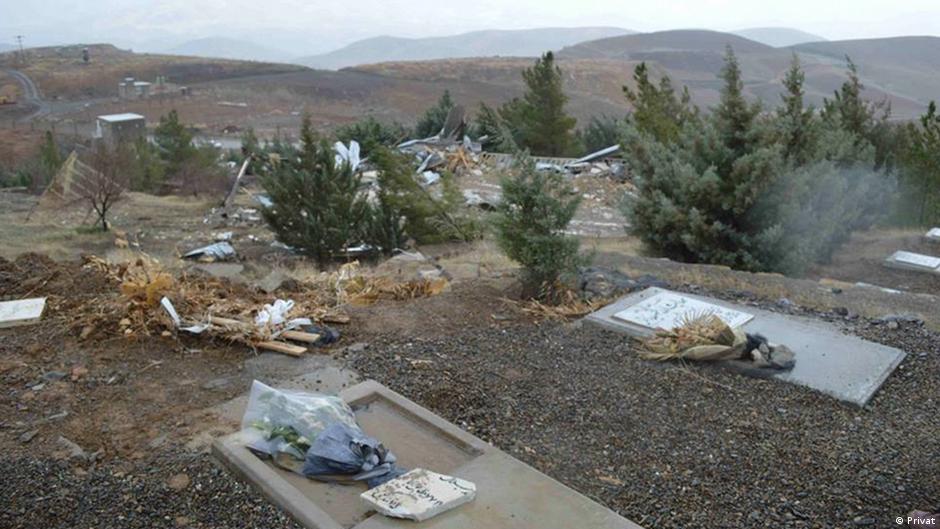
For decades, they have been denied educational and professional opportunities, arrested, had their property confiscated and seen their cemeteries and sacred sites desecrated. In Iran, business licenses may be denied on the basis of affiliation with the Bahá’í Faith. Businesses may also be arbitrarily closed, with owners summoned to appear before disciplinary committees.
In the 1990s, German newspapers regularly featured obituaries published by German Bahá’ís commemorating fellow believers killed in Iran.
In the beginning, it was difficult for Najafi to find out anything about his family’s fate. Authorities took away the parents’ mobile phones and she could not contact them. Najafi now occasionally contacts him in Isfahan. But the authorities have not yet given any information about his brother.
“We are very concerned about what is happening to him and his mental and physical condition,” he said.
Najafi sits in a central Berlin office belonging to the local Bahá’í community. Pictures of important holy sites hang on the walls: the Mausoleum of the Faith’s Founder on the slopes of Mount Carmel in Haifa, Israel, and the House of Worship in Hofheim am Taunus in the state of Hesse. The latter is the only Bahá’í temple in Europe.
german support
The human rights commissioner of the German Bahá’í community, Jascha Noltenius, agrees with Najafi’s concerns.
“The number of Baha’is imprisoned in Iran has risen to 65 in recent months,” the 35-year-old lawyer told DW. “Before the war between Israel and Iran, there were about 20. According to information from the Bahá’í community, some prisoners have been severely tortured. At least two Bahá’ís were subjected to so-called mock executions in prison.”
Noltenius explains what this meant: The prisoners were “seated in a chair, a noose was put around their neck, and they felt as if they were about to take their last breath.”
Human rights representatives now fear that the Iranian regime could take even harsher action and actually execute Bahá’ís for the first time since the early 1990s.
Noltenius is also in contact with the Iran department at Germany’s Foreign Ministry, the country’s commissioner for freedom of religion or belief, Thomas Rachel, and its commissioner for human rights policy.
“Other members of the German parliament are also listening to us and are assuring us that they too will advocate for the Baha’is in Iran,” said Noltenius, who is also networking with other human rights organizations.
Rachel condemns “in the strongest terms” the violation of the religious freedom of the Baha’is.
“About 300,000 Bahá’ís in Iran are systematically discriminated against, disenfranchised and persecuted,” he told DW. Germany’s Commissioner for Freedom of Religion said Bahai women also face gender-based discrimination. And all this has intensified in the wake of the Iran-Israel-US war.
raising awareness
Worldwide, the Bahá’í community numbers approximately 6 million and is represented in approximately 200 countries. One of the largest Bahá’í communities still lives in Iran, although it was banned after the Islamic Revolution in 1983. Its spiritual center is located in Haifa, Israel.
There are about 6,000 Bahá’ís in Germany, and the community has long welcomed people like dentistry student Najafi, young Iranians who come to Europe to study, even if their families in Iran are under pressure.
“Many people in Germany have no idea what is happening to the Bahá’ís in Iran,” Najafi said, adding that she wanted to help raise awareness.
Noltenius says the Bahá’ís in Iranian prisons should not be forgotten.
The German government’s Thomas Reichel is trying to help. In May, he took up political protection of Iranian cousins Peyvand and Borna Naimi, both Bahá’ís, who were arrested in early 2026 on charges of inciting unrest in anti-government protests. No evidence has been presented and according to their supporters, both could face the death penalty.
For student Najafi, not knowing is painful. She is worried about her brother, Parsa, she says, because she doesn’t know where he is, whether he is getting medical care, or whether he is being abused. Finding more information may bring some clarity or it may confirm her family’s worst fears.
“We don’t know what’s happening to my brother,” she says, “and that uncertainty is the worst part.”
This article was originally written in German.