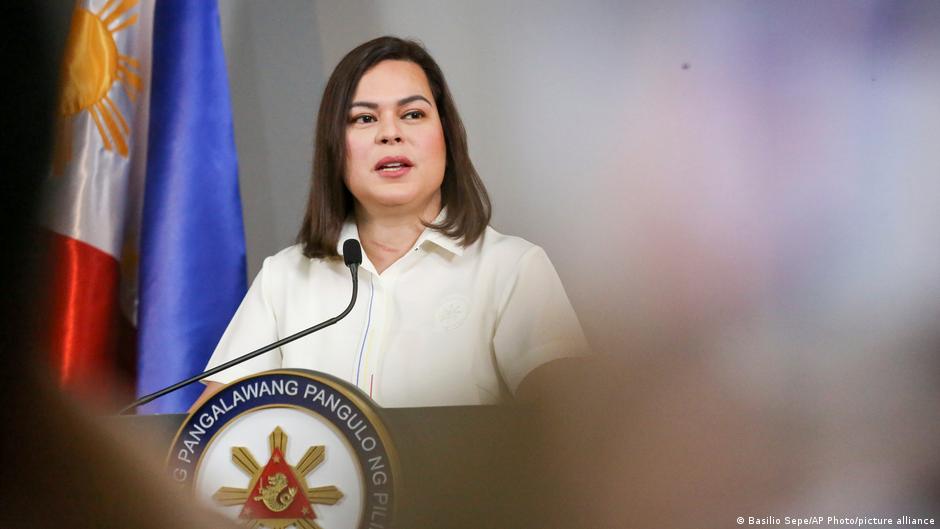
Impeachment proceedings against Philippine Vice President Sara Duterte began on Monday on charges including corruption and threats to assassinate President Ferdinand “Bongbong” Marcos, Jr.
The start of the 92-day trial saw clashes between police, Duterte supporters and protesters demanding his removal.
The Senate trial comes after the lower house, the House of Representatives, overwhelmingly approved impeachment charges against Duterte. The chamber, which is dominated by Marcos Jr.’s allies, voted to impeach Duterte in May by 257 votes to 25, with nine abstentions.
The articles of impeachment mention alleged misappropriation of public funds, undisclosed assets and bribery of public officials. They also cover alleged death threats against his former associate, Marcos Jr.
Duterte, who did not personally attend the proceedings, denies the allegations. His defense lawyer argued on Monday that the impeachment case was politically motivated.
“Philippine democracy is also on trial here. The public will want to be reassured that the proceedings have been thorough and legitimate,” Jean Franco, a political science professor at the University of the Philippines, told DW.
family Feud
Franco said, “Philippine politics is dominated by political families rather than political parties. We do not have stable parties – we have coalitions.”
Duterte’s political career has seen him succeed his father, former Philippine President Rodrigo Duterte, as mayor of Davao City, before becoming vice president in 2022 to the dictator’s son Marcos Jr., who was ousted following a bloodless revolution in 1986.
But relations between Duterte and Marcos Jr. have deteriorated dramatically since then, sparking a feud between the country’s two most influential political dynasties.
Duterte accused the Philippine president of colluding with the International Criminal Court (ICC) to facilitate the arrest of his father to face charges in a deadly anti-drug crackdown during his tenure from 2016 to 2022.
In February, Duterte formally announced his 2028 presidential bid.
Despite the ongoing controversies, she remains popular among voters. A poll in March indicated that 51% of those surveyed said they would vote for Duterte if presidential elections were held today.
Franco said, “The public will be watching the evidence and proceedings closely. Even if Sara is not convicted, her allies will ensure that the process is not detrimental to her presidential aspirations.”
“Ultimately, regardless of the final verdict, this will test Dutertes’ political capital and strength,” human rights lawyer Dino de Leon told DW.
Young voters ‘disappointed, disappointed and neglected’
The impeachment proceedings are underway in the Senate after weeks of political turmoil.
The saga, which netizens dubbed #SenetFlix, involved a shootout and senator and former police chief Ronald dela Rosa escaping an arrest warrant from the International Criminal Court (ICC) on alleged crimes against humanity linked to the former Duterte administration’s anti-drug campaign.
For many young Filipinos, impeachment is a pivotal moment that could determine the fate of the vice president and the credibility of the country’s democratic institutions.
Amid legislative devolution, political dynasty politics and personality-based politics, many of the country’s youth are feeling “disheartened, dejected and neglected”.
“We deserve a system, a country that preserves justice and accountability,” Frank Araneta, a 20-year-old university student and deputy secretary general of Akbayan Youth, told DW.
Araneta said, “We think the youth are ‘decorations’ for politicians to describe the country as having a vibrant youth workforce. But the issues that matter to us, such as education and better governance by eliminating political dynasties, are constantly being sidelined.”
His views reflect the decline in Duterte’s standing among young Filipinos. A survey in May found that among 18 to 24-year-olds their net satisfaction rating fell 16 points, from +49 to +33.
Edited by: Carl Sexton