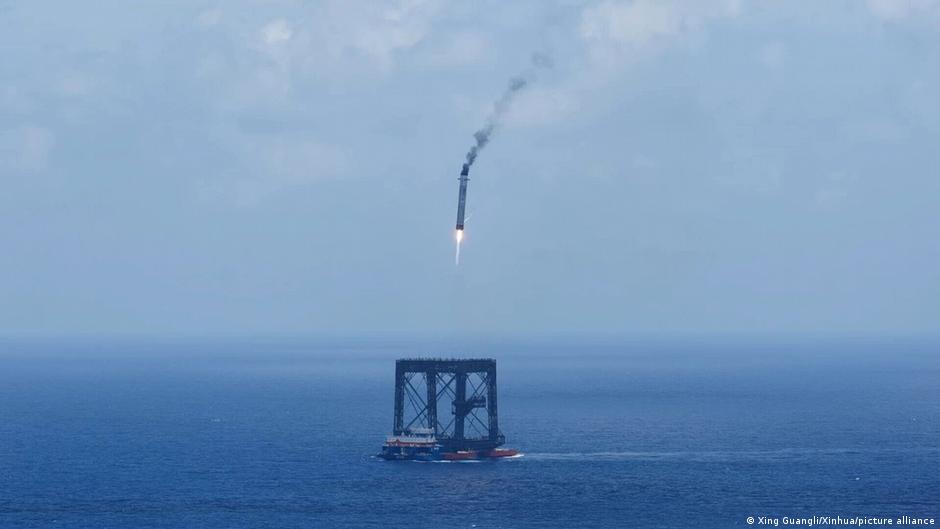
China on Friday successfully recovered the booster of an orbital-class rocket for the first time, a major advance in its effort to develop reusable launch systems.
The Long March 10B took off from the Hainan commercial space launch site in southern China at 12:15 pm on Friday and placed a satellite in its intended orbit, state media reported.
What do we know about the Long March flight?
About six minutes after the booster separated from the rocket’s upper stage, it descended vertically toward an offshore platform and was caught by a net-based recovery system.
Unlike rockets used by US companies SpaceX and Blue Origin, which land autonomously on deployable legs, the Long March 10B uses four hooks to hold a net suspended above a marine platform.
Chen Muye, an expert at the China Academy of Launch Vehicle Technology, said this approach simplifies the rocket’s onboard structure, reduces its weight and can increase payload capacity.
“It is also highly adaptable to landing-point deviations, as coordinated net systems can effectively expand the capture window,” Muye told state media agency Xinhua.
How does China plan to deploy reusable rockets?
China has spent nearly a decade developing reusable rocket technology as it seeks to cut launch costs and support its rapidly growing commercial satellite network.
Previous recovery attempts by private company Landspace and state-owned China Aerospace Science and Technology Corporation failed during the final landing phase last year.
Long March 10B is also part of the broader Long March 10 family that China is developing for crewed lunar missions planned before 2030. Data from Friday’s flight could help validate the technology for the country’s lunar program.
Shares of several Chinese aerospace companies surged after the test, with China Spacesat and China Satellite Communications reaching their daily trading limits.
The Long March 10B can carry at least 16 metric tons to low Earth orbit and has been compared to SpaceX’s Falcon 9, which has a maximum payload of 22.8 metric tons.
SpaceX first landed a Falcon 9 booster after an orbital mission in December 2015. It now launches rockets about 150 times a year, often reusing individual boosters dozens of times.
Edited by: Dmytro Lyubenko
Don’t let algorithms hide news. If you rely on our team for reliable reporting, please take a moment Select us as your favorite source on Google by clicking here and pressing the “Star” or “Favorite” buttonThat’s why you’ll always see our verified news first.