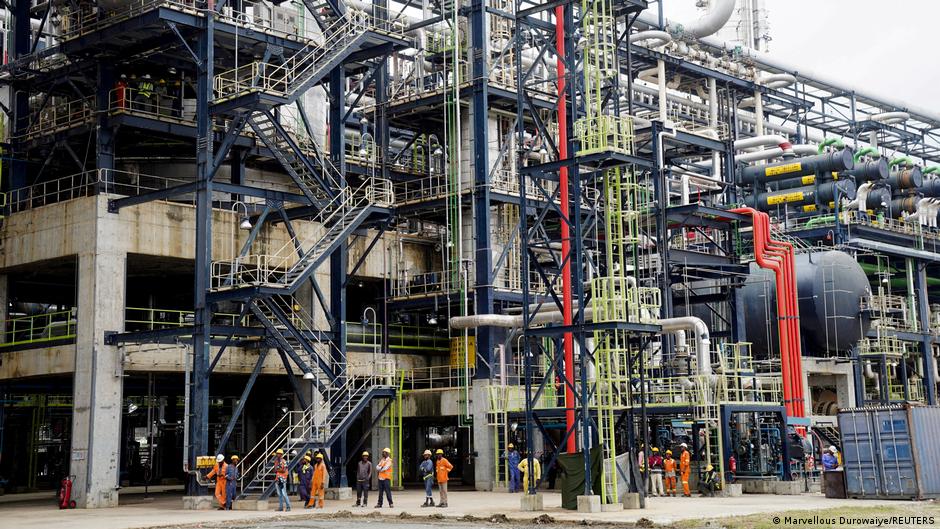
Nigerian billionaire and business tycoon Aliko Dangote last week confirmed the final location of his new oil refinery in East Africa: Lamu Island off the Kenyan coast.
With an estimated refinery output of 700,000 barrels per day the facility is set to transform not only Kenya but the entire region. Once operational, the facility is expected to become Africa’s second largest refinery.
Oge Onubogu, director and senior fellow at the Center for Strategic and International Studies in Washington, DC, told DW that “people on the ground [think] It is wonderful that this investment is coming into Kenya; “There is potential for jobs to be created not only for local Kenyan economies but for the region at large.”
“It is a big project, but it is needed in many ways on the continent and in the East African region,” he said.
Dangote Industries Limited has not yet announced the estimated cost of the ambitious venture. However, according to Bloomberg, construction of the proposed refinery could run a bill of up to $17 billion (€15 billion), making it one of the largest privately financed industrial projects in the region to date.
But what’s in it for Dangote?
Negotiations are still ongoing
Leo Kemboi, an economist at the Institute of Economic Affairs Kenya, highlights that little is known about the details of the agreement between the Kenyan government and Dangote.
“We have not received any announcement from the Government of Kenya as to whether specific guarantees will be given, but since we have seen several meetings [Kenyan President William] Ruto and Dangote, we know that negotiations are definitely still going on,” he told DW.
“It confirms that there are specific incentives that are up for discussion.”
According to Reuters, Dangote Industries intends to finance the project through internally generated revenues, bond issuance and proceeds from the planned initial public offering (IPO) of the Dangote Petroleum Refinery. However, Nigeria’s Securities and Exchange Commission said it had neither received nor approved the IPO application, raising questions over the extent to which the facility’s financing process can be considered a done deal.
According to media reports, Dangote has said that any East African refinery project would need anti-dumping protection to prevent cheap imported fuel from undercutting local refining operations. There is a possibility that Kemboi’s concerns could backfire.
“If too much [tax] Dangote is given incentives, this would not be acceptable to any Kenyan, which has happened with many other investments [before],” He said.
“It’s a Kenyan thing. We rebel, or revolt, when people think that either you’re cheating, or you’re cornering the market – in Kenya anything that seems suspicious is always something that will fail in the end.”
fossil fuels vs green energy
According to Reuters, despite such objections geotechnical investigations are already well underway on Lamu Island, with media reports confirming that engineering and design work has also begun and construction is expected to take three to five years.
However, there are concerns about what impact this massive project will have on Lamu, a UNESCO-protected World Heritage Site. Balancing the potential ecological impact of the refinery with environmental concerns appears to be a difficult tightrope that officials will have to walk in the coming years.
Kemboi believes that Kenya is on the path to adopting greener and more sustainable technologies. Highlighting that renewable energy is indeed gaining popularity, he highlighted that “[i]If you look at Kenya’s energy mix, 35%… is electricity, and over 90% of that electricity is green energy – much of which is generated from geothermal or hydroelectric [resources]”
Onubogu is more hesitant, tense that “[a]As they work to bring this refinery online, they do different feasibility studies, I hope these ideas will figure into their conversations, based on lessons learned elsewhere on the continent.
“In Nigeria, in the Niger Delta, years of exploration have really resulted in environmental damage. I think it will be some time before we see a complete transition from fossil fuels to other forms of energy,” he explained.
African supply chains for African demand
“Obviously, there are people who will have environmental concerns, but on the economic side – given the size of the East African oil market – it is a good thing for the economy of the EAC (East African Community),” says Kemboi, who believes Kenya is primarily looking at the feasibility of incoming investment, at least for the time being.
However, there is more at stake than just profits for Kenya and its neighbours. Once completed, the refinery is expected to supply refined petroleum products not only to Kenya but beyond the region, helping to reduce East Africa’s dependence on imported fuel amid rising geopolitical tensions.
According to Onubogu, now is the time for “African governments… to think creatively and proactively about how to protect themselves from similar shocks in the future.”
“A lot of African countries — or really the continent in general — have realized that things that happen globally also impact on the continent, like the war with Iran and the closure of the Strait of Hormuz and how that affected oil prices,” Onubogu told DW.
Role of Ruto’s re-election campaign
The project is also perhaps personally important to President Ruto, whose re-election campaign next year is expected to focus on what he can do to improve the East African country’s economy after years of discontent over a lack of job opportunities, particularly among Kenyan youth.
According to Kemboi, there may also be political motives behind the project, saying that it is a “substantial investment that will transform the coastal counties”. [in the region]”which will be considered swing counties in next year’s contest.”
However, Onubogu believes that “it is still too early to think that this will affect the condition of the people.”
“[Ruto’s] The popularity is not necessarily the same as it was several years ago, when he first ran for office. His supporters love him; “Those who do not support some of the policies made by him, he vehemently opposes them,” he said.
For Onubogu, the bottom line of the effort is primarily “seen as a win” – not just for Kenya, but for the region at large, not just in terms of economics.
“It is wonderful to see African-led investment taking place on the continent, and it is visionary because of the potential not only for jobs but also for regional integration.”
Edited by: Keith Walker