The South Korean defense industry was stunned by the Canadian government’s recent decision to select German designs for its next generation of submarines, but it has moved quickly to reassert its strength in advanced military equipment and make a new effort to command a greater share of growing global defense spending.
To protect the country from the belligerent and unpredictable regime in North Korea along its border, South Korea has long maintained a strong defense zone.
However, succeeding governments in Seoul have placed greater emphasis on developing export markets over the past decade.
That strategy has borne fruit since Russia’s full-scale invasion of Ukraine in February 2022.
“South Korea is in a unique political and geopolitical situation because of our heavy reliance on North Korea and the US military presence for security,” said Park Seung-in, an economist at Seoul National University.
“But governments are trying to be more independent in terms of the equipment we provide for their armed forces, the government is spending heavily on research and development in defense companies, which has helped them catch up with other countries,” he told DW.
Emerging as a major defense exporter
High-end items are still purchased from the US – such as F-35 Lightning II stealth fighters – but South Korean arms manufacturers have become adept at producing mid-range weapons systems and equipment that are delivered to buyers rapidly and at comparatively low cost because manufacturers already have production lines.
For example, the Cheongyang-II medium-range surface-to-air missile is designed to intercept ballistic missiles and aircraft at ranges up to 40 kilometers (24.8 mi). Similar to the US-made Patriot, South Korea sold 10 batteries to the United Arab Emirates (UAE) in 2022 and the system caught the attention of defense analysts when it achieved a 96% intercept rate during initial missile attacks in the ongoing conflict in the Middle East.
Each interceptor is estimated to cost $1.1 million (€970,000) – significantly less than the Patriot interceptor, which can cost several million dollars – and the manufacturer can deliver an entire system in about a year. The delivery time for Patriot batteries is a minimum of four years.
As a result, in recent years, South Korea has emerged as one of the top arms exporters globally.
Its arms exports are set to reach $15.4 billion in 2025, according to the Seoul Economic Daily, citing the Defense Acquisition Program Administration (DAPA). Exports are set to peak at $17.3 billion in 2022.
South Korean companies have also diversified their offerings. In the past, the country had drawn heavily on its shipbuilding heritage to deliver artillery systems and aircraft as well as warships. It has since expanded to include armored vehicles, missiles and air defense systems.
Europe is a major market for South Korea
European countries – shocked by Russia’s aggression against Ukraine and weakened by years of underinvestment in defense – have been key markets.
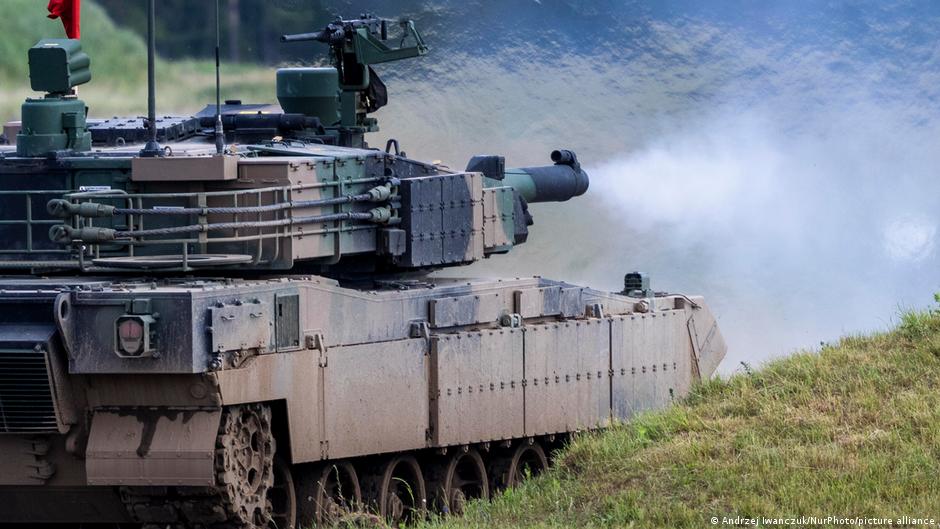
Poland has been the largest buyer in recent years, accounting for more than 40% of total South Korean exports. Warsaw has ordered 364 customized K9 Thunder 155 mm self-propelled howitzers and 360 K2 Black Panther main battle tanks, which are considered among the most capable tanks in the world.
Poland is also purchasing K239 Chunmu multiple rocket launchers, 48 FA-50 light combat and training aircraft and 1,266 “Legwan” four-wheel-drive combat vehicles.
The dramatic transformation of Poland’s military hardware has enabled Warsaw to offer its old Soviet-era equipment to Ukraine.
Elsewhere in Europe, Finland, Estonia, Norway and Romania have purchased K9 howitzers, while deals are also expected for K2 tanks and Redback infantry fighting vehicles, which are also being acquired by the Australian Army in a AU$2.4 billion (€1.46 billion) deal.
Deals for missiles, warships, aircraft
Apart from the UAE, Saudi Arabia has purchased the Cheongyang-II missile defense system and Iraq is expected to follow suit. Vietnam and the Philippines are in talks for military patrol ships and FA-50 aircraft. Peru has signed an agreement with Hyundai Heavy Industries for a naval project and is discussing acquiring K2 tanks and K808 armored vehicles.
In May, South Korean President Lee Jae-myung attended the rollout ceremony of the first domestically developed KF-21 fighter jet, a project in which Indonesia has also been involved and is expected to purchase several aircraft.
“The strength of South Korean arms companies is that they are able to produce high-quality equipment in a short period of time and at relatively cheap prices,” Park said.
“And that has been important for the economy overall because South Korea was heavily dependent on six or seven sectors for a long time,” he said. “And while South Korea is still strong in semiconductors, cars and ships, we have lost other sectors like chemicals to China.”
Chun In-bum, a retired general in the South Korean military and now a senior fellow at the National Institute for Deterrence Studies, said South Korean companies had previously been successful in identifying and improving domestic products such as televisions and selling them at cheaper prices than their foreign rivals.
He underlined that now they have done the same in the military equipment sector.
“We are a strong manufacturing nation, we are open to foreign technology and we are good at catching up with other countries,” he said, adding that doing so is a national imperative given the threat posed by North Korea.
at the edge of the battlefield
Not every domestic weapon system has proven a hit, with Chun pointing to shortcomings of South Korean-made helicopters. But foreign countries have quickly identified the systems that will give them an edge on the battlefield and purchased them in large numbers.
“They may not be the best in the world, but they are readily available, we know they work, they come at a good price and usually they come as part of a deal to prop up the system,” he said. “For countries that need something right now, this is all very attractive.”
However, Park added a cautionary note about the defense sector, pointing out that the business is booming at a time of unparalleled global uncertainty. But the sector cannot rely on that forever.
“Korean companies are doing well now, but in the long run, I expect European and other NATO countries will try to build their own industries to meet further demand,” he said. “And that is why it is important that South Korea pursue the creation of a partnership that extends beyond sales to joint research and development, production and deployment.”
Edited by: Srinivas Majumdaru