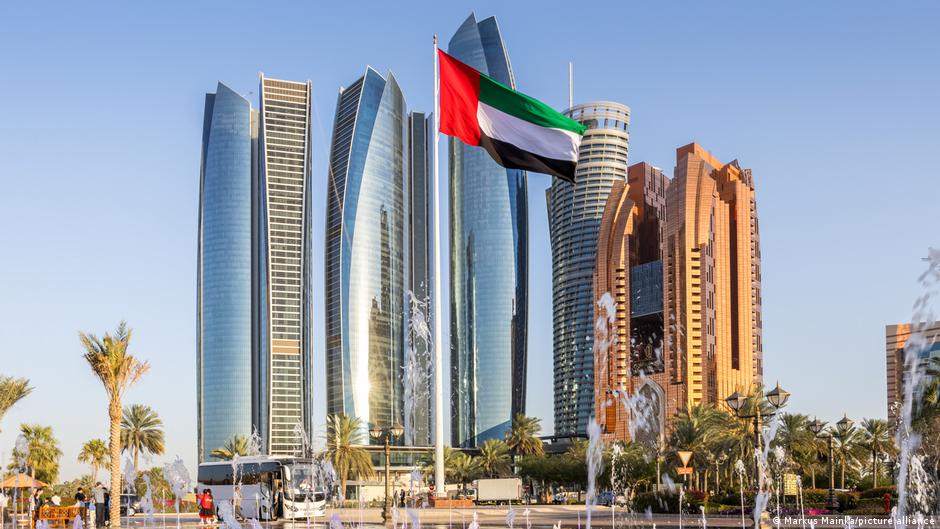
The news broke just a few days ago: ADNOC Distribution, a petroleum retailer in Abu Dhabi, the capital of the United Arab Emirates, will acquire energy giant Shell’s petrol stations and fuel business in South Africa. Its value is believed to be around $1 billion (€870 million). With this purchase, Abu Dhabi has cemented its place in the fuel market of the African continent.
This billion-dollar deal is just one example of a larger trend. Even with occasional small dips, the Gulf states have been increasing their economic presence in Africa over the years.
According to Chatham House, a UK-based think tank, countries belonging to the Gulf Cooperation Council, or GCC, have invested more than $100 billion in Africa in the last decade. Of this, about $59 billion came from the UAE and another $26 billion from Saudi Arabia.
“For the Gulf countries, Africa is not a distant region – it is in their neighborhood,” said Stefan Roll, a senior fellow in the Africa and Middle East division at the German Institute for International and Security Affairs. In East Africa, there are central trade routes and social and economic relations between the two regions have existed for decades. He told DW that the increasing involvement of Gulf countries in Africa should not surprise anyone.
Gulf economies are diversifying
“One of the biggest reasons they have started to look at Africa differently, especially in the last 10 years, is the need to diversify away from hydrocarbons and strengthen their own economic trajectory,” said Maddalena Procopio, a senior policy fellow in the Africa program at the European Council on Foreign Relations. “But they also started to look at the rest of Africa as an incredible potential market, where they can basically drive revenue in areas they haven’t ventured into.”
Investment from outside the Gulf focuses on energy, ports, logistics, agriculture and critical raw materials, according to analysis by several institutions, including the Brookings Institution, Chatham House and the African Development Bank Group. These investments make sense because they secure trade routes, strengthen food security and ensure access to raw materials such as copper, cobalt and lithium, which are essential for the development of electric vehicles and artificial intelligence.
However, the countries involved are adopting different strategies. Procopio said Saudi Arabia and the United Arab Emirates are investing primarily in renewable energy and the processing and distribution of petroleum products. Qatar, which has so far played a less significant role in Africa, is focusing more on selected economic cooperation, he said.
Experts see the UAE as the country most involved. “You need to look at their policies as a whole package,” Rolle said. Ports, logistics and economic interests cannot be separated from their foreign policy and security goals, he said.
Having control over strategically located ports not only provides the UAE with economic benefits, it also allows them to exert political influence over important global trade routes. Procopio affirmed that the UAE’s economic partnership with African countries is larger than that of other Gulf countries due to its foreign policy and security interests.
Saudi Arabia is much more selective and is focusing on certain sectors, especially energy, Roll said. He said the Saudis have also played an important role in development financing on a bilateral basis as well as through multilateral institutions such as the Islamic Development Bank. And he didn’t think the Saudis were interested in competing with the UAE when it came to investment.
Saudi Arabia–UAE rivalry
Procopio believed that the disparities in investment strategies could be explained by some fundamental differences in the economies of those two countries.
“The UAE’s development model is based on foreign countries because the country is very small,” he said. “So it needs to trade with the rest of the world to grow. And if it wants to diversify away from oil and gas, it needs to build many commercial relationships abroad, even more so than with Saudi Arabia.”
Saudi Arabia, a much larger country, needs to more closely link foreign trade goals with its plans for economic transformation, he said.
Procopio argued that the UAE’s commercial footprint also has a “strong political dimension…the investment aims to project power and challenge Saudi Arabia’s regional position.”
For many African countries, interest from outside the Gulf comes at a good time. The African Development Bank estimates the continent’s financial needs are growing, even as Western development funding is shrinking and China is reducing the amount of loans on offer. Direct investment from Gulf countries could help bridge the gap in financing things like infrastructure, energy and logistics.
Procopio also saw another advantage. Unlike China, he said, Gulf countries prioritized investment rather than debt. So in comparison, Gulf financing was often more readily available and did not come with as many political conditions. And African states were not just tied to one another; They still had the opportunity to broaden their international alliances.
Africa also dependent?
The Gulf states’ financial involvement in Africa is not without controversy. Chatham House warned that investment is focused on ports, supply chains and raw materials, serving mostly the strategic interests of the financing states. Brookings Institution cautioned that some investments have limited the role of African states to mere suppliers of raw materials. The UT said what would be more helpful would be to provide support to manufacturing and industry.
Roll also saw this as a challenge. The investments themselves were not problematic; This was a new dependency that they created through strategic infrastructure or export of unprocessed raw materials. He argued that economic interests and geopolitical policy were not necessarily separate.
Procopio was more cautious. He pointed out that the partnership between African countries and the Gulf countries is really in its nascent stage. It remains to be seen whether the billions of dollars coming from the UAE, Saudi Arabia or Qatar will ultimately spur greater industrialization.
The real challenge lies here. The source of investment alone will not determine how successful a financial partnership is. This will depend on how African countries create value from money. Both the Brookings Institution and the African Development Bank point to the same thing: foreign direct investment can be an important driver of economic growth but will only be sustainable if it supports African domestic industry and long-term development.
This story was originally published in German.