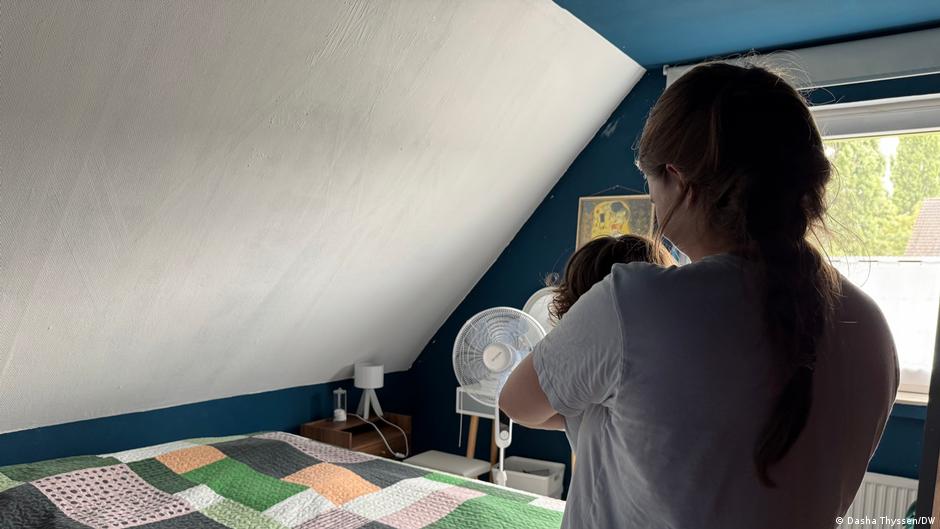
Daria* was very happy with her vacation plans: her short trip to Türkiye coincided with the beginning of the heat wave in Germany. But when she returned to her flat in the northwestern city of Bochum on June 26, she got an unpleasant surprise. The temperature inside her apartment reached 31°C (87.8°F) – higher than the 29°C she experienced on the Turkish beach. Outside, the temperature was rising to 39 degrees Celsius.
“This flat turns into a thermos in the summer,” Daria said, describing the attic apartment where she lives with her husband and one-year-old daughter.
There is no external curtain or air conditioning in his south facing flat. Last year, Daria had to buy her own blackout curtains, and now relies on a fan during the summer. “We tried placing frozen bottles of ice in front of the fan, but it didn’t help much – it was just moving hot air around,” she says, adding that her bedroom, with its dark walls, became the hottest place in the flat.
During the winter months, Darya appreciates how well the flat is protected from the cold, thanks to its triple-glazed windows and an insulated facade. But when extreme heat hits, these features become a liability.
heat and health problems
The EU climate monitor ‘Copernicus’ said June 2026 was the warmest June on record in Western Europe and the second warmest globally. The Robert Koch Institute (RKI) has recorded an estimated 5,120 heat-related deaths in Germany so far in 2026, the majority of which occurred during a heat wave in late June. In comparison, for all of 2025, the RKI projected 2,600 heat-related deaths.
In this context, protecting people from extreme heat “should also be seen as a health measure,” said Trinidad Fernandez, head of the climate change strategy unit at the Fraunhofer Institute for Industrial Engineering (IAO). “We need to consider heat resistance as a core requirement for good housing and good urban planning,” he said.
Tenants are protected from the cold, but not the heat
More than half of people living in Germany rent their homes, the highest proportion in the European Union. Darya’s tenancy agreement sets out clear rules for winter, stating a minimum daytime indoor temperature of 21 degrees Celsius. Yet, there is no mention of any summer temperature target.
“Under rulings of the Federal Court of Justice, residential tenants have the right to a sufficiently warm room (20-24 degrees Celsius, depending on the room), but no right to a cooling one,” Michael Selk, a lawyer specializing in rental law, told DW in an email. This is probably due to the temperatures Germany has historically been accustomed to, he said.
Nowadays, under the Building Energy Act (GEEG) buildings in Germany must be designed to limit overheating in summer.
Nevertheless, according to one Study Published by the Working Group for Contemporary Building e.V. in 2023, 75% of Germany’s housing stock was built before 1990, so many tenants live in buildings that do not meet today’s heat conservation requirements. In most cases, landlords are under no obligation to meet those standards.
“The landlord is required to provide only the standard that was in effect when the building was constructed,” Selk said, citing Federal Court case law decisions regarding property defects.
“The tenant has no right to modernize,” he added. In practice, this means that for a building built in 1990, the relevant standards will apply in court hearings.
Tenants in Germany can sometimes win property defect cases in lower courts if their apartments overheat regularly. This primarily applies to buildings that failed to meet the heat conservation standards in force at the time of construction, or indeed in extreme cases of general uninhabitability.
From emergency response to prevention
Selk does not believe that German tenancy law will change soon to properly address the problem of extreme summer heat.
“The main factors are whether a case ever reaches federal court and whether the court, citing health protections, makes an exception to the rule,” he explains.
Such exceptions, such as the one made by the Federal Constitutional Court in 1998 for PCP (pentachlorophenol) toxins or lead pipes, would mean that homeowners would have to follow modern standards rather than those dating back to the time of construction.
Selk points out that, in commercial leases, courts sometimes resort to occupational health and safety regulations that generally treat 26 °C as a threshold for workplaces above which steps to limit heat exposure should be considered.
“In my personal opinion, there is definitely a right to maintain temperature limits. What applies to commercial leases should be applied even more to residential tenancies,” he says, adding that German basic law explicitly guarantees every person’s right to physical integrity. But even if that happens, it’s still up to the homeowner to decide how they can ensure cooling, he says.
Climate researcher Fernandez believes that extreme heat in summer should be dealt with systematically. “We need to move from simple emergency response to prevention by design,” she says, adding that the focus should be on how the design of buildings and neighborhoods incorporate active and passive cooling based on their respective needs.
financing issue
Fernandez also argues that the government should establish clear temperature standards to protect both future and existing buildings from overheating, as well as provide the financial means to make this possible.
Financing is also a major concern for Germany’s largest real estate association, which represents the interests of owners and landlords.
“Reliable economic conditions are crucial,” Inca-Marie Storm, chief legal counsel representing the association, told DW in an email.
“In particular, investment-friendly subsidy programs, tax incentives and tenancy laws that make financing the necessary modernization reasonably possible,” says Storm, pointing out that protection from summer heat is usually included as part of larger modernization plans. “If such investments are supported by credible subsidy terms and practical tenancy laws, both landlords and tenants will benefit.”
Chancellor Friedrich Merz seems to have heard the message.
“We cannot stop climate change within Europe, and that is why the second big challenge will be living with climate change – and this must be reflected in building codes, health care and the protection of particularly vulnerable groups,” he said at his summer press conference in Berlin on 15 July.
Temporary escape is the only way out – for now
As a new mom, Daria admits she’s especially struggled to deal with the heat this summer. He is more worried about his one year old daughter than about himself.
Young children have it worst, says Darya, because they “don’t really understand what’s going on.” The day the family returned from Turkey, the heat kept the girl awake all night.
The next morning, the family decided to move to a hotel with air conditioning — a decision that many others in Germany have also made, as dozens of videos on social media and local reports show. But relying on hotels is hardly a long-term answer – as heat waves become more frequent and last longer, such temporary escapes are likely to become less affordable and less accessible.
*DW withheld full name to avoid anonymity.
Edited by Reena Goldenberg