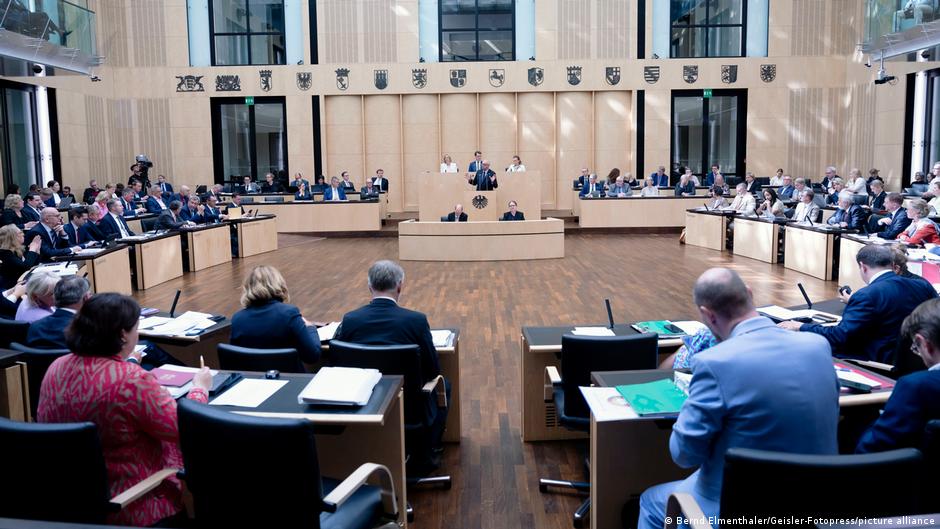
Germany’s upper house of parliament, the Bundesrat, is pushing for a statutory ban on slogans that members say deny Israel’s right to exist.
During their last session before the summer recess, the delegates approved a bill submitted by the state of Hesse. “We are intentionally introducing this bill now because it is time to move beyond discussion and take legislative action.”
According to the Bundesrat’s resolution, “whoever publicly, or in a public gathering, denies the right to exist of the State of Israel or calls for its destruction” would be subject to criminal penalties. However, the offense will only be punishable where the conduct in question is capable of encouraging anti-Semitic acts of violence or other forms of discriminatory behaviour. According to the explanatory memorandum accompanying the bill, existing provisions of German criminal law – including those addressing incitement to hatred and the use of symbols associated with terrorist organizations – are inadequate.
freedom of expression
Hesse’s Justice Minister, Christian Heinz, said that, since October 7, 2023 – the day the Hamas attack within Israel – anti-Semitism had “spread” to the wider world and also to Germany. Anti-Semitism occurs “blatantly on our streets,” he said. Referring to the “stumbling stones” on German sidewalks reminiscent of the murder of Jews during the Nazi era, the politician from the centre-right Christian Democrats (CDU) said: “The public is once again marching across those brass stumbling blocks that you all know from our streets and cities, openly shouting these slogans and this hatred towards Jews.”
Heinz said the bill is not designed to infringe on freedom of expression or prohibit criticism of the Israeli government. Nor will it stop debate about a peaceful political solution in the Middle East, he said. All this is an integral part of a free democracy, he said. He described the draft law as “very deliberately drafted in narrowly defined terms”. Its purpose, he said, was to address “calls that glorify violence” aimed at Israel’s destruction. Germany must not “once again stand by helplessly” while hatred of Jews “expands on our streets.”
In the vote in July, several federal states entered a statement in the official record calling on the federal government to submit a motion so that the Bundestag could enact a law that is “legally sound and constitutionally compliant.” In doing so, he indicated Hesse’s support for such legislation while avoiding endorsing every detail of the proposal.
an unusual process
It is quite common for a Bundesrat bill to be introduced into the Bundestag after the formal opinion of the federal government. It is rare for such a proposal to complete the legislative process and become law. During the current, 21st legislative term of the Bundestag, which began in the spring of 2025, the Bundesrat has approved 45 draft bills and sent them to the federal government – not one of them has yet been enacted into law.
From 2021 to 2025, the Bundesrat initiated 49 draft bills, of which only two ultimately became law. Meanwhile, between 2017 and 2021, the Bundesrat introduced 66 draft bills, of which seven were enacted. Those seven measures represent only a small part of the 542 legislative proposals enacted during that period.
There have been long-standing calls for legislative action in this area. Central Council of Jews in Germany Pressure for such a response has been mounting for some time. Central Council Chairman Joseph Schuster told DW in mid-June that the German federal government’s criticism of the Israeli government is “absolutely legitimate.” What is not, he added, is “when Israel’s right to exist is questioned or the country is demonized.”
Before the Bundesrat session, about 30 law professors discussed whether the proposal was unconstitutional. He acknowledged that concern about rising anti-Semitism and anti-Jewish violence was understandable. However, generally applicable law cannot be used to outlaw a particular opinion.
A legal opinion prepared by the Bundestag’s research services also at one stage cast doubt on whether the proposal was compatible with the German Constitution.
Critics called the law ‘misguided’
In June, Daniel Cohn-Bendit, a Franco-German who served in the European Parliament for the Greens from 1994 to 2014 and is of Jewish descent, described Hesse’s initiative as “fundamentally misguided” in an interview with the German daily. Frankfurter Allgemeine Zeitung (Faiz).
Cohn-Bendit said, “There are many people who are sharply critical of Israel, including Israelis themselves. Not all of them are anti-Semites.” As an example, he cited philosopher Judith Butler, who supports the anti-Israel BDS boycott movement. In his view, BDS is “silly” and a “completely misguided position ideologically”. “Nevertheless, Butler is not anti-Semitic,” he said.
Fundamentally, the controversy concerns the tension between freedom of speech and anti-Semitism. under Basic Law of Germany (Article 5)Freedom of expression can only be restricted by “general laws” – that is, laws that do not target a particular opinion. According to critics of the proposal, the draft bill is contrary to this principle. It would only make it a crime to deny Israel’s right to exist, while denying any other state’s right to exist would remain legal.
Before the vote, Heinz pointed to the “Wunsiedel decision” of 2009 by the Federal Constitutional Court. In that case, judges in Karlsruhe ruled as constitutional a provision criminalizing the glorification of the National Socialist regime through violence. He based his argument on Germany’s special historical responsibility.
Hesse said this argument can be applied to the current debate: there is a historical and political connection between the National Socialist regime, the Holocaust, the establishment of Israel, and the denial of Israel’s right to exist. Thus, Israel’s right to exist is part of the reason for Germany’s statehood. The argument is that to deny that right is to simultaneously challenge Germany’s constitutional identity.
The political debate will continue for months. Since fundamental rights are at the center of the dispute, constitutional judges in Karlsruhe may eventually be called upon to decide the case.
This article was originally written in German.