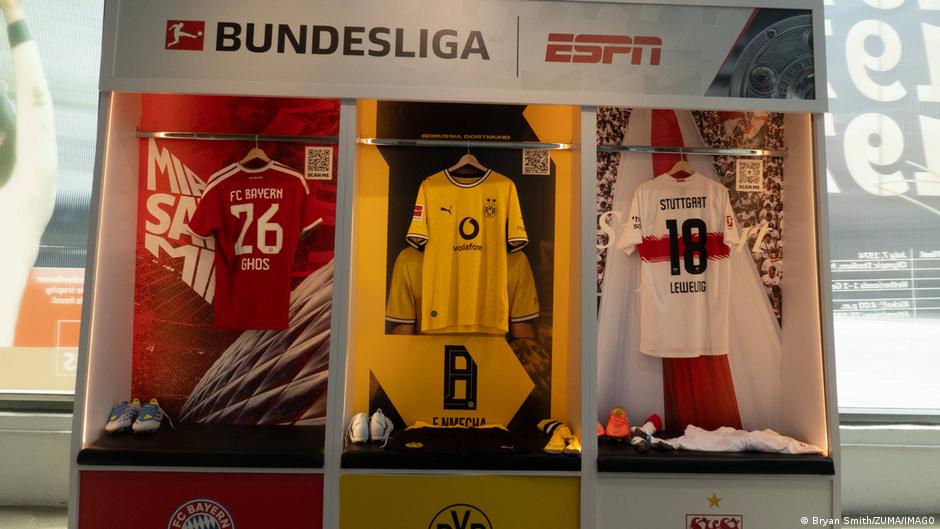
After six years on ESPN, the Bundesliga has found a new home in the United States.
The combination of USA Network and Fandango has reportedly struck a deal to become the English-language broadcaster of Germany’s top flight in USA during the 2030–31 season. The deal is reportedly worth $20 million (€17.4 million) per year, significantly less than the $34 million per year paid by ESPN.
USA and Fandango are part of Versant, a media company in the country that is trying to develop itself as a home for broadcast rights between the top leagues of the NFL and NBA. Fandango is primarily an app for buying movie tickets, but Versant is looking to diversify its offering by including live sports. All 300-plus Bundesliga games will be broadcast on any channel, with USA requiring a subscription and Fandango being free and ad-supported.
Reaction from US-based Bundesliga fans on social media was mostly negative.
“This will make the Bundesliga even more obscure,” posted @skierpro.
“This is bad. The simplicity of having every game on ESPN, which already has many other sports, was perfect. Fandango, a company with almost no sports streaming experience, may be free, but games in the United States will require an expensive YT TV, Fubo or similar package,” Corbin Williams posted on X.
Eric Smith wrote on social media, “Sad! USA is ok but Fandango is not a popular streaming app. ESPN was readily available. Games on Fandango would be like going to a bike shop to buy a BMW.”
New Bundesliga deal in America is a case of less money, but more reach
Some believe that the decline in financial returns is a sign of the times for the Bundesliga. Others see it as an opportunity.
“From the outside, the new agreement offers less media-rights income per season, but broader distribution, greater search potential and a better chance of reaching audiences beyond the Bundesliga’s existing fan base. In short, the reported financial returns appear to be lower, but the potential reach is higher,” Dominik Schreiber, a professor of sports economics at Germany’s Otto Beisheim School of Management, told DW.
While Schreiber admits that the reported fee is lower than the previous deal, disappointing from a business perspective, it is also important to consider its context.
Schreiber said, “The DFL faces a difficult market reality. The media-rights market has become more selective, while competition for audience attention is intensifying. So maximizing the check from each individual cycle is no longer the only sensitive objective.”
“The new distribution model may still prove strategically valuable if its broader reach helps create a larger and more commercially attractive audience over time.”
ESPN’s coverage in terms of reporters and commentators was praised by most fans, but the new deal showed that perhaps it was not the ideal location for Germany’s top flight.
“My best guess is that the previous model provided insufficient prominence in ESPN’s crowded sports portfolio, potentially limiting audience growth. The Bundesliga may now be more important to a partner seeking to establish and differentiate its own live-sports offering in an extremely competitive market, although we cannot know from the outside what idea ultimately motivated the change,” Schreiber said.
Is the Bundesliga really growing in America?
“The 2026 World Cup highlights the tremendous growth potential of soccer in the Americas,” Robin Osterman, executive vice president of Bundesliga America, said in a statement from the Bundesliga. “We have seen that momentum firsthand, with the number of Bundesliga fans in the US increasing by 43% over the past five years.”
While this may be true, the struggles of German football in general cannot help the Bundesliga’s position in the market. Bayern Munich have long been dominant domestically, injecting a sense of both competition and suspense into the league. The number of star players in the league is not high compared to other leagues, and Germany’s poor performance in the recent World Cup has also weakened the position of German football on the world stage.
It is clear that the Bundesliga faces a huge challenge when it comes to improving their position at the negotiating table for broadcast deals, much of which is beyond their control. Still, there is hope that, as Ostermann mentioned, the soccer momentum provided by the 2026 World Cup in the United States, Canada and Mexico can be used to the Bundesliga’s advantage.
“Major scheduling, strong promotions and local storytelling are needed now to build consumption capital,” Schreier said. “Once audiences discover the product, repeated exposure helps them learn about clubs, recognize stars, understand rivalries, and gradually turn occasional viewings into habit, fandom, and ultimately commercial value.”
Edited by: Chuck Penfold