Heatstroke begins with headache, dizziness, and loss of awareness. The body’s regulation systems fail, causing the body temperature to rise to life-threatening levels. Multiple organ failure and death may occur. But doctors rarely record deaths that can be directly attributed to the heat. According to Germany’s Federal Statistics Office, an average of 21 such cases were recorded each year between 2004 and 2014.
Published by the Robert Koch Institute (RKI), one estimate is 5,120 heat-related deaths in Germany from 2026 to June 28. But that doesn’t mean this picture was pulled out of thin air. “It is based on a statistical correlation,” says Alexandra Schneider, meteorologist, epidemiologist and deputy director of the Helmholtz Institute for Epidemiology in Munich.
Statistical relationship between temperature and deaths
This estimate was found by comparing death data collected by Germany’s Federal Statistical Office with temperature trends over a certain period measured by the German Weather Service. About 23,600 people died in the last week of June alone. The weekly average temperature – that is, the average day and night temperature over the course of a week – was 26 degrees Celsius. The RKI believes that heat-related deaths occur with a weekly average temperature of 20 °C.
The number of deaths in that last week of June was about 30% higher than the average for comparable periods in previous years, when about 18,200 people died. To estimate the number of heat-related deaths, researchers modeled how many deaths would have occurred under conditions with temperatures exceeding 20 degrees Celsius.
Schneider points out that the researchers also adjusted for some confounding factors. Using this method, the RKI estimates that there were 5,120 heat-related deaths – 4,310 of which occurred in the last week of June alone.
Alexandra Schneider considers the estimate credible and says that she had expected a figure of this magnitude. In the past, epidemiologists have criticized the methodology of the RKI. “If temperatures fluctuate rapidly within a week, using weekly averages may overestimate those extremes and lead to underestimating deaths,” she explains. “However, this time, it was consistently hot.”
In Germany and Europe, more deaths are related to cold than heat
The same applies to cold deaths as well as heat deaths: these are estimates based on a plausible statistical link. Respiratory illnesses become more common during the colder months. Epidemiologist Schneider points out that cold temperatures, like heat, contribute to heart disease.
“In Europe, cold-related mortality still far exceeds heat-related mortality,” says Schneider. “But we are seeing slow change.” Could climate change perhaps be causing milder winters and therefore fewer deaths? Researchers have also looked into this question and modeled different scenarios.
Schneider says that no matter how favorable the scenarios are, they all point to the same conclusion: “The net impact – meaning the total number of deaths – increases.” This is because the increase in heat deaths is so significant that it cannot be offset by the decline in cold deaths.
Heat-related deaths are just the tip of the iceberg
Schneider says focusing solely on heatstroke as the cause of high-temperature-related death would vastly underestimate the impact of heat. “That’s why these statistical methods are used to identify and investigate associations between heat and other chronic diseases.”
He himself has contributed to studies showing the relationship between heat and certain diseases. “We were able to show that heat is now strongly linked to heart attacks,” says Schneider. Heat at night also increases the risk of stroke.
The heat is troubling emergency responders and hospital workers
Jonas Sonnenstuhl is a paramedic in Teltow, Brandenburg. “We all know that conditions like strokes and heart attacks are occurring more frequently and can even become life-threatening,” he says.
Alexandra Schneider called heat-related deaths just the tip of the iceberg. Even when high temperatures don’t cause death, they still put a strain on people’s health – especially those with pre-existing conditions.
Sonnenstuhl recalls a 17-year-old patient with a congenital heart defect who called emergency services during a heatwave. “That day he showed clear symptoms, which could already be traced back to the fact that his body was at its limits.” Shortness of breath, dizziness and impaired consciousness.
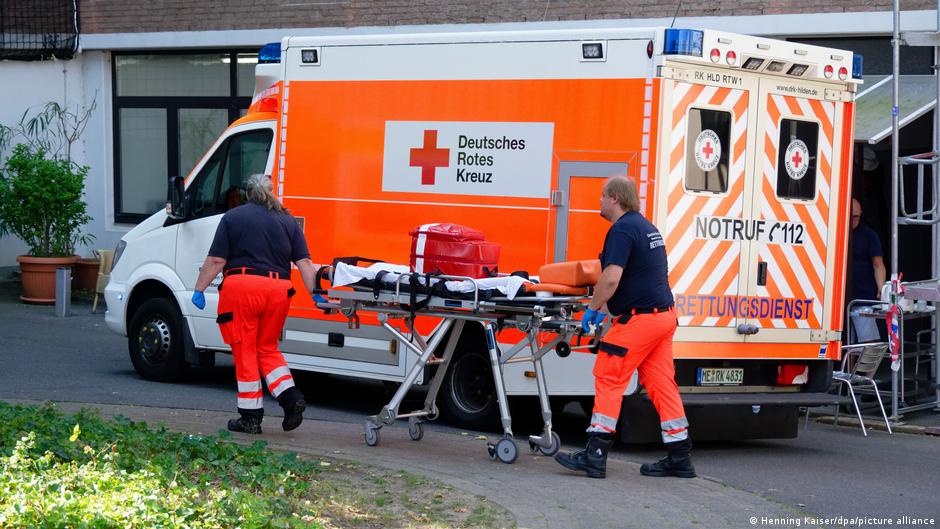
The heat also pushed emergency responders and hospital staff to their physical limits. On June 28, while Sonnenstuhl was working a 24-hour shift, the temperature inside the ambulance did not drop below 30 degrees Celsius. Heavy protective clothing, steel-toed boots, and physically demanding work further increased the stress.
Sonnenstuhl says many hospital emergency departments are not air conditioned and emergency stations are even less likely to be air conditioned. “Both we and the hospital staff were at our limits.” He says that for people whose job is to save lives, it is necessary to remain calm in emergency situations.
This article was originally published in German.