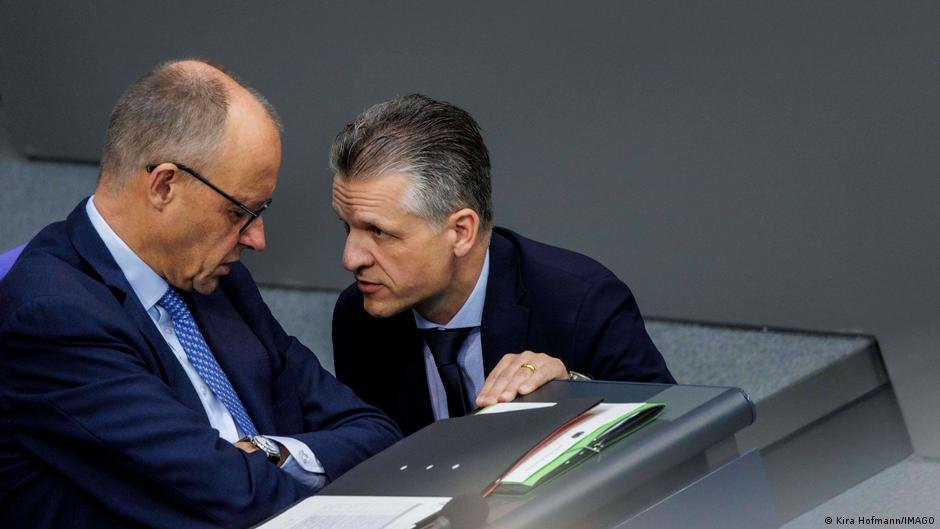
The leaders of Germany’s ruling conservatives wasted no time: Just days after Jens Spahn resigned as parliamentary group leader following a scandal over surrogacy, the Christian Democratic Union (CDU) named its candidate to succeed him: Thorsten Frei.
The 52-year-old, who currently serves as the chancellor’s chief of staff and is considered a close confidant of Chancellor Friedrich Merz, is now set to take over one of the most important posts in German politics, leading Bundestag members of both the CDU and its Bavarian sister party the Christian Social Union (CSU).
Frei can officially take office only after being elected by MPs. To this end, 208 CDU and CSU lawmakers are scheduled to interrupt their summer recess on July 29 to call a special session in the Bundestag. The name of Frei’s successor at the Chancellery is also expected to be announced by then.
Working behind the scenes was not Frei’s strength
Friendly, likable, sociable and a good mediator – this is how Thorsten Frei is often described in Berlin political circles.
A trained lawyer, he has been married to a teacher for 20 years and has three children. He lives in the city of Donaueschingen in the south-western state of Baden-Württemberg in the Black Forest, where Frei was also mayor for nine years before entering federal politics.
At the Chancellery, his job was essentially to cover the back of Friedrich Merz, a kind of first officer to a ship’s captain who was responsible for ensuring that the Chancellor’s affairs ran smoothly, getting obstacles out of the way, and keeping the Chancellor properly informed about the day’s appointments.
It was a role that, some critics said, was not really a good fit for Frei, who was sometimes accused of preferring to give interviews herself rather than quietly coordinating the Chancellor’s affairs.
in the headlines again
But as parliamentary group leader, Frei will be more free to take center stage. His job will be to articulate his party’s position in speeches in the Bundestag parliament and in media interviews. Above all, he must secure a majority for government policies and ensure that the members of his parliamentary group are as united as possible.
This is not being considered an easy task. Since the current government took power in May last year, outgoing group leader Jens Spahn has at times struggled to maintain the government’s 18-seat majority.
The parliamentary group leader must also negotiate with the conservatives’ coalition partner, the centre-left Social Democratic Party (SPD), which until recently Spahn was seen as good at. In short: the Chancellor rules, while the leader of the parliamentary group ensures his political support.
When the CDU/CSU is in opposition from 2021 to 2025, Frei holds the position of parliamentary secretary of the group, an administrative task that includes overseeing the day-to-day coordination of the parliament’s agenda, organizing committees, and ensuring that group members are present for important votes. At that time, Frei worked closely with Merz, who was then leader of the opposition and parliamentary group.
After the February 2025 election, Frei reportedly coveted the group leader job, but she had to make way for the more famous Spahn, a former health minister under Angela Merkel.
case of double standards
Spahn had been in the post for almost 14 months when he resigned last Saturday (July 18). She and her husband Daniel Funke had announced that they had become parents with the help of a surrogate mother in the United States. However, surrogacy is banned in Germany, and the CDU is a party that has repeatedly voted in support of this ban.
Spahn was accused of hypocrisy. By circumventing a law that some saw as a cornerstone of his party’s moral values, Spahn was seen as creating a credibility problem not only for himself but also for his party.
Social Democrats are satisfied
Frei’s nomination as Spahn’s successor has received approval from its coalition partner, the SPD. “I have worked very well with Thorsten Frey in the past,” said Dirk Wiese, parliamentary secretary of the SPD parliamentary group in the Bundestag in Berlin. “We were both deputy parliamentary group leaders for domestic and legal policy in the last Grand Coalition, and I found him there to be a very knowledgeable colleague, who is easy to talk to and who always has a very detailed understanding of the issues.”
Wiese said he looked forward to working with them in the future once approved by the CDU/CSU leadership bodies.
This article has been translated from German.