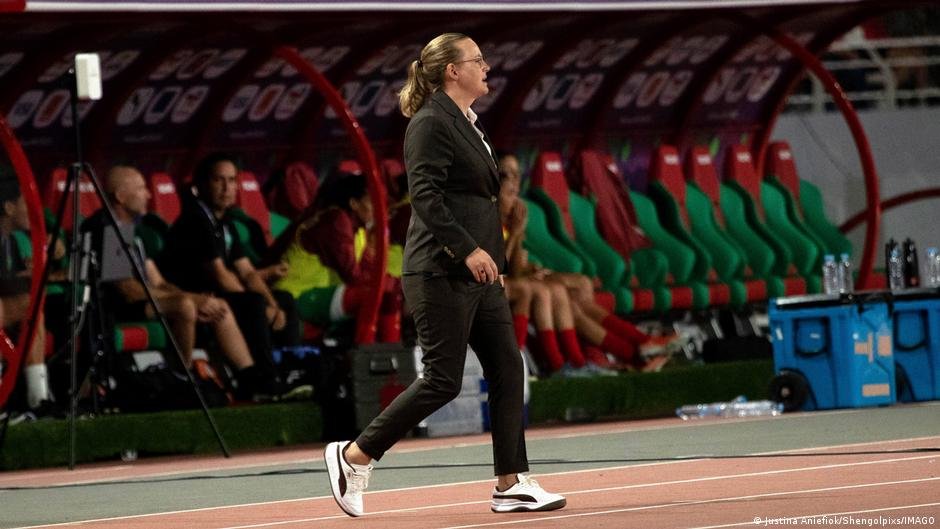
When it kicks off in Morocco on July 26, the Women’s African Cup of Nations (WAFCON) promises to deliver great goals, games and memories as 16 teams compete for the continental title. While the focus will be on the stars on the pitch, some attention can also be paid to the fact that very few head coaches are women.
The number comes from Cameroon’s appointment of Valentin Nguel a few weeks before the tournament. WAFCON Four countries, including Zambia, Kenya and South Africa, have female coaches. Still, most coaches are men. Other teams have hired female assistants to comply with a rule passed by FIFA earlier this year that requires women’s teams to have at least one female coach on the bench.
Africa may be slowly moving in the right direction, with two out of 12 chief trainers at the 2025 WAFCON (16.7%) versus four out of 16 in 2026 (25%), but there is still a long way to go.
South Africa is at the forefront. Desiree Ellis is one of the most successful female coaches in the world and led South Africa to the 2022 title. The fourth-time African Female Coach of the Year wants more countries to follow the example she has set.
helping female trainers
“Our federation has long ago taken the position that all women’s teams will be coached by women,” Ellis told DW.
“This needs to happen and federations need to be bold and hire female coaches. They need to not only hire them but support them, otherwise they will not be successful.”
South Africa is one of the 14 members of the Council of Southern African Football Associations (COSAFA). Even before the FIFA regulation announced in March, the regional organization already had a rule mandating that women be part of coaching teams.
“It’s about forcing federations to provide more opportunities for female coaches and we can see that paying off in South Africa,” Ellis said.
Jacqueline Juma is the head coach of the Kenya under-20 women’s team and she wants to see a similar arrangement across the continent.
“We don’t have many female coaches in charge of African women’s teams… It’s because they still don’t trust women, don’t give them opportunities, the support is not as much as male coaches,” Zuma told DW.
They believe that this kind of attitude means that help is needed.
“At the very least, put in place restrictions when it comes to club licensing so that female coaches are prioritized as head coaches for women’s football teams, which will allow us to get a good number of female coaches.”
Zuma suggests that the first assistant coach should also be female and that men should then be allowed to fill out the coaching staff.
set the path
More jobs with role models like Ellis could inspire a new generation of female coaches, and Vicki Houghton, who founded the Female Coaching Network in 2014, told DW that while only 20% of women’s national teams have female coaches, they account for 90% of major championships.
However, inspiring young girls is just the beginning of a long and difficult journey to the top of the game. Although there are some countries that have made progress, some federations still have a lot to do in this area for coaches to reach their full potential.
“I am frequently contacted by wonderful female trainers in Africa – different countries, Uganda, Kenya, Nigeria.” Houghton told DW.
“Often they say ‘I have a passion, I have a desire, but I have nowhere to go.'”
Houghton would like to see a clear pathway for all youth coaches.
“They don’t know how to take that path and it’s not necessarily the coach’s fault, it’s the federations or governing bodies that are not reaching out to these women and saying ‘if you want to be a national team coach, this is what you have to do.’ I honestly think even the governing bodies in some sports don’t know how to get them there.”
Houghton admits there is still a long way to go around the world but there is a basic lesson Africa can learn from Europe.
“What does the path look like to go from a level-one grassroots coach, volunteering once a week, to a national team coach?” he asked.
“It’s really important to understand what the journey will be like. People think women don’t want to coach…that’s not true.”
reasons for optimism
The lack of representation at the top level is not limited to Africa. It is common to see men on the benches of women’s games around the world, including Europe. At Women’s Euro 2025, only seven of the 16 teams had female coaches, an increase from previous tournaments but still less than half.
The England national team may be European champions and led by a woman, but female coaches are still a minority in the country’s Women’s Super League, considered the strongest domestic competition in the world.
According to Ellis, progress is being made in Africa and although it has been slower than many people expected for women to reach senior positions, there are reasons to be optimistic.
“Now, you have Lamia [Boumehdi] Ellis, who recently won the CAF (Confederation of African Football) Coach of the Year award, has been appointed as Morocco’s U20 coach.
“You have Adelaide [Koudougnon] After qualifying Ivory Coast for the first time for the U17 tournament, you have Carroll [Kanyemba] With Zambia going to back-to-back World Cups with the U17s, you have Mildred [Cheche] Going to the U17 World Cup with Kenya. There are a lot of future coaches coming in.”
Edited by: Chuck Penfold