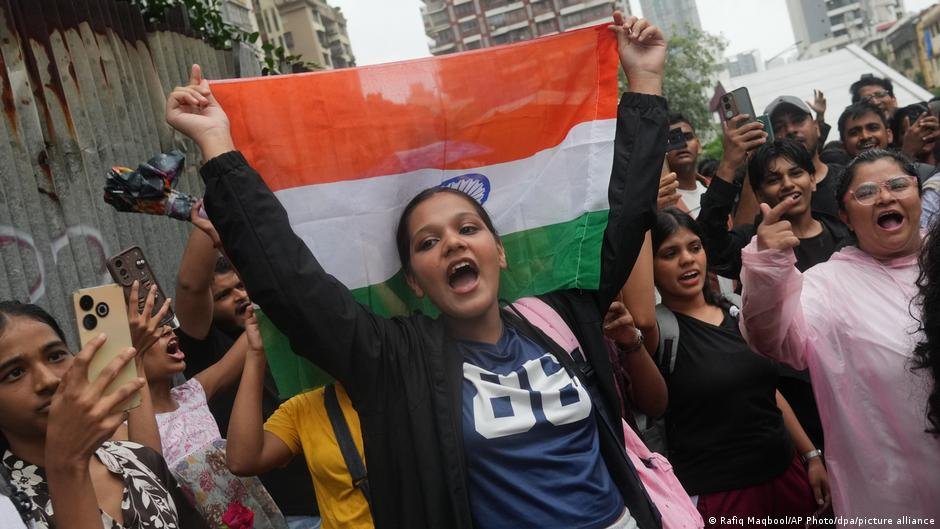
A youth-led protest movement that calls itself the “Cockroach Janata Party (CJP)” has begun to find supporters outside the Indian capital, after thousands of young protesters marched on Parliament in New Delhi earlier this week.
The youth-led “cockroach” movement began in May when Chief Justice of the Supreme Court of India Surya Kant publicly called unemployed youth “cockroaches” in an offhand remark during an unrelated court hearing.
The youth adopted this nickname, which has become a banner of youth anger over failures in the country’s education system and its widespread youth unemployment problem.
The protests are putting public pressure on Prime Minister Narendra Modi’s Hindu nationalist Bharatiya Janata Party (BJP).
And as support for the campaign continues to grow, solidarity protests have erupted across India outside New Delhi.
BJP takes notice
Frustrations began to grow during a campaign demanding accountability over a scandal involving a highly competitive university entrance exam. The news of question papers being leaked ahead of the exam dates in early May highlighted long-standing grievances over privileged access for some students.
Fueled by millions of young followers on social media, the movement soon turned into widespread frustration over unemployment, dwindling opportunities and an education system that many young Indians believe has failed them.
However, until last week, many in the ruling BJP had dismissed the cockroach movement as nothing more than a social media phenomenon.
The situation changed after activist Sonam Wangchuk went on a three-week hunger strike and police began cracking down in response to a march to India’s Parliament this week.
Images of tear gas, lathicharge and injured students spread rapidly online, prompting solidarity rallies across India and forcing the government into political defence.
Among other things, the protesters are demanding the resignation of Education Minister Dharmendra Pradhan.
In response to the issue, Pradhan promised “answers, reforms and accountability”.
India’s main opposition leader Rahul Gandhi on Wednesday said he supports the students’ demands, which include Pradhan’s resignation and Modi’s apology to the students.
‘Cockroach’ caught national attention
While Delhi remains the main epicenter of the movement, rallies and marches have been organized in several other states.
Social activist and transparency campaigner Anjali Bhardwaj said the movement is no longer limited to the capital.
“The infection has also spread to remote areas of central Chhattisgarh, a rural state in central India,” Bhardwaj told DW.
“The anger is palpable. It has given rise to frustration and disillusionment among young people who are demanding accountability.”
The western state of Maharashtra has emerged as the movement’s strongest base outside Delhi.
In Pune city, thousands of people gathered at Savitribai Phule Pune University in June, where CJP founder Abhijit Dipke unveiled the movement’s education manifesto.
In the financial hub of Mumbai, police issued a ban on public gatherings till August 6 following a solidarity demonstration in support of the CJP.
Authorities there also opened eight criminal cases involving about 900 protesters, citing intelligence reports that warned of potential violence and threats to public order. Security was also tightened across the city to prevent further protests.
“If we leave now, after enduring everything, it will all be in vain,” CJP’s Maharashtra coordinator Manthan told DW.
Supporters of the movement have also started organizing demonstrations in Bengaluru, Kolkata, Guwahati, Shillong, Dimapur, Hyderabad, Ahmedabad, Thiruvananthapuram, Jammu and parts of Uttar Pradesh.
Farmer groups are with CJP
In many states, support appears to be driven by students, local activists, and civil society groups rather than centrally run formal structures.
“The issues raised by the CJP cannot be dismissed. Exam paper leaks, corruption and unemployment are real concerns for the youth and it is natural that students are joining the movement,” M Sivaprasad, Kerala state president of the Students Federation of India, told DW.
This movement has also received support from some sections of farmer organizations of India.
“Students and youth are also the children of farmers and are the future of India. SKM firmly believes that the struggles of students and youth are the struggles of farmers,” leaders associated with the Samyukta Kisan Morcha (SKM) wrote in a statement.
However, BJP spokesperson Tom Vadakkan rejected suggestions that the movement could rapidly grow into a nationwide political force, arguing that it faces significant structural obstacles outside the capital.
“The CJP will have to bridge India’s urban-rural divide and overcome language barriers before it can claim to be a national movement,” Vadakkan told DW.
“I also don’t think the name ‘Cockroach’ is acceptable in civil society. It may attract attention in Delhi, but I don’t think it will gain popularity across the states,” he said.
Will the movement be able to maintain its momentum?
Gilles Verniers, a political scientist at Sciences Po, a Paris-based public research university, believes the movement has the potential to spread beyond Delhi because its demands resonate with a far wider audience than those directly affected by the exam paper leak.
“Given the increasing state repression, the cockroach movement is likely to expand and spread to other cities,” Verniers told DW.
He said, “Its demands are simple enough to mobilize supporters without centralized leadership or coordination. They are also broadly non-partisan, focusing on the fairness of public institutions and government accountability rather than partisan politics.”
Verniers said the movement has the potential to engage activists and civil society groups who have had few opportunities for sustained public protest since the 2019 anti-citizenship law protests.
Media and political commentator Pamela Philipose believes that the movement has already crossed a critical threshold.
“It has already built support across the country, given the resurgence of youth-led protests in cities across India,” he told DW.
“This points to a commonality of concerns among young people. By reacting with insensitivity and cruelty, the government is inadvertently creating disunity between disparate groups that may take years of activism to come together.”
The challenge facing the CJP has moved beyond attracting attention to turning solidarity into a sustained organisation.
Many protest movements in India have attracted national attention before fading after the immediate trigger was passed.
Whether the Cockroach movement follows that pattern or evolves into a broader nationwide campaign will depend on its ability to build local leadership, sustain mobilization, and convince youth outside Delhi that it speaks to their own aspirations as well as those of students in the capital.
Edited by: Wesley Rahn