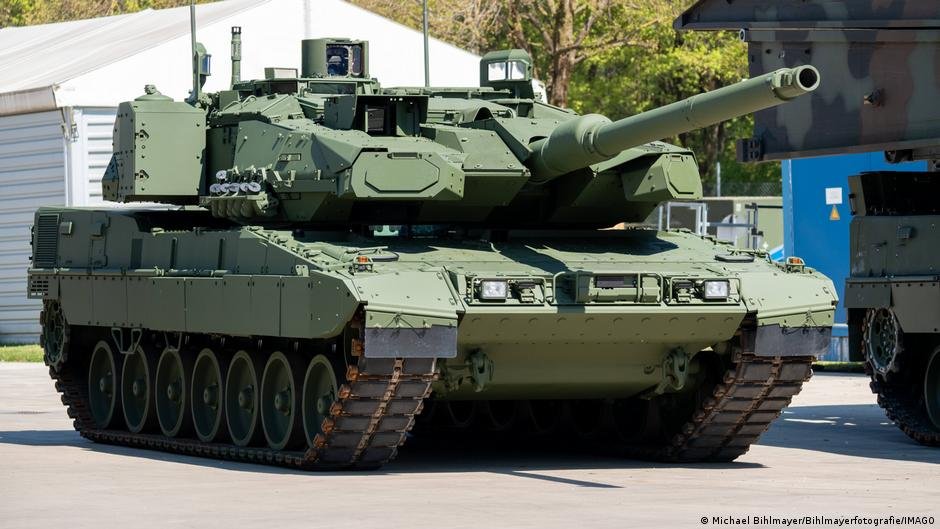
According to critics, the German government’s efforts to modernize and expand its military, the Bundeswehr, are in danger of being derailed by the country’s slow procurement processes.
The wars in Ukraine and Iran have shown that drones costing only tens of thousands can be effective against weapons that cost untold millions to develop and manufacture. For example, Ukrainian air defense has shown that they are able to hold their own against Russian attacks, despite the fact that the Ukrainian Air Force has only a fraction of the number of fighter jets and bombers.
Meanwhile, Germany has increased its defense spending significantly over the past few years. In addition to a €100 billion ($114 billion) “special fund” announced in view of Russia’s full-scale invasion of Ukraine in 2022, the state is rapidly increasing its regular defense spending: from €62.4 billion in 2025 to €82.7 billion in 2026, with plans to increase it to €152 billion by 2029.
But critics are wondering whether the huge sums are being spent in the best way, not least since the FCAS Franco-German fighter jet, worth more than €100 billion, was canceled in June.
Defense analyst Nico Lang, who once worked for the German Defense Ministry, gave a scathing verdict on the current strategy. “It’s the same dysfunctional system as before. They’re pouring too much money into it,” he told news portal Web.de. “The point is: Unless you actually change the structures of military planning and procurement, nothing better will come of it.”
Germany is learning lessons from its purchases
According to some politicians, Germany is currently embarking on a steep learning curve. Andreas Schwarz, a Social Democrat member of the Bundestag defense committee, said the war in Ukraine is “completely changing the way wars are fought.”
On a visit to Ukraine earlier this month, Schwarz found that the debates that had dominated German politics in the first year after Russia’s full-scale invasion of the country – about whether Germany should send Taurus rockets or Leopard tanks to help Ukraine – had become completely irrelevant.
“When I was in Ukraine last week and visited the Defense Ministry, no one asked me about the Taurus cruise missiles or the Leopard tanks,” he told DW. “They need help with drones, ammunition, modernization of their IT sector, satellites and communications.”
Can an army still fight with ‘legacy’ weapons?
But the Ukrainian experience does not mean that heavy weapons systems – often called “legacy systems” – have become obsolete, as some analysts have been arguing in recent months. Max Becker, Policy Fellow German Council on Foreign Relations (DGAP)That said, the Ukrainian War, in contrast, had shown that tanks or artillery systems were still important for capturing territory as well as for long-range attacks.
“It’s the right mix of legacy systems that you still need, and drone technology,” Baker told DW. “It’s a dilemma because, on the one hand, you still need to invest in very expensive systems like combat tanks, which take a long time from order to delivery, but you also have to invest in systems like drones and loitering weapons.”
The Ukrainian military developed its drone-based strategy partly out of necessity, Baker said, due to a lack of conventional artillery and combat tanks. “I think the scenarios that Germany and NATO are preparing for are very different from a war between Russia and Ukraine because NATO has very different equipment.”
Andreas Schwarz also thinks that the Bundeswehr still needs old weapons. He said, “I don’t want to say that we don’t need tanks anymore – not at all, we will always need them.” “But the question is: Do we still need them in that quantity? And can’t I supplement or adapt them with smaller, more flexible units?”
Drones are not only becoming more sophisticated, but they are also easier and cheaper to control – whereas in the past expensive specialized computer systems were critical, some military drones can now be piloted with apps on smartphones. Schwarz believes that although the German government and defense industry have understood this new reality, they still need some time to implement the necessary measures to deal with it.
purchase problem
The devil is in the details – or, as is often the case, in the bureaucracy. Defense procurement is extremely slow and complex, and this has been especially proven in a country where the arms industry is dominated by major companies like Rhinemetall, which have made a lot of money building tanks and submarines for the world’s armies.
“We have an arms industry that has relied on some tried-and-tested technologies for decades,” Schwarz said. “Of course, we also have a military that has spent decades preparing for scenarios that are highly unlikely today. And of course, it is difficult to establish this new way of thinking when we have been working on the basis of different scenarios until now – which requires those responsible to be prepared to rethink their approach.”
In an effort to speed things up, the German government introduced a new law at the beginning of the year, the name of which is as self-explanatory as it is cumbersome: Bundeswehr Procurement Acceleration Act – Or, Military Procurement Acceleration Law.
The measure is expected to decentralize procurement by increasing the price range so that some purchases can be made without involving additional decision makers and removing paperwork for defense purchases between governments.
These are all good things, Baker said, because they help change the received logic of defense procurement: In a world where drones and weapons can become obsolete in a matter of weeks, there is no point in ordering and then stockpiling weapons that will become obsolete in months.
“You create this new logic by agreeing to innovation clauses in the procurement process, which obligate companies to update their systems,” Baker said. He said seeing that the German government understood that such innovations were important gave him hope.
He suggested that what Germany should focus on is setting up a new manufacturing infrastructure that can respond quickly to new orders. “I can’t buy a million drones,” he said. “I need a stockpile of drones for training and exercise purposes, but I also need industrial capabilities so that mass production of drones can be established within four to six weeks.”
The German military is also in the midst of a massive recruitment drive that is proving unpopular among young people – but, despite the increasing automation of warfare, Schwarz believes new human recruitment is still necessary. “We still need those people as drone pilots, for example, but we also need people who can work with this technology,” he said. Moreover, he said, new recruits were necessary to strengthen the reserve army to defend German territory in case of a worsening situation.
Edited by: Reena Goldenberg