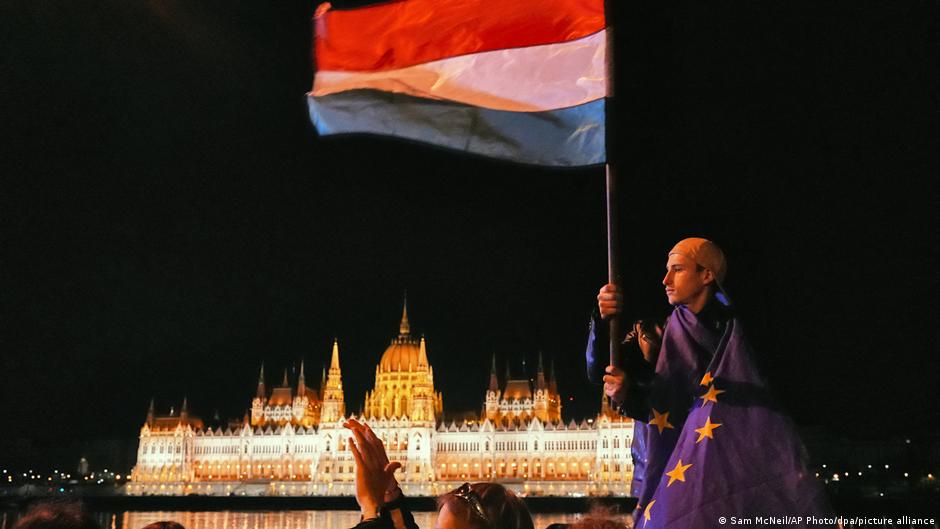
Ursula von der Leyen said on election night, “The heart of Europe is beating faster in Hungary tonight.” The country is reclaiming its European path, he wrote on X, and said the EU will become stronger as a result.
European Council President Antonio Costa praised the record turnout as a sign of Hungarians’ “democratic spirit” and said he looked forward to “close” cooperation with Peter Magyar to make Europe “stronger and more prosperous.”
Congratulations also came from European leaders who will work closely with the Magyars in the European Council. French President Emmanuel Macron said the result showed the Hungarian people’s attachment to “the values of the European Union.” Spanish Prime Minister Pedro Sanchez talked about the benefits for Europe and said he looked forward to working together.
Germany’s Chancellor Friedrich Merz said voters had shown the world that “there is no irreversible trend toward totalitarianism.”
For his part, Polish Prime Minister Donald Tusk posted a video on Twitter in which he is seen speaking on the phone with Magyar. “I’m very happy,” he said, adding that he might be even happier than the Magyars themselves.
While many heads of state and government welcomed Peter Magyar as a pro-European force within their ranks, Italian Prime Minister Giorgia Meloni also congratulated defeated leader Viktor Orbán, whom she called her “friend”. He thanked them for their “intense cooperation” in recent years.
The Czech and Slovak prime ministers, considered Orbán allies, also congratulated Magyar on his election victory.
End of an era of strained relations
The historic election in Hungary marks a turning point in strained relations between the EU and its long-serving leader, Viktor Orban.
Already in 2015, then-European Commission President Jean-Claude Juncker welcomed Orbán with a “Hello dictator” joke during an EU event.
Since then, relations have steadily deteriorated over disputes over the rule of law in Hungary, a strategic veto of unanimous EU decisions, and most recently the country’s move to block a 90 billion euro Ukraine loan package.
On Monday, European Commission President Ursula von der Leyen said conclusions should be drawn from recent experience, highlighting the possibility of a move away from consensus in EU foreign policy. He said the Commission would start working with Hungary’s new government as soon as possible.
Ukraine debt as the first test of the new era
Peter Magyar had already announced during the election campaign that he wanted to make Hungary a reliable partner in NATO and the EU. The first test is likely to be approval of a loan of 90 billion euros for Ukraine. The European Union had approved this loan for the years 2026 and 2027 last December. Hungary, along with the Czech Republic and Slovakia, are exempted from liability. Officials in Brussels hope Magyar will allow the payments and abandon any further attempts to withhold support for Ukraine.
According to Julia Pokz, an expert on rule of law at the Center for European Policy Studies (CEPS), there is no indication that Magyar intends to continue obstructing the loan. They hope it will be approved by the end of May, subject to a transition period.
What stance will Magyar take on Ukraine?
Observers in Brussels will be watching closely to see what stance Peter Magyar takes toward Ukraine, especially with regard to its potential future EU membership.
According to observers, Magyar, himself a member of the European Parliament, is not necessarily seen as pro-Ukrainian. According to news agency AFP, conservative politicians oppose the delivery of weapons to Ukraine.
An EU diplomat told DW that he does not expect the new Hungarian government to take a 180-degree stance on Ukraine, but rather that the country will continue to act cautiously with respect to its neighbor.
Constitutional law expert Pokz is expected to take a “neutral stance”. This would mean that Hungary would likely not participate in future arms deliveries, but would also not oppose EU and NATO support for Ukraine. According to the legal expert, this is because Magyar is not particularly pro-Russian.
Allegations that the Orbán government had informed the Russian government about internal EU proceedings have sparked outrage in Brussels and other EU member states. According to the EU diplomat, there is a clear assumption that such calls will stop in future.
Unlocking EU funds for Hungary
Peter Magyar had already announced he would implement reforms sought by Brussels to secure funds that were withheld amid concerns about the rule of law. The total amount involved is approximately EUR 17 billion (by January 2026). The reforms include areas such as the award of public contracts, the fight against corruption, and law enforcement.
For its part, Pokz expects these funds to be released relatively soon. She compares the situation to Poland after Donald Tusk’s re-election. At the time, the European Commission released funds within a few months of announcing reform plans.
Pokz told DW that thanks to winning a two-thirds majority, Magyar would be able to amend the constitution and implement his program, which focuses specifically on fighting corruption.
The possibility of conflict and new alliances?
Like his predecessor, Magyar advocates a staunch anti-immigration policy. This is an issue that has been a source of conflict between the EU and Hungary for years. As a result, the country still faces a daily fine of one million euros for failing to comply with a European Court of Justice ruling on asylum policy.
Pokz told DW that the Magyars have already stressed several times that they do not intend to implement the new migration agreement. This is an area where conflict between the EU and Hungary is likely to continue. Member states are required to implement the new migration rules by June 2026. Polish Prime Minister Donald Tusk also spoke out against implementing the agreement last year.
Perhaps this will be one of the topics that Donald Tusk and Peter Magyar will discuss when the future Prime Minister of Hungary, as announced, arrives in Warsaw on his first official visit. Both men are members of the conservative European People’s Party.
Piotr Buras, head of the Warsaw office of the European Council on Foreign Relations, hopes that Magyar’s election victory will further strengthen conservative and “eurorealist” positions, for example in environmental and industrial policy, an outcome that will likely please many.
This article was originally published in German.