While walking through Spandau, a western neighborhood of Berlin, a 13-year-old boy made a discovery that has been considered of immense importance in the archaeological history of Germany.
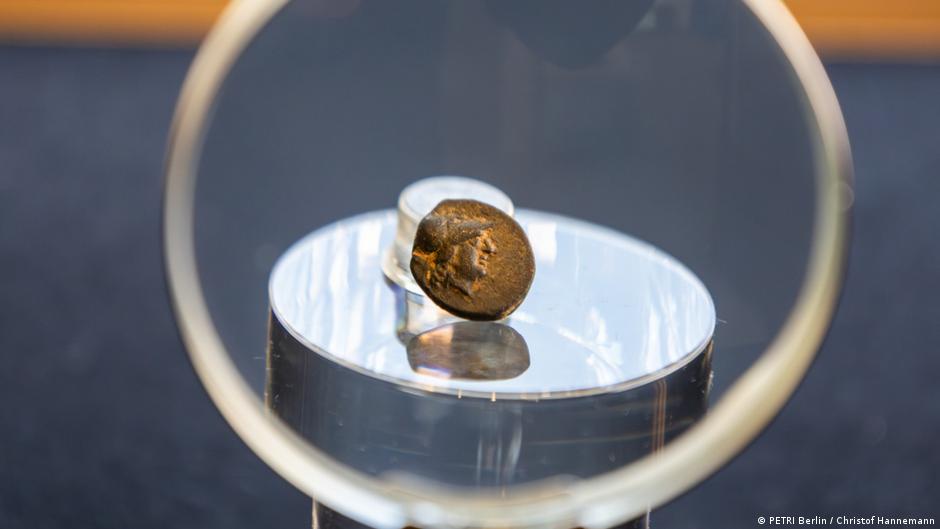
They found a small bronze coin, which experts say is 2,300 years old – from the ancient Greek city of Troy, in present-day Turkey.
For archaeologist Jens Hencker of the Berlin Heritage Authority, who was responsible for analyzing the discovery, it was a situation he had never seen before in his career: “This young boy realized he had found something interesting and he wanted to know more about it,” Hencker told DW.
During a school visit to the archaeological laboratory Petri Berlin in winter, the young treasure hunter and his teacher asked the staff to take a look at the coin. “My co-worker saw it and said ‘Oh, that’s quite interesting!’ Remembers the executioner.
From there, the coin passed from one expert to another in an attempt to determine its origins.
After all, an expert at the Münzkabinett Berlin (Numismatic Collection), which houses one of the world’s most important coin collections, said that the coin definitely originated from the ancient Greek city of Troy.
“This is the first discovery of Greek antiquity for Berlin; although there are some other finds from this period in Germany, they are very rare.”
Trade networks between Northern Europe and the ancient Romans are well documented, but little is known about relations between the ancient Greeks and Germanic tribes in the Iron Age.
“The Greeks in Germany did not write about us; they considered us barbarians. And about the people of [in present-day Germany] Not written down at all, so we’re really relying on these discoveries to learn more about possible connections,” Henker says.
This coin dates from the Hellenistic period, between 281 and 261 BC. The references to ancient Greece are obvious: on the one hand, it shows the warrior goddess Athena wearing a Corinthian helmet, on the other, Athena wears a headdress and has a spear and a spindle.
The small bronze coin weighs only 7 grams (0.25 oz) and measures 12 millimeters (0.5 in) and is currently on display in the “Current Discoveries” exhibition space at the Petrie Museum in Berlin.
A serious gift?
“Once we understood where it came from, I got the job of finding out where exactly this coin was found. Luckily, the guy was very accurate and he showed me exactly where he found it on the map. Then we went into registering our findings and found out that this agricultural site was actually a well-known location,” Henker explained.
The Museum of Early and Early History of Berlin has been systematically conducting surveys on vacant land in Berlin since the 1950s to determine where potential excavation sites might be.
At this particular location, the top layers of soil were surveyed in the 1950s and 70s, and again later, explains Henker. “Each time, they found different things that made them say ‘Okay, maybe there’s more here in the ground.’
Over the past few years, pottery shards, Slavonic-era knives and a bronze button have been unearthed at the site, as well as burnt human bones, leading researchers to conclude that they have been used as a burial ground since the early Iron Age – and have been so for centuries.
Henker explains that metal objects are not typically found in ancient settlements, as they were usually smelted and reused over the centuries: “However, metal was sometimes placed in tombs as a kind of grave gift. It appears to be a souvenir, used to remember something – perhaps even an experience in one’s life.”
What we know about the ancient Greeks moving north
One of the only ancient Greeks known to have traveled north, Pytheas was a Greek explorer who, around 330 BC, traveled from present-day Marseille, France to Northern Europe, documenting the British Isles, traveling to the Arctic Ocean and possibly even reaching the Baltic Sea. Henker explains, “He described the northern lights and the open sea with ice. In his time he was dismissed by the Greeks, who did not believe him and thought he was doing it to attract attention.”
However, later scholars confirmed that he had indeed traveled this distance. The general belief was that he was behind amber, the fossilized tree resin that was used in medicine for its purported healing properties. The so-called “Amber Road” is one of the only known trade routes between the Mediterranean Sea and Northern Europe.
“But I think that’s not the whole story; there may be something deeper to it, because if you think about the large army that the Greeks and Macedonians had at that time, they recruited people from other countries [to serve in them]. It may be that there were people who went there from the north and returned, and that way there are connections,” Henker suggests.
Could the coin be a memento of someone from Greece who was later buried with them?
As the archaeologist notes, the true story of how the coin came to be in the German capital ultimately remains a mystery. “All possible explanations of how the Greek coin came to be here are just guesses. If this coin could tell its own story, it would probably be a crazy coin with a lot to offer.”
Edited by: Elizabeth Grenier