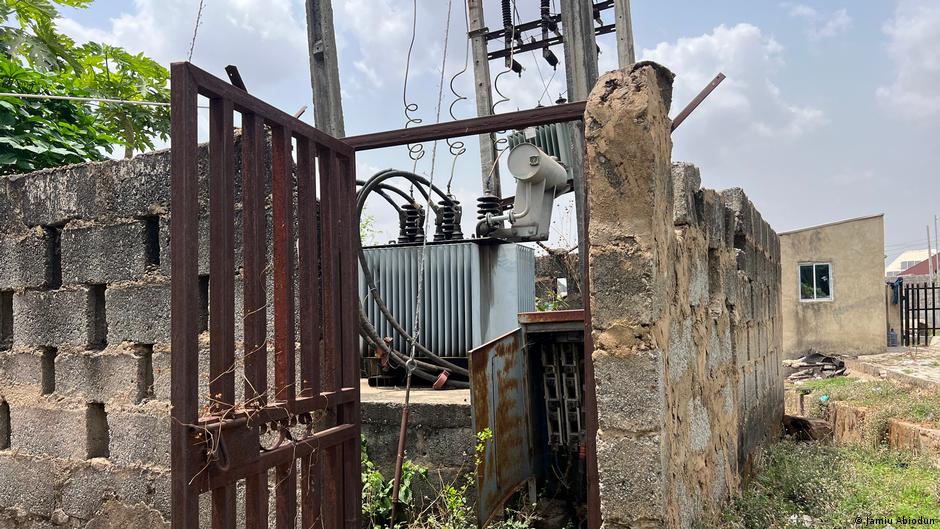
Blessing Johnson’s freezer is no longer full. A frozen food seller in Lugbe, a suburb of Nigeria’s capital Abuja, now deliberately keeps his stock low.
Earlier this year, ahead of the Eid-ul-Fitr festival, there was no electricity in his area for almost two months. Most of his stock deteriorated, forcing him to sell what remained at below cost.
“I had to sell at some losses, things I should have sold for 2,500 naira ($1.85), I sold for 1,500 naira or less – just to avoid losing everything,” Johnson said, adding that he lost more than he gained.
“I used to fill my freezer with chicken, turkey and fish,” she told DW. “Now I limit what I buy because I’m afraid it will spoil.”
Johnson’s experience reflects the reality for many small business owners across Nigeria, where unreliable power supply continues to threaten their businesses.
Power outages hit small businesses in Nigeria
In early April, Nigerian President Bola Tinubu approved a payment of 3.3 trillion naira (over $2 billion) to settle long-overdue debts owed by power generation companies.
Tinubu’s special energy adviser, Olu Arowolo-Verheijen, said the program is “not just about settling legacy debts,” but also aims to restore “confidence in the power sector.”
Aerovolo-Verheijen said it was “about ensuring that gas suppliers are paid, power plants keep running and the system starts working more reliably.”
And while experts believe the agreement will increase credibility, they argue that it is not a silver bullet to resolve the issues plaguing Nigeria’s energy sector.
Energy industry analyst Ayodele Oni said the move “still will not resolve all indebtedness, but it will allow gas producers to pay an amount or a portion of their dues.”
“Of course, this will mean that more gas will be available for the power sector,” Oni told DW.
Why did privatization fail to fix Nigeria’s power sector?
In 2013, the Nigerian government privatized its power sector.
But unlike the country’s banking and telecommunications industries, which have seen rapid growth over the years, the power sector continues to struggle and has not translated into stable supply for Nigerians.
The World Bank estimates that the Nigerian economy loses $29 billion annually due to unstable power supply, which causes frequent blackouts across the country.
About 90 million of Nigeria’s 242 million people live without access to electricity, with an average supply of less than 4,000 MW.
Decades of underinvestment and aging infrastructure have left the grid vulnerable to tripping.
Debt, tariffs and a broken electricity market
Also, according to analysts, the tariffs are not cost-reflective.
Electricity distribution companies often struggle to cover the costs of generating and transmitting electricity.
In 2024, Abuja’s electricity distributor threatened to disconnect the Presidential Villa and dozens of federal agencies over unpaid electricity bills amounting to over 47 billion naira.
This gap has forced authorities to intervene repeatedly, accumulating debt in the process, while structural issues remain in the transmission and distribution chains.
“Tariffs are fundamental, but there are other issues around implementation of infrastructure and market design,” Ayodele said.
He said the design requires supporting services to improve the grid, “and with an emergency management system that can remotely monitor the infrastructure and network.”
“All of these, for a very long time, were not in place,” Ayodele said.
Ikemesit Effiong, managing partner of SBM Intelligence, an Africa-focused consulting firm, said distribution companies lack the capital and political will for “metering customers, collecting revenue and maintaining the infrastructure”.
“And without retail feasibility, generation and transmission investments simply cannot sustain themselves.”
Why won’t debt repayment fix the power sector?
Ayodele said the government intervention is expected to ease pressure on production companies and restore some confidence in the market.
But both analysts agreed that repaying existing loans would not solve the underlying problems the sector is grappling with.
Ikemecit noted that without reforms to ensure cost-reflective tariffs, better governance and accountability across the value chain, there is a risk that the same situation could lead to another cycle of debt accumulation.
“Without binding conditions, it becomes a template: perform poorly, rack up debt, bail out,” Effiong said.
“To break the cycle, the government needs to link disbursements to metering targets, collection benchmarks and transparent audits. Publish who gets paid, why and on what terms.”
But for now, small business owners like Johnson are bearing the brunt.
He rummaged through the pile of fish in his warm freezer and handed a medium-sized fish to a customer without making eye contact.
“The government keeps sanctioning huge amounts of money for electricity, but we do not see any impact,” he said. “If they really want to help businesses grow, they should fix the electrical system, even if it’s just one thing.”
Edited by: Keith Walker