
For Sprone, the current bitcoin cycle is completely different from previous ones.
Latin America is taking a fundamental role in the cryptocurrency market, explains the manager.
Bitcoin (BTC) is having a particular year. Despite favorable news for its price, such as institutional purchases and flows to investment funds, the digital currency has been immersed in a “crypto winter” that took it to $60,000 on February 5, 2026.
Geopolitical tensions of global magnitude such as the war between the United States and Israel against Iran, with the consequent blockade of the Strait of Hormuz (key maritime passage for global oil production) have negatively impacted in the bitcoin price.
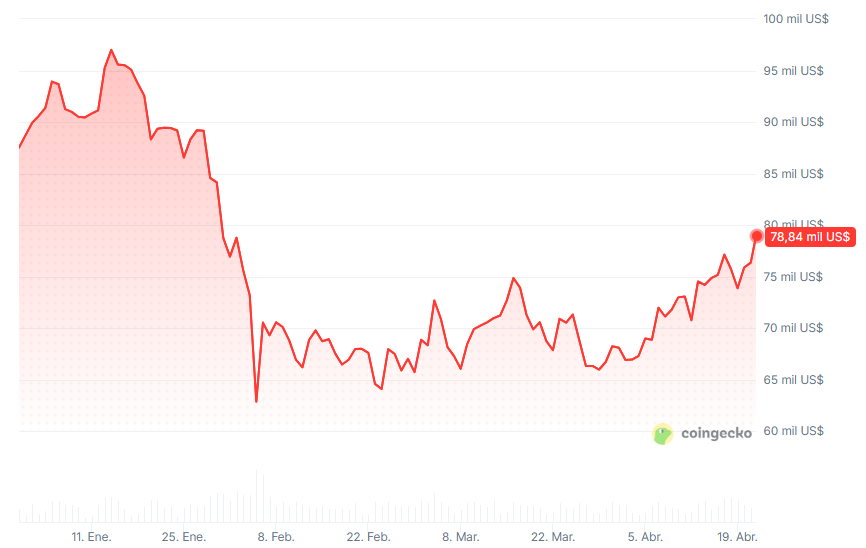
The fall also responded to other market elements: net outflows from spot ETFs, adjustment of leveraged positions and a high temporal correlation with traditional equity markets.
In the midst of this apparently negative scenario, some dissident voices are raised who see “the glass half full.” But not with blind optimism, but based on data. This is the case of André Sprone, leader for Latin America of the MEXC exchange.
In a statement sent to CriptoNoticias, dated April 20, 2026, Sprone assures that “the market is not correcting, but rather it is reorganizing”. Furthermore, he adds that the signs of this reorganization “are everywhere, but most are interpreting them wrong.”
Capital flows are being redirected. Risk perception is changing in ways that do not fit into traditional schemes. The architecture of how global markets assign value is changing. For those of us working at the intersection between traditional finance and digital assets, this is not an abstract observation. It has real consequences.
André Sprone, leader for Ibero-America at MEXC.
In the current context, The executive pays special attention to the price of oil, which he defines as a “geopolitical thermometer”. Sprone comments that the potential inflationary repercussions of the oil crisis in the Middle East have clear conclusions. The main one is that “the macroeconomic environment is not going to normalize as quickly as many expected.”
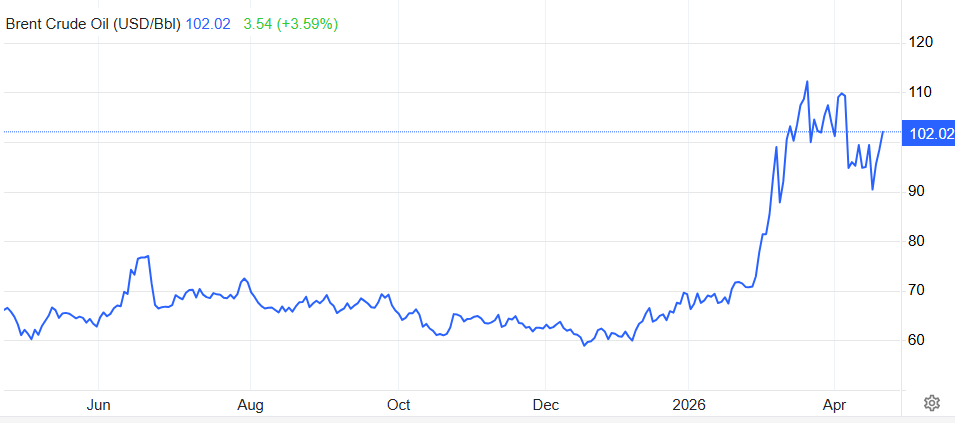
“Interest rates can remain high for longer, equity valuations remain under pressure and the search for assets that behave independently of the traditional system is no longer a strategic preference but has become a necessity,” says the MEXC leader for Latin America.
Among these assets bitcoin stands out. Sprone does not deny that the digital currency is trading “well below its all-time high near $126,000 reached in October 2025.” Nor does he deny that “five consecutive months in the red affected sentiment.” But he says that “what’s important is beneath the surface.”
Long-term holders—addresses that hold bitcoin for more than 365 days—drastically reduced sales. 30-day net sales fell 87% between early February and early March. These are not patterns of a market in free fall. They are more like a market quietly building a floor.
André Sprone, leader for Ibero-America at MEXC.
Beyond the behavior of long-term holders, Sprone identifies an even more relevant structural change in this cycle: the demand side.
Demand makes the difference in this cycle
The analyst says that “what really differentiates this cycle [de los anteriores] It’s the demand side.”. He mentions that “spot bitcoin ETFs—nonexistent in previous corrections—today represent constant institutional demand.” In addition, he adds that “corporate treasuries continue to allocate capital.” CriptoNoticias has reported the recent case of Strategy (company led by Michael Saylor) that surpassed the BlackRock ETF in bitcoin holdings.
All of this, says Sprone, means that “the infrastructure connecting traditional markets to digital assets is no longer experimental: it is operational and expanding.”
And the specialist adds:
Therefore, when I hear that bitcoin ‘failed’ as a hedge or store of value, I understand that the analysis is incomplete. It may not yet be fully decoupled from equities, but its investor base, liquidity infrastructure and institutional integration are fundamentally different from just two years ago. He ticker It’s the same. The market around it, no.
André Sprone, leader for Ibero-America at MEXC.
The manager goes further, and summarizes the transformations that, according to his vision, define the new scenario for the ecosystem.
3 structural transformations beyond the price of bitcoin
By way of conclusion, André Sprone points out what he considers to be “three changes that go beyond the price” and that “transcend short-term movements.
First of all, mention the re-regionalization of global trade. As an example, he comments that “sanctions against Russia are redirecting crude oil flows; India reduces imports, China absorbs them; “There are new tariffs and industrial policies that are redesigning supply chains.” He adds that “in 2025 alone, more than 3,000 new commercial and industrial measures were implemented globally, triple the number a decade ago.”
Secondly, he predicts that “institutional capital discovered cryptocurrencies and is not retreating”. This, according to Sprone, “is no longer narrative but capital flow.”
And finally, the executive mentions that «Latin America emerges as a protagonist». The region, “accustomed to volatility and operating in uncertain contexts, today has a competitive advantage in this new scenario.”
MEXC internal data as of mid-2025 shows that 46% of global users cite inflation hedging as their primary reason for holding cryptocurrencies, up from 29% a year earlier. In Latin America, that percentage is even higher. The region also leads in holding public network tokens, with 74% of users owning them. But the most relevant thing is the level of sophistication. At a recent meeting we organized in Buenos Aires, with KOLs, high-volume traders and industry leaders, the conversations did not revolve around price predictions. They talked about macroeconomics, portfolio construction and the role of digital assets in a global system that is being redefined in real time.
André Sprone, leader for Ibero-America at MEXC.
In short, the current moment of bitcoin and the cryptocurrency market in general, seems to demand the abandonment of superficial readings based solely on price. The data presented by Sprone paint a more complex—and more encouraging—picture than a simple red graph suggests.
As the MEXC director points out, The asset (bitcoin) may be the same, but the market around it is structurally different from previous cycles. Those who manage to read this transformation in the background, instead of reacting to short-term noise, will be better positioned to understand—and take advantage of—the new scenario that is being configured globally.