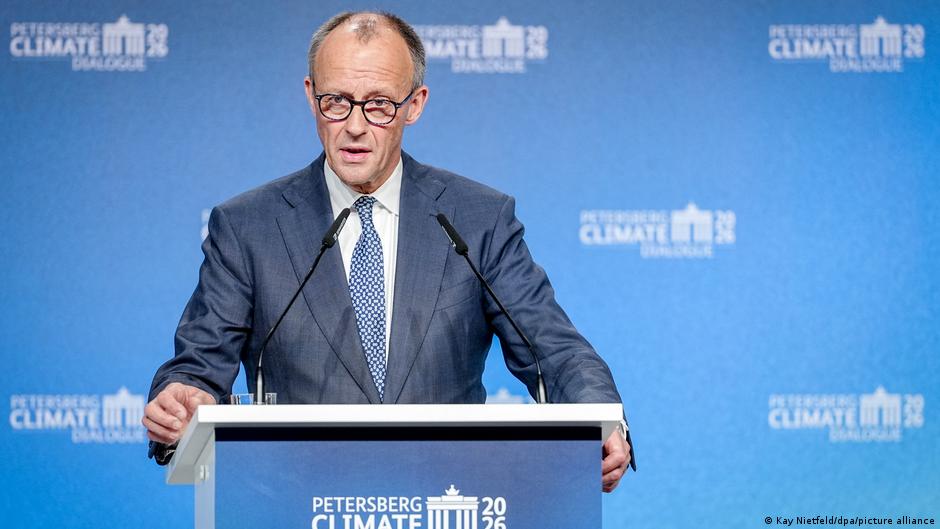
German Chancellor Friedrich Merz has said that climate protection policies should not hinder economic and industrial progress.
“We want to contribute to climate change mitigation and Germany will make big efforts to tackle it,” he said at the international Petersburg Climate Dialogue (PCD) conference in Berlin on Wednesday.
However, he stressed “multilateral, ambitious and effective” climate policies to maintain public support and stimulate economic growth.
He said, “A change that leads to de-industrialization will not be accepted by the public and will ultimately hinder innovation.” “Nevertheless, we remain an important sponsor of public climate action.”
Since 2010, Germany has hosted the Petersburg Climate Talks in addition to the UN climate conferences. Originally held in Petersburg, near Bonn, the meeting now takes place regularly in Berlin.
Clean energy as a driver of development
The German Chancellor also highlighted the economic growth potential offered by investment in clean energy, with the global market for green technology set to almost triple to around $2 billion (€1.7 billion) by 2035.
“Clean energy has become a driver of growth,” Merz said. “In Germany, the clean tech sector has grown 50% faster than the overall economy since 2010.”
Merz, who leads the conservative Christian Democratic Union (CDU), also expressed his support for emissions trading because it is “market-based and technology-neutral”.
However, making the plan “fit for the future” requires an update to the EU Emissions Trading System (ETS) rules “with a clear focus on maintaining competition,” Merz said.
The ETS, established in 2005, aimed to address climate change. The system regulates greenhouse gas emissions and creates a market for companies to trade allowances, requiring heavy polluters to purchase permits.
Germany aims to achieve climate neutrality by 2045. While Merz has insisted that the country will meet its targets, environmental groups have criticized his government for rolling back green policies.
His coalition government has called for loosening the EU ban on combustion engines and pushed for the construction of gas-fired power plants.
Edited by: Carl Sexton