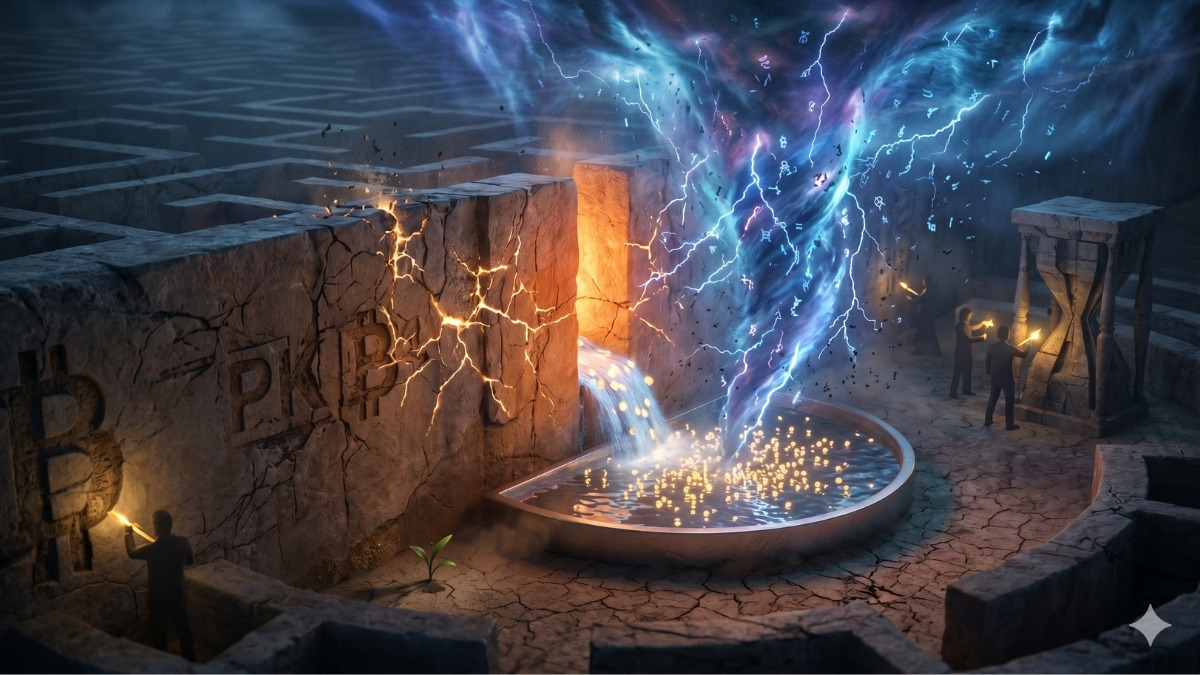
There are 6.93M BTC vulnerable to a quantum attack, but only 1.7M in danger, according to the researcher.
The market absorbed more than 2.3M BTC in capitulations between February and April 2026.
Onchain analyst James Check published a report on April 23 in which he concluded that the massive sale of the Bitcoin coins most vulnerable to a quantum attack would generate a bear market, but not a fatal event for the network.
According to Check’s analysis, the 1.7 million BTC stored in Satoshi-era P2PK addresses — the real target of any attack — is equivalent to between 60 and 90 days of typical bull market selling pressure, a volume that bitcoin buyers have been shown to absorb routinely.
Check’s central argument is that the figure of 6.93 million BTC circulating in the debate about the threat of quantum computing, as a total vulnerable volume, is a theoretical ceiling, not a realistic number.
Most of these funds are in the hands of exchangescustodians or active users with incentives to update their systems, says the researcher. The real risk is concentrated in coins in P2PK addresses, considered lost for more than a decade, whose public key was exposed by design in the original Bitcoin protocol.
To measure the potential impact, Check compared that volume to different market metrics. In the last 90 days, more than 2.3 million BTC changed hands during the bearish capitulation1.36 times the total P2PK. Deposits to exchanges in 60 days total around 1.8 million BTC. The conclusion is consistent in all scenarios: the pressure would be bearable in months, not years.
The debate surrounding these numbers
The report comes at the height of the debate over how Bitcoin should respond to the quantum threat.
The BIP-361 proposal, headed by cypherpunk Jameson Lopp, proposes implementing through a soft fork a mechanism that would make current Bitcoin cryptographic signatures invalid as of a certain date. With it would force users to migrate their funds to addresses resistant to quantum computing.
Andrew Howard, director of Bull Bitcoin, warned that this proposal is not a security improvement but rather a precedent for protocol-forced freezing.
As an alternative, BitMEX proposed a conditional system where the freeze would only be activated if it is verifiably demonstrated that quantum technology, capable of breaking cryptography, already exists. This, supported by a “canary” address (designed so that any expenditure from it automatically confirms that Bitcoin cryptography was compromised). Such an expense would function as an automatic trigger for the emergency protocol.
check proposes a third wayalready contemplated in BIP-360: the approach hourglass. This is an intermediate proposal within the debate that seeks to avoid both the forced freezing of currencies and an uncontrolled massive sale.
The approach works like this: Instead of allowing a quantum attacker to move all P2PK coins at once, the protocol would only allow one output P2PK per mined block. Since there are approximately 38,000 such outputs, exhausting them would take about 264 daysabout nine months.
At the moment, the BIP-361 is in draft status and has no activation date. Any change to the protocol requires broad consensus between developers, miners and custodians.