The “special relationship” between the United States and the United Kingdom has survived a revolution. Now the British government is working to ensure that it can face Donald Trump.
Despite deep economic and social ties and unparalleled intelligence sharing, the US President has chosen to repeatedly attack Britain and its Prime Minister Keir Starmer. Trigger: London’s reluctance to get involved in Washington’s war with Iran.
When Starmer initially refused to allow American troops to use British bases, Trump commented: “This is not Winston Churchill we’re dealing with.” he later said Sun “It is sad to see that relations are clearly not what they used to be,” the newspaper said, adding that the prime minister “has not been helpful.”
US-UK relations: from trade deal to tensions
The contrast is stronger than just a year ago. Then, the UK became the first country to sign a post-tariff trade deal with the US. Since then, Trump’s threat to invade Greenland, his sweeping tariff policies – including against allies – his attacks on “weak” Europe and, above all, the war in Iran, have strained the relationship.
While Trump’s disputes with the EU focus on trade and defense spending, the rift with London appears to be more personal. Britain had established itself as Washington’s closest ally. Securing an initial trade deal raised expectations in the White House – perhaps Britain’s refusal to support the US and Israel in Iran felt like a betrayal to Trump.
Imperial diplomacy as a foreign policy tool
British governments have long used their monarchs as tools of soft diplomacy. State visits are undertaken by the UK Government, and have largely symbolic significance. As a constitutional monarch, King Charles III cannot negotiate treaties, set policy or speak on political matters. His role is formal, not executive.
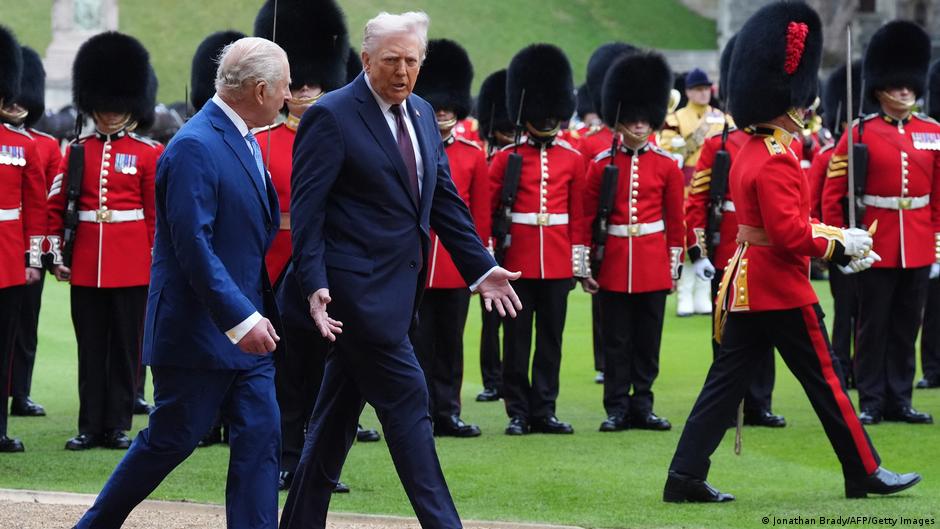
As recently as September 2025, Trump and the First Lady were given an unprecedented second state visit to the UK, with all the glamour, military pomp and royal attention that the kingdom had to offer. At the state banquet, Trump praised the “bond of kinship and identity” between the two countries as “priceless and eternal…irreplaceable and unbreakable.”
So why redeploy King when Trump’s position could change so quickly?
“The British government’s view would be that it would be better to at least try and have a chance to win favor and have some influence for a short period of time,” Nigel Fletcher, a political historian and visiting scholar at King’s College London, told DW.
Declining the invitation, which was probably issued before the Iran war, was hardly an option.
“Donald Trump would have reacted very badly to that. The Foreign Office and the British government would want to avoid doing anything to upset him,” Fletcher said.
Public opinion in the UK is less favourable. In March, an opinion poll showed that almost half of Britons were opposed to the visit, while only a third wanted it to go ahead. According to a recent poll, more than 80% of Britons view Trump negatively.
Critics also question the strategy. Graham Smith of the anti-monarchy group Republic argues that the effort is futile. He believes Trump has no interest in being diplomatic and there is nothing King Charles can do about it.
“We’re just wasting our time… Trump has advertised the impotence of being a king,” Smith told DW.
It remains to be seen whether the king and queen will draw crowds during their visit to the US, in which they will attend garden parties and state dinners. The diplomatic highlight of the visit is expected to be an address to Congress – the second such address by a British monarch since Queen Elizabeth II gave a speech at the Capitol in 1991. There is no doubt that the King will once again emphasize the enduring friendship and shared culture between the two countries.
Controversy and Unpredictability Badal Yatra
However, there is a possibility of controversy. Andrew, King’s brother, was closely linked to the late sex offender Jeffrey Epstein. The survivors have requested to meet the king; The Palace has denied, pointing to the ongoing police investigation. The requests have been echoed by Congressman Ro Khanna, who expressed disappointment at the Palace’s decision. With the possibility of protests by women’s rights groups, there is a risk that the scandal could impact travel.
Then there’s Trump’s unpredictability. He has previously embarrassed foreign visitors to the Oval Office, such as Ukrainian President Volodymyr Zelensky. However, King Charles is unlikely to face similar treatment. Trump has consistently spoken warmly of the king, calling him a friend and “a fantastic guy”, and suggesting that his visit could “absolutely” help improve relations.
Still, the two men couldn’t be more different. At a state banquet at Windsor Castle, the passionate environmentalist spoke about the “priceless opportunity” to protect “the wonders and beauty of nature for future generations,” but did not directly address the president’s anti-climate policies.
“Donald Trump has created this idea that he has his own special relationship with King Charles,” says Nigel Fletcher, “because he responded well to flattery.”
Since this appears to be the strongest personal relationship available at this time, the British government may have concluded that any potential embarrassment during the trip is worth the risk to save the “special relationship”.
Edited by: Jay Wingard